Mosquito Control Services in Bangalore
Safe • Effective • Protection Against Dengue, Malaria & Chikungunya
Trusted Since 2007
Government Licensed & Experienced Technicians
Safe • Effective • Protection Against Dengue, Malaria & Chikungunya
Trusted Since 2007
Government Licensed & Experienced Technicians
Mosquitoes are one of the most dangerous pests as they can spread serious viral diseases such as dengue, chikungunya, malaria, Zika virus, and West Nile virus. Mosquito infestations usually increase during Bangalore's rainy seasons and in areas with stagnant water, damp surroundings, drainage issues, gardens, and water storage containers. Warm and humid climates create the perfect breeding conditions for mosquitoes, making proper mosquito management essential for every home and business.
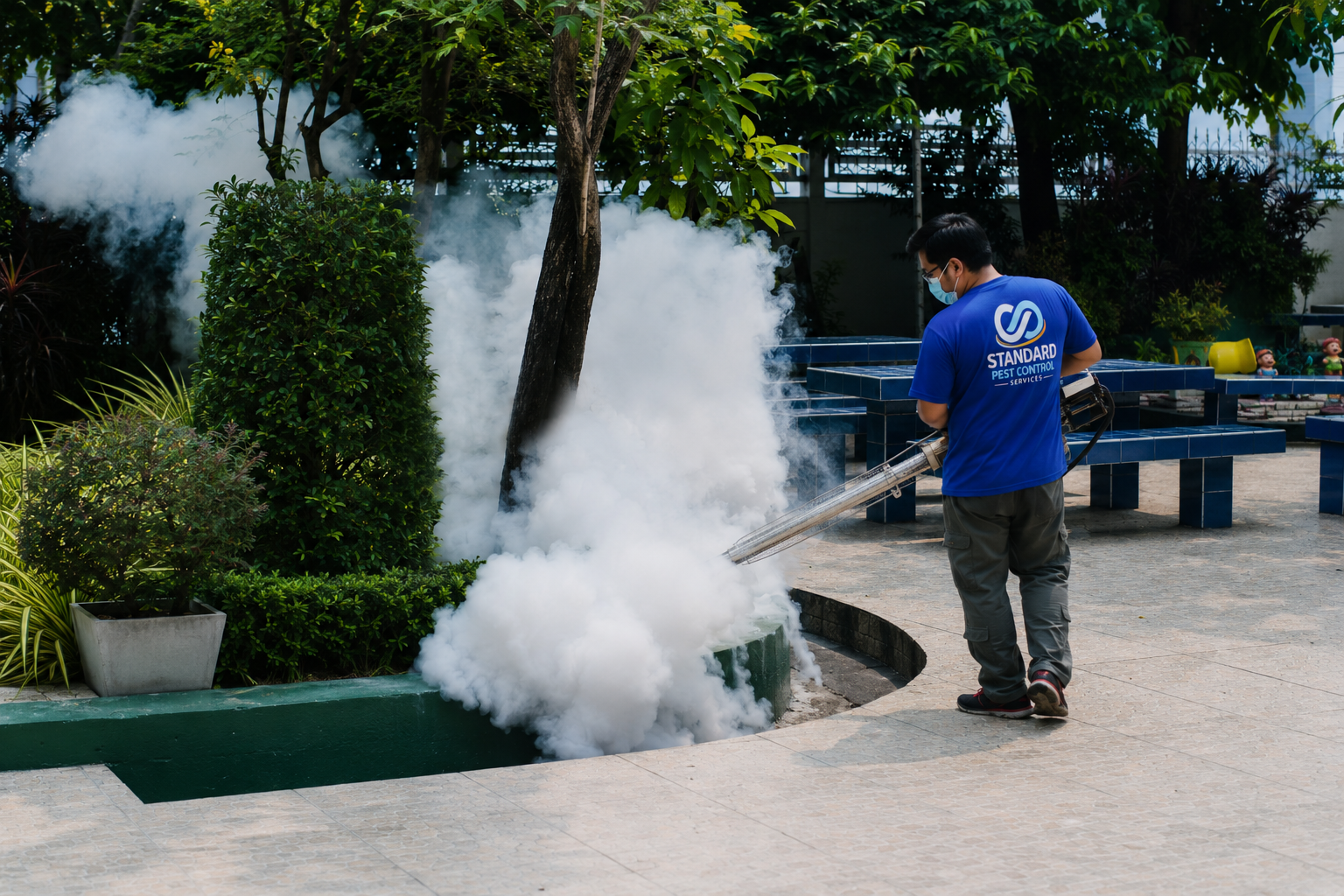
At Standard Pest Control, we provide professional Mosquito Control Services in Bangalore using advanced fogging, misting, spraying, and eco-friendly mosquito treatment solutions to reduce mosquito breeding and protect your family from harmful mosquito-borne diseases.
Our Mosquito Pest Control Service targets both adult mosquitoes and breeding areas around homes, apartments, offices, schools, hospitals, restaurants, gardens, and commercial properties. We identify stagnant water sources, drainage problem areas, and mosquito hiding spots to provide complete and long-lasting mosquito protection.
We also recommend preventive mosquito management practices such as removing stagnant water, maintaining clean surroundings, and using natural repellents like citronella oil. Citronella-based treatments and mosquito repellents help reduce mosquito activity naturally and safely between professional treatments. Curious how much they actually help? See our full breakdown of whether natural mosquito repellents really work.
Flower pots, bird baths, water tanks, coolers, tyres, and any container holding still water for more than 3 days becomes a mosquito breeding site. Even a bottle cap of water is enough for Aedes mosquitoes to lay eggs.
Blocked drains, gutters, and sewage areas are prime Culex mosquito breeding zones. These areas hold organic-rich stagnant water — ideal for mosquito larvae to develop rapidly during monsoon season.
Dense vegetation, leaf litter, and shaded areas provide resting places for adult mosquitoes during the day. Lawns with poor drainage and garden ponds create additional breeding opportunities around homes and offices.
Basement excavations, water-filled trenches, and material storage areas at construction sites create massive mosquito breeding zones that affect entire neighbourhoods. Common in Bangalore's rapidly developing areas.
Because breeding sources like these often sit outside any one property, lasting control usually needs everyone in a street, apartment complex or campus on board — read our guide to community-wide mosquito control programs to see how coordinated surveillance, source reduction and monitoring work together. Curious where the field is headed? See our look at the future of mosquito control — from smart traps and AI surveillance to Wolbachia and sterile insect techniques. Not every mosquito-like insect around your lights is actually a mosquito — see how to tell mosquitoes and non-biting midges apart before you book a treatment. A mosquito's own anatomy — how it finds you and why it bites — also explains a lot about why mosquito control needs more than a fogging session. And once you're inspecting a bite, it helps to know how to tell a mosquito bite from a bed bug, flea, ant or spider bite in the first place. None of that biting happens without water first — see the full mosquito life cycle from egg to adult to understand why breeding sources matter more than the mosquitoes you can see. Source reduction starts at home — see our guide to eliminating standing water around your own property, and pair it with our guide to mosquito-proofing your home with screens and sealing. When source control isn't enough on its own, our guide to professional mosquito treatment options explains the barrier sprays, larvicides and ULV treatments technicians use, and if you're wondering whether natural mosquito repellents really work, we've tested the claims. For properties that keep facing repeat breeding, see the benefits of a seasonal mosquito control program over one-off fogging.
Mosquito fogging kills adult mosquitoes on contact within minutes. The treated area shows significant reduction in mosquito activity within 24 hours. However, fogging targets adult mosquitoes — larval control treatment is also needed to stop new mosquitoes from developing.
Fogging disperses a fine insecticide mist to kill adult mosquitoes in the air and on surfaces quickly, while spraying applies a residual treatment to walls, drains, and breeding-prone surfaces for longer-lasting control between visits.
A single visit reduces adult mosquitoes significantly, but lasting control needs repeat treatment and breeding-source removal, since eggs already laid nearby will continue to hatch for weeks afterward.
If mosquito bites persist despite home remedies, you're near stagnant water or drainage issues, or dengue/malaria cases have been reported nearby, it's time to call in a professional treatment.
A professional mosquito spraying or fogging treatment provides protection for 4–8 weeks. Monthly treatments are recommended during monsoon season (June–September) when mosquito populations peak in Bangalore. See the full benefits of a seasonal mosquito control program.
Larviciding treats standing water to kill mosquito larvae before they mature, while adulticiding (fogging/spraying) targets flying adult mosquitoes. We combine both for complete breeding-cycle control.
Yes, we inspect and treat outdoor breeding sources — gardens, terraces, drains, and stagnant water containers — alongside indoor fogging for complete mosquito control.
Monthly treatment is generally recommended from June to September, when Bangalore's mosquito populations peak due to increased breeding in monsoon rainwater.
Yes, heavily affected properties often need a follow-up visit within 2–3 weeks to catch newly hatched mosquitoes from eggs laid before the first treatment.
Yes. We use WHO-approved, low-toxicity insecticides for fogging. Children and pets should leave the treated area for 1–2 hours during and after fogging, then it's completely safe once ventilated.
As a precaution, we recommend pregnant occupants stay out of the treated area during and for a couple of hours after fogging, with the room ventilated in the meantime.
Our technicians take care around ornamental plants and covered water features. We recommend covering fish ponds and aquariums during treatment as an added precaution.
You don't need to leave the whole house, but occupants should step out of the room being fogged for 1–2 hours and return once the mist has settled and the area is ventilated.
Yes, we use WHO-approved, low-toxicity insecticides applied strictly according to label instructions and dosage guidelines by trained, licensed technicians.
Pricing depends on property size, outdoor area coverage, and treatment frequency. Call us or request a callback for a free, transparent quote tailored to your property.
Yes, we provide a free, no-obligation quote after understanding your property size and the extent of the mosquito problem.
Yes, our Annual Pest Control AMC plans include scheduled mosquito treatment through the monsoon season and beyond.
Yes, commercial properties like offices, schools, and hospitals typically involve larger areas and outdoor coverage, which is reflected in the quote.
Remove all stagnant water weekly from containers, coolers, and pots. Install window and door screens. Use mosquito nets at night. Keep drains clean and flowing. See our full guide to mosquito-proofing your home.
At least once a week — mosquito eggs can hatch and develop into biting adults in as little as 7–10 days, so weekly emptying breaks the breeding cycle before it completes.
Yes, physical barriers like nets and mesh screens are one of the most reliable ways to reduce indoor mosquito exposure, especially overnight when biting activity is high.
They can offer mild supplementary relief in small outdoor areas, but they don't address breeding sources and work best alongside — not instead of — professional treatment.
Yes, since breeding sources often sit outside any one property, coordinated treatment across a street or apartment complex delivers much better results — see our guide to community-wide mosquito control programs.
Yes, we provide tailored mosquito control programs for offices, schools, hospitals, and other commercial properties, including outdoor grounds and common areas.
Yes, we work with commercial clients to schedule fogging and spraying before opening hours, after closing, or on off-days to avoid disruption.
Areas near lakes, poorly drained construction sites, and neighbourhoods with irregular waste or drainage management tend to see the highest mosquito activity across Bangalore.
Yes, mosquito populations and dengue/chikungunya cases both surge during Bangalore's June–September monsoon, when stagnant water accumulates city-wide.
Yes, Standard Pest Control services apartment complexes, gated communities, and independent homes across Bangalore, including Whitefield, Koramangala, Indiranagar, HSR Layout, and Electronic City.
Common questions about mosquito biology, behaviour and bite prevention.
Only female mosquitoes bite and take blood meals. They use nutrients from blood, particularly proteins, to help develop their eggs. Male mosquitoes do not bite humans and mainly feed on plant sugars such as nectar.
Both male and female mosquitoes feed on plant nectar and other sugar sources for energy. Blood is primarily used by females of many species for egg development.
Mosquitoes use several signals to locate people, including carbon dioxide (CO₂), body heat, skin odours and other chemicals released by the body. This is why some people may attract more mosquitoes than others.
A female mosquito pierces the skin with its proboscis and introduces saliva while feeding. Your immune system reacts to components in the saliva, producing the familiar redness, swelling and itching.
Mosquito lifespan varies considerably by species, sex and environmental conditions. Many adults live for several days to several weeks, while some females can survive longer under favourable conditions.
Mosquitoes lay eggs on or near water, depending on the species. Common breeding sources include buckets, flowerpot trays, tyres, roof gutters, tanks, discarded containers and other places where water collects.
There are more than 3,500 recognised mosquito species worldwide.
No. Most mosquito species are not important vectors of human disease. Disease transmission is associated with particular species within genera such as Aedes, Anopheles and Culex.
Depending on the mosquito species and geographical region, mosquitoes can transmit diseases including malaria, dengue, chikungunya, Zika, yellow fever, Japanese encephalitis and West Nile virus.
It varies greatly by species. Some mosquitoes remain relatively close to their breeding sites, while others can travel several kilometres or considerably farther under suitable conditions. There is no single 1–3-mile rule that applies to all mosquitoes.
Citronella may provide limited, short-range protection in some situations, but it should not be relied upon as the primary method of mosquito control. Effectiveness depends on concentration, airflow and other environmental conditions.
Yes. Mosquitoes may bite through thin or tightly fitting fabrics. Loose-fitting, tightly woven clothing provides better physical protection.
It depends on the species. Many Anopheles and Culex mosquitoes are more active from dusk through the night, while Aedes aegypti, an important dengue vector, commonly bites during daylight hours, particularly around morning and late afternoon. See our full visual guide to Aedes, Culex and Anopheles to tell them apart.
Yes. Mosquito larvae and adults can be eaten by fish, aquatic insects, dragonflies, spiders, birds and other animals. However, predators alone usually cannot provide reliable mosquito control around homes.
The most important measure is to remove or manage standing water. Empty containers, clean gutters, cover water-storage tanks, maintain drains, manage vegetation and regularly inspect areas where rainwater collects. See our full guide to eliminating standing water for exactly where to look around your property.
Professional mosquito treatments can be used safely when approved products are applied according to their labels. Pets should be kept away during treatment and for the period specified by the product label or pest-control professional.
There is no universal 21-day duration. Residual effectiveness depends on the product, treated surface, rainfall, sunlight, vegetation, mosquito pressure and environmental conditions. Follow-up frequency should be based on the treatment programme and product label.
Some species survive unfavourable seasons as eggs, larvae or dormant adults, depending on the species and climate.
The itching is caused by your body's immune response to proteins and other components in mosquito saliva, not simply by the physical puncture.
Yes. Differences in CO₂ production, body heat, skin chemistry, odours and microorganisms on the skin can influence mosquito attraction.
They combine several sensory cues, particularly carbon dioxide, odours, heat and visual information, to locate potential hosts.
No. Mosquitoes do not have teeth. Females use a specialised mouthpart called a proboscis to obtain a blood meal.
Yes. Mosquitoes use visual cues, and research suggests that certain colours and contrasts can influence their attraction. However, colour is only one factor alongside CO₂, odour and heat.
The claim that mosquito activity universally increases by 500% during a full moon is not reliable. Moonlight may influence the behaviour of some mosquito species under certain conditions, but the effect varies and should not be presented as a universal percentage.
It depends on the species. Females may lay dozens to several hundred eggs in a batch and can produce multiple batches during their lifetime.
It is a local immune reaction to substances in mosquito saliva. Histamine released by your body contributes to redness, swelling and itching.
No. Mosquitoes do not transmit HIV. The virus does not reproduce inside mosquitoes in the way mosquito-borne pathogens must, and mosquitoes do not inject another person's blood when they bite.
Generally, female mosquitoes tend to live longer than males, although lifespan varies by species and environmental conditions.
Mosquitoes are often described this way because mosquito-borne diseases cause a very large number of illnesses and deaths worldwide. Malaria alone represents a major global health burden.
Mosquitoes generally have more difficulty flying and locating hosts in stronger air movement, which is one reason fans can reduce mosquito landings indoors or on patios. The claim that they cannot fly above 1–1.5 mph is too specific and not generally accurate.
Some studies have found differences in mosquito attraction associated with blood type, but blood type is only one possible factor and the evidence should not be simplified to “mosquitoes always prefer Type O.” CO₂, body odour, heat and skin chemistry are also important.
There is no strong evidence that eating garlic provides reliable protection against mosquito bites.
Traditional UV bug zappers are generally not an effective primary mosquito-control method. They can kill many non-target insects while having limited impact on mosquito populations.
Male mosquitoes never require blood. Female mosquitoes obtain energy primarily from plant sugars, but females of many species require a blood meal for successful egg development.
Under warm and favourable conditions, some mosquito species can complete their aquatic development and emerge as adults in roughly a week or somewhat longer. Temperature, species, food and water conditions strongly affect development time.
Larviciding means controlling mosquito larvae in aquatic breeding habitats before they develop into flying adults, using approved biological, chemical or other larval-control methods. See our full guide to professional mosquito treatment options to see how larviciding compares with barrier sprays, fogging and ULV treatment.
Adulticiding is the use of approved control measures designed to reduce adult mosquito populations. It is usually one component of a broader mosquito-management programme.
Mosquitoes have a dorsal vessel that functions as part of their circulatory system, moving hemolymph through the body. Their circulatory system is very different from the human cardiovascular system.
Mosquitoes can detect sound and vibrations using specialised sensory structures associated with their antennae. This is particularly important in mating behaviour.
The buzzing sound is primarily produced by their rapidly beating wings. Wingbeat frequency varies by species, sex and other factors.
Yes. Mosquitoes have a small nervous system and brain capable of processing sensory information related to smell, vision, movement, feeding and reproduction.
Mosquitoes can detect host-related cues from a distance, but there is no universal 100-foot limit. Detection distance depends on mosquito species, airflow, CO₂ concentration and environmental conditions.
Yes. Many mosquito species rarely or never feed on humans. Toxorhynchites, sometimes called elephant mosquitoes, are particularly interesting because adults do not blood-feed and their larvae prey on other mosquito larvae.
Yes. Some mosquito species frequently feed on birds. This is epidemiologically important because birds can participate in the transmission cycles of certain mosquito-borne viruses.
Adult mosquitoes do not normally feed on fish. Instead, many fish species eat mosquito larvae living in water.
Some fragrances may influence mosquito attraction, but the effect depends on their chemical composition. Natural body odours, CO₂ and heat are generally more important host-location signals.
Some research indicates that pregnancy can increase attraction to certain mosquitoes, potentially because of factors such as increased carbon-dioxide output and body temperature.
Thick, loose-fitting denim generally provides substantial protection, but mosquitoes may exploit thin, stretched or tightly fitting areas. No clothing should be considered completely mosquito-proof unless specifically designed for that purpose.
Mosquitoes have daily periods of activity and inactivity, although describing this simply as human-like "sleep" is not entirely accurate.
The Asian tiger mosquito (Aedes albopictus) is an invasive, distinctive black-and-white mosquito. It commonly bites during the daytime and can transmit several pathogens under suitable epidemiological conditions.
Some mosquito species are adapted to brackish or saline habitats, while many common container-breeding species prefer freshwater or relatively low-salinity water.
No. Mosquitoes breathe through a network of tubes called the tracheal system, which connects to external openings called spiracles.
The female mosquito's proboscis is a complex feeding structure containing multiple specialised mouthparts (stylets) that work together during blood feeding. Describing it simply as one needle is inaccurate.
Not in the same sense humans do. Their mouthparts are highly specialised for feeding on liquids such as nectar and, in females of many species, blood.
Mosquitoes can operate under low-light conditions using a combination of visual, chemical, thermal and other sensory cues. It is inaccurate to say that mosquitoes simply "see using infrared."
Antarctica is generally considered to have no native mosquito populations because its extreme environmental conditions do not support them.
Male lifespan varies by species and environment. They often live for several days to a few weeks, generally less time than females.
Mosquitoes have a circulating fluid called hemolymph, rather than blood like humans and other vertebrates.
Some mosquito species have cold-resistant eggs or other life stages capable of surviving freezing or prolonged cold. This varies significantly among species.
Feet and ankles can produce skin odours and microbial compounds attractive to certain mosquitoes. They are also relatively exposed areas and may be easy for low-flying mosquitoes to reach.
If you are searching for the Best Mosquito Control Services in Bangalore, Standard Pest Control provides safe, effective, and affordable mosquito management solutions for homes and businesses across Bangalore. Don't wait for dengue season — book your treatment today.