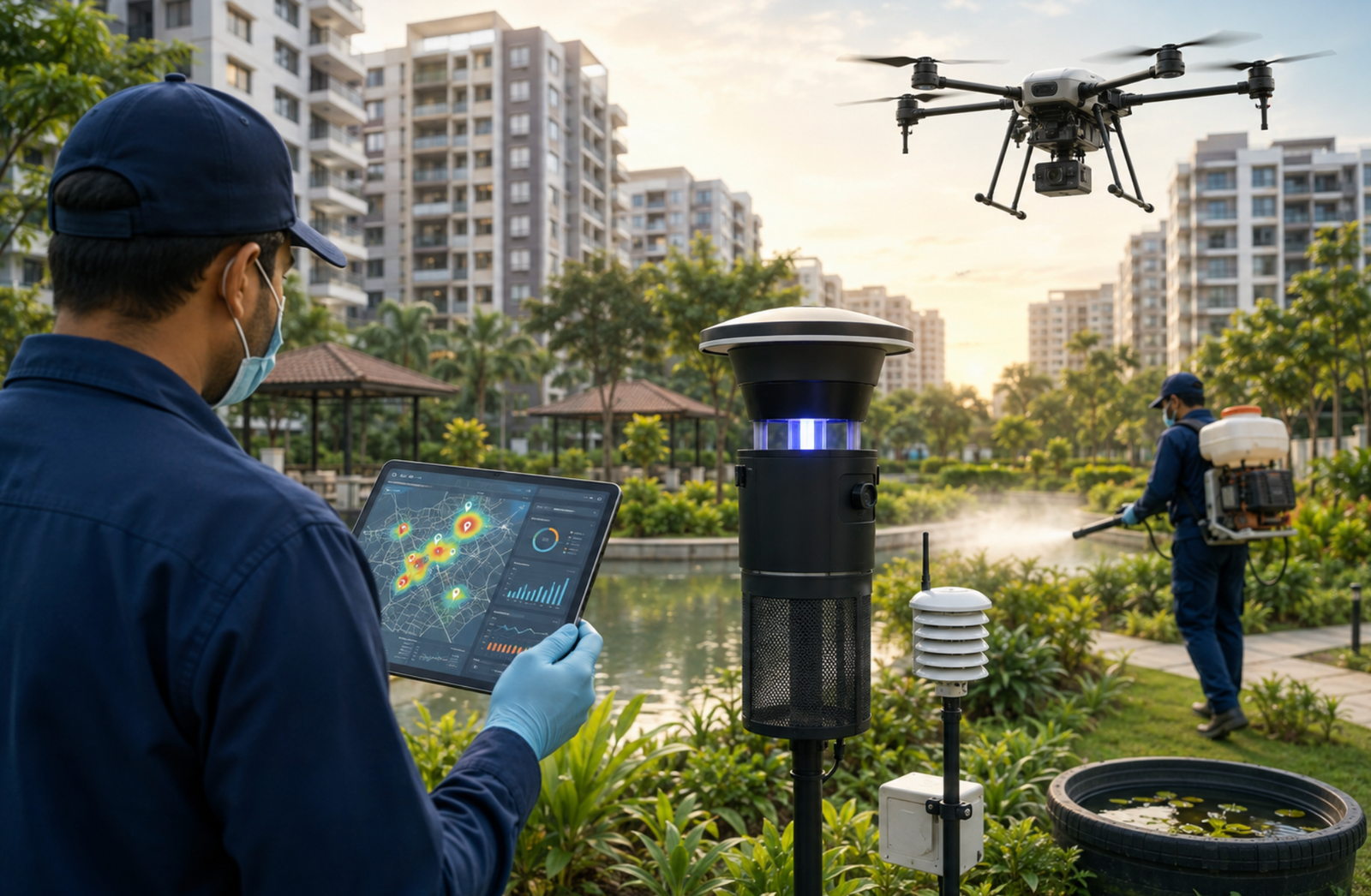
Mosquito control has traditionally depended on familiar methods such as removing standing water, applying larvicides, using adult mosquito treatments, installing screens, and encouraging people to use personal protection.
These methods remain important — but mosquito control is changing.
Urban growth, climate variability, insecticide resistance, international travel, changing mosquito distribution, and mosquito-borne diseases are creating new challenges for public-health authorities and pest-management professionals.
At the same time, scientists are developing innovative approaches involving biological control, Wolbachia-based programs, sterile insect techniques, improved mosquito surveillance, artificial intelligence, smart traps, drones, genetic technologies, and data-driven mosquito management.
The future is therefore unlikely to depend on one "miracle" mosquito-control technology. Instead, successful mosquito management will increasingly combine:
Let's explore the technologies shaping the future of mosquito control and the challenges that still need to be addressed.
Why Does Mosquito Control Need to Evolve?
Mosquitoes are highly adaptable insects. Many species can successfully exploit environments created by humans. Cities provide numerous potential breeding opportunities — water-storage containers, construction sites, storm-water systems, discarded containers, rooftops, gardens, utility areas, and poorly drained spaces.
Traditional mosquito-control methods can reduce populations, but long-term management is becoming increasingly complex. One important challenge is insecticide resistance.
Challenge 1: Insecticide Resistance
Repeated exposure to particular insecticides can select for mosquito populations that are less susceptible to them. Over time, this can reduce the effectiveness of certain control products.
Resistance management may involve monitoring susceptibility, using appropriate approved products, following label directions, avoiding unnecessary applications, combining chemical and non-chemical methods, and using integrated mosquito-management strategies. The future of mosquito control cannot simply be:
It needs to become increasingly targeted and evidence-based.
Innovation 1: Smarter Mosquito Surveillance
One of the biggest changes in mosquito management is the increasing use of data. Traditional surveillance may involve larval inspections, adult mosquito traps, species identification, complaint records, and disease surveillance.
Newer systems can potentially make this information faster and more useful. Smart mosquito traps may incorporate sensors, automated counting, image analysis, or connected reporting. Instead of waiting for residents to complain, mosquito-control teams can potentially identify population changes earlier.
From Reactive to Predictive Mosquito Control
Traditional mosquito management is often reactive:
Future programs can become more predictive:
Information such as rainfall, temperature, humidity, mosquito-trap data, historical breeding locations, and disease surveillance can potentially help identify where mosquito activity is likely to increase. This allows resources to be directed toward higher-risk areas.
Innovation 2: Artificial Intelligence in Mosquito Surveillance
Artificial intelligence may increasingly assist mosquito surveillance. Computer-vision systems can potentially help analyze images captured by monitoring devices. AI-assisted systems may help with mosquito counting, species classification, activity monitoring, hotspot identification, and large-scale data analysis.
However, AI should be treated as a decision-support tool rather than an automatic replacement for trained entomologists and pest-management professionals. Incorrect identification can lead to incorrect control decisions. Human expertise remains important.
Want mosquito management based on real surveillance, not guesswork? Get a free inspection and treatment plan.
Book Free Inspection Call NowInnovation 3: Smart Mosquito Traps
Traditional mosquito traps are useful surveillance tools, but they often require manual inspection. Future smart traps may automatically detect insects, record activity, transmit data, track mosquito numbers, and support species identification.
Imagine a large residential community with monitoring devices positioned at several locations. Instead of relying only on complaints, facility managers could potentially observe Location A with low activity, Location B with increasing activity, and Location C with high activity. Inspection teams could then concentrate on Location C. This can make mosquito management more targeted.
Innovation 4: Geographic Information Systems (GIS)
Mapping is becoming increasingly important. GIS technology allows mosquito information to be connected to specific geographic locations. Maps can potentially display breeding sites, mosquito-trap results, treatment locations, drainage systems, construction sites, complaint clusters, and disease-risk areas.
This changes mosquito control from a collection of individual treatments into an area-wide management program.
Innovation 5: Drone-Assisted Mosquito Surveillance
Large properties can contain breeding areas that are difficult to inspect from the ground — examples include large wetlands, rooftops, construction sites, industrial campuses, water bodies, and difficult terrain.
Drones can potentially assist with inspection and mapping. Depending on regulations, equipment, and the application involved, drones may also support certain mosquito-control operations. However, drone use does not remove the need for professional assessment. A drone can identify suspicious water accumulation — someone still needs to determine whether mosquito breeding is actually occurring there.
Innovation 6: Wolbachia-Based Mosquito Programs
One of the most discussed biological approaches involves Wolbachia, naturally occurring bacteria found in many insects. Certain mosquito-control programs introduce Wolbachia into populations of Aedes aegypti, an important mosquito associated with dengue transmission.
Specific Wolbachia approaches can reduce the mosquito's ability to transmit certain viruses or can be used in population-suppression strategies. This approach is fundamentally different from conventional insecticide spraying — instead of treating the environment with an insecticide, the intervention works through mosquito biology.
Large-scale Wolbachia programs require careful planning, monitoring, regulatory oversight, community engagement, and scientific evaluation.
Innovation 7: Sterile Insect Technique
Another approach is the Sterile Insect Technique (SIT). The basic concept is:
Because male mosquitoes do not blood-feed, release programs focus on males. If enough sterile males successfully compete with wild males, the target mosquito population may decline. SIT has a long history in the management of certain agricultural insect pests and continues to be explored and applied for some mosquito-control programs.
Recurring mosquito activity across your community? See how a structured program can help.
Book Free Inspection WhatsApp UsInnovation 8: Genetic Mosquito Technologies
Researchers are also investigating genetically based mosquito-control strategies. Some approaches involve modified male mosquitoes whose offspring have characteristics designed to suppress target populations. Other research explores more advanced genetic mechanisms.
These technologies can generate significant public interest because they involve deliberate modification or manipulation of mosquito populations. Important considerations include effectiveness, ecological impact, regulation, community acceptance, long-term monitoring, cost, and ethical considerations. Genetic mosquito control should therefore be evaluated through rigorous scientific and regulatory processes.
What About Gene Drives?
Gene-drive technology is one of the most advanced and debated areas of mosquito research. Normally, an organism has approximately a 50% chance of passing a particular copy of a gene to its offspring. Certain engineered gene-drive systems are designed to increase the likelihood that a genetic trait is inherited.
Researchers have investigated whether this concept could potentially alter or suppress mosquito populations. However, gene drives raise major questions about environmental impact, geographic spread, reversibility, governance, ethics, and international coordination. Gene-drive mosquitoes remain primarily a research and development area rather than an everyday pest-control service.
Innovation 9: Biological Larval Control
Biological mosquito control will continue to play an important role. One established approach involves microbial larvicides such as Bacillus thuringiensis israelensis (Bti) in suitable mosquito-breeding environments. These approaches target mosquito larvae in water before they become flying adults.
Future mosquito programs are likely to increasingly combine biological larval management with improved surveillance. The advantage of larval control is simple: control the mosquito before it can fly and disperse.
Innovation 10: Better Mosquito Traps and Attractants
Researchers continue developing more effective mosquito attractants and trapping technologies. Mosquitoes locate hosts using cues that can include carbon dioxide, odours, heat, moisture, and visual signals.
Improved understanding of mosquito sensory biology may help develop better traps for surveillance or population management. However, mosquito traps should not automatically be treated as complete replacements for source reduction and other proven methods.
Innovation 11: Digital Pest-Management Reporting
Technology is also changing everyday professional pest management. Mosquito-control technicians can increasingly use mobile systems to record breeding sites, treatment locations, inspection findings, mosquito activity, photographs, corrective actions, and follow-up requirements.
For apartment complexes, hospitals, hotels, factories, and commercial campuses, digital records can improve accountability. Instead of simply recording "Mosquito treatment completed," a more useful report can show where activity was found, what was treated, what corrective action is required, and when it should be inspected again.
Innovation 12: Weather-Based Mosquito Prediction
Weather has a major influence on mosquito populations. Rainfall can create new breeding habitats, temperature can influence development, and humidity can affect adult mosquito survival and activity.
Future mosquito-management systems may increasingly combine weather forecasts with mosquito surveillance. For example:
This is more proactive than waiting for mosquito complaints after populations increase.
Challenge 2: Climate and Environmental Change
Changing weather patterns can affect mosquito ecology. Temperature, rainfall, humidity, drought, and extreme weather can influence mosquito development, breeding habitats, seasonal activity, and geographic distribution.
However, the effects are complex. Not every region will experience the same changes, and different mosquito species respond differently. Local surveillance remains essential.
Challenge 3: Rapid Urbanization
Growing cities create enormous mosquito-management challenges. Construction activity can create temporary breeding habitats such as open drums, lift pits, tarpaulins, excavations, containers, and unfinished drainage.
At the same time, dense populations mean mosquito-borne disease outbreaks can affect large numbers of people. Future urban mosquito control must therefore involve:
Challenge 4: Community Participation
Technology alone cannot eliminate every mosquito-breeding site. A sophisticated surveillance system cannot prevent mosquitoes breeding in an uncovered bucket on a balcony unless someone empties it.
Community mosquito control therefore still depends on simple actions:
Residents need to regularly inspect balconies, flowerpots, buckets, water-storage containers, gardens, and rooftops. The future of mosquito control is technological — but it is also behavioural.
Challenge 5: Cost and Scalability
Some advanced mosquito technologies may work well in research trials or targeted programs but can be difficult or expensive to implement across entire cities. Programs must consider infrastructure, staffing, equipment, monitoring, laboratory capacity, and long-term funding.
The best technology is not necessarily the most complicated one. It is the one that can be safely, effectively, consistently, and sustainably implemented.
Challenge 6: Public Trust
New technologies involving bacteria, sterile insects, or genetic modification can raise understandable public questions. People may ask: Is it safe? Who regulates it? What happens to the ecosystem? How long will the program continue? How will results be measured?
Successful mosquito-control programs therefore need transparent communication. Community engagement should happen before and during implementation — not only after concerns arise.
Will Technology Replace Mosquito Fogging?
Probably not completely in the near future. Adult mosquito control may continue to have a role in certain circumstances.
However, future programs are likely to rely less on routine indiscriminate treatment and more on:
Fogging or other adult-control methods should be used as part of a broader mosquito-management strategy rather than treated as the entire solution.
The Future Is Integrated Mosquito Management
No single technology is likely to solve every mosquito problem. Future programs may combine:
- Surveillance — understand mosquito populations
- Source reduction — remove breeding sites
- Biological control — target larvae or mosquito biology
- Targeted chemical control — use appropriate insecticides when necessary
- Technology — use sensors, mapping, AI, drones, and digital reporting
- Community participation — remove breeding opportunities around homes
- Evaluation — measure whether interventions actually work
This is Integrated Mosquito Management (IMM).
What Could Mosquito Control Look Like in the Future?
Imagine a large residential community. Smart mosquito traps identify an increase in activity. The data automatically highlights one section of the property. Weather information shows recent rainfall. The pest-management team inspects the area and finds several breeding sites around a drainage problem.
The breeding sites are corrected. Appropriate larval management is implemented where necessary. Adult mosquito treatment is used only if justified. The area is then monitored. The future workflow becomes:
rather than:
The Future of Mosquito Control in Bangalore
Bangalore presents unique mosquito-management challenges because of rapid urban development, large apartment communities, construction activity, monsoon rainfall, water storage, storm-water drainage, extensive landscaping, and dense residential development.
Future mosquito management in Bangalore could increasingly benefit from digital hotspot mapping, better breeding-site surveillance, apartment-level monitoring, construction-site mosquito programs, weather-based inspections, data-driven pest-control reporting, community awareness, and integrated mosquito management.
The biggest improvement may not come from a single new pesticide. It may come from better information and earlier intervention.
Professional Mosquito Control in Bangalore
Standard Pest Control provides professional mosquito control services in Bangalore for residential and commercial properties. Services can support apartments, gated communities, hotels, hospitals, schools, offices, factories, commercial campuses, and construction sites.
Professional mosquito management should focus on more than visible adult mosquitoes. A structured approach may include:
As mosquito-control technology evolves, the core principle will remain the same: understand the mosquito before choosing the treatment.
Frequently Asked Questions
What is the future of mosquito control?
The future is likely to combine improved surveillance, biological approaches, data analysis, smart traps, mapping, targeted treatments, and community-based source reduction.
Can artificial intelligence help control mosquitoes?
AI can potentially assist with mosquito identification, automated counting, hotspot detection, and analysis of surveillance data. Human expertise is still needed to interpret results and select appropriate interventions.
What is Wolbachia mosquito control?
Wolbachia-based programs use bacteria introduced into target mosquito populations. Depending on the strategy, they can help reduce the ability of certain mosquitoes to transmit viruses or help suppress mosquito populations.
What is the Sterile Insect Technique?
SIT involves releasing sterile male insects. When they mate with wild females, viable offspring are reduced, potentially suppressing the target population.
Will genetically modified mosquitoes eliminate mosquitoes?
Genetic technologies generally target particular mosquito species or populations rather than all mosquitoes. Their effectiveness and suitability depend on the technology, location, regulation, and program design.
Will fogging disappear in the future?
Adult mosquito treatment is likely to remain useful in some circumstances, but modern mosquito management increasingly emphasizes surveillance, source reduction, larval control, and targeted intervention.
Can drones be used for mosquito control?
Drones can assist with mapping and surveillance of difficult-to-access areas. Some jurisdictions and programs may also use them for specific applications subject to regulation and appropriate professional controls.
What is the biggest challenge facing mosquito control?
There is no single challenge. Important issues include insecticide resistance, urbanization, changing environmental conditions, mosquito-borne disease, community participation, funding, and the need to implement new technologies responsibly.
What is the best long-term mosquito-control strategy?
Integrated Mosquito Management is generally the strongest approach because it combines surveillance, breeding-source reduction, larval management, appropriate adult control, public education, and ongoing evaluation.
Final Takeaway: Smarter, More Targeted Mosquito Control
The future of mosquito control is not simply about developing stronger chemicals. It is about becoming smarter, earlier, more targeted, and more measurable. Emerging tools such as:
could strengthen mosquito-management programs. But technology alone will not solve the problem. Communities will still need to remove standing water. Cities will still need effective drainage. Construction sites will still need regular inspections. Pest-management professionals will still need accurate identification and monitoring.
The most promising future therefore combines:
Instead of simply asking "How do we kill more mosquitoes?", the better question is "How can we detect mosquito risks earlier, prevent breeding, target interventions precisely, and measure whether our control program is actually working?"
That shift — from reactive treatment to intelligent prevention — may define the next generation of mosquito control.
Related reading: How Pests Inspire Science and Technology | Community-Wide Mosquito Control Programs: What They Involve | Mosquito Control Through Spraying and Fogging | Best Mosquito Control Tips for Apartments