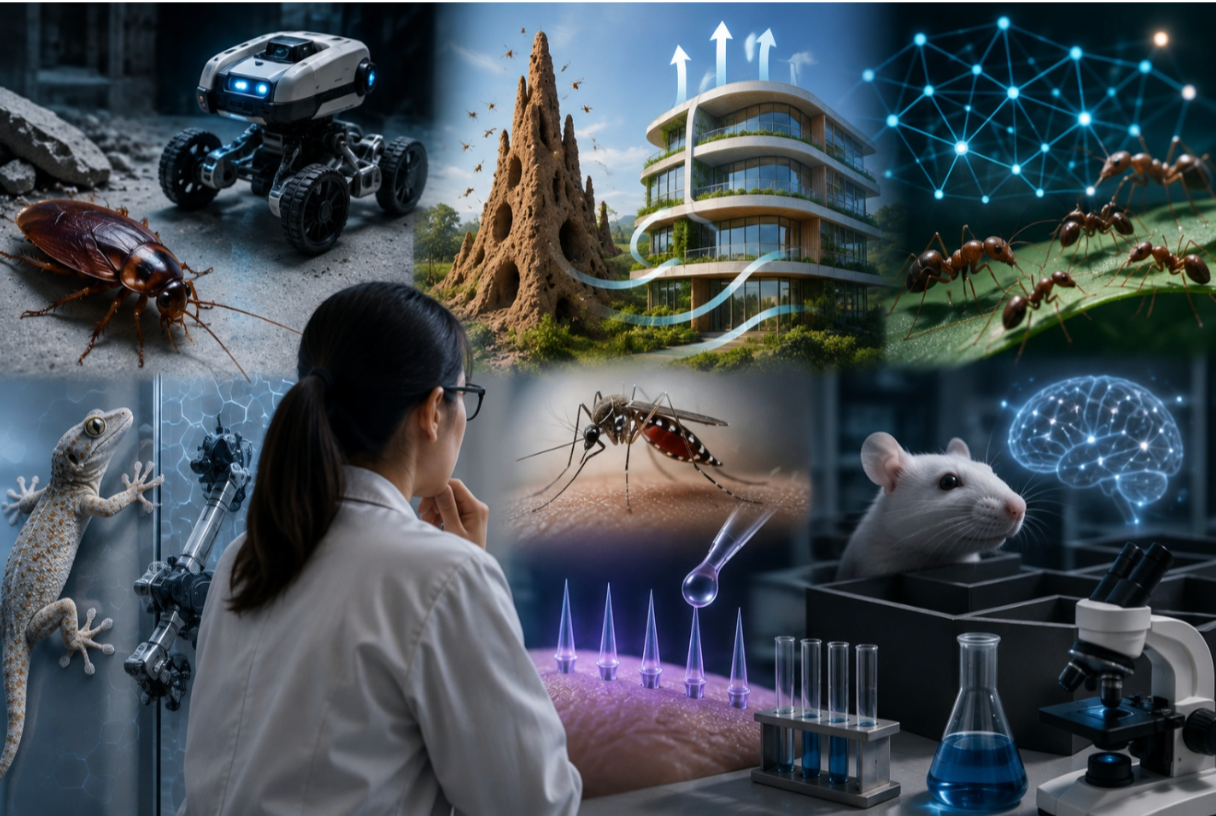
Cockroaches running across kitchen floors, termites damaging timber, mosquitoes buzzing around our homes, and ants invading food areas are usually viewed as problems that need to be controlled.
But scientists sometimes see something very different. They see extraordinary biological systems developed through millions of years of evolution.
A cockroach can squeeze through narrow spaces and continue moving after impacts. Ant colonies coordinate thousands of individuals without a central commander. Termites regulate conditions inside enormous nests. Mosquitoes use highly specialized sensory systems to locate hosts.
These abilities are inspiring research in areas ranging from robotics and architecture to artificial intelligence, materials science and medical technology. This field is broadly related to biomimicry — studying biological systems and using their principles to help solve human engineering and design problems.
So although we may not want pests living in our homes, laboratories and engineers can still learn a great deal from them.
What Is Biomimicry?
Biomimicry means studying strategies found in nature and using those ideas to inspire human design. Nature has already spent enormous periods of evolutionary time solving problems such as movement, communication, temperature regulation, navigation, structural strength, resource collection, and survival.
Instead of inventing every solution from the beginning, researchers can ask: "How has nature already solved a similar problem?" Sometimes the answer comes from animals most people would rather avoid.
Cockroaches and Rescue Robots
Cockroaches are exceptionally good at moving through cluttered environments. They can move rapidly, navigate uneven surfaces, fit through narrow gaps, recover from collisions, and continue moving through complex obstacles. These abilities have attracted the attention of robotics researchers.
Scientists have studied cockroach movement to help design small robots capable of navigating environments that would be difficult for conventional wheeled machines.
Why Cockroach-Inspired Robots Could Matter
Imagine a building damaged by an earthquake. Large rescue equipment may not be able to enter narrow voids within collapsed structures. A small robot inspired by cockroach movement could potentially travel through:
while carrying sensors or cameras. Such robots could potentially help rescue teams identify survivors, temperature changes, dangerous gases, and structural conditions.
The same characteristics that make cockroaches difficult household pests — see our guide on when to call a professional for cockroach control for more on managing them at home — can therefore make them interesting models for search-and-rescue robotics.
Learning From the Cockroach Body
Cockroaches have relatively flat, flexible bodies. Their exoskeleton and leg arrangement allow them to move through confined environments. Researchers studying these movements can explore how a robot can remain functional when compressed, how it can move without becoming stuck, and how legs should interact with irregular terrain.
The objective isn't necessarily to create a robot that looks exactly like a cockroach. It is to understand the mechanical principles behind its movement.
Cockroach Movement and High-Speed Robotics
Cockroaches are also remarkably fast relative to their body size. Their movement involves rapid coordination between multiple legs. Studying this locomotion can help engineers understand stability, leg coordination, rapid turning, and movement over obstacles — insights that may contribute to the development of more agile legged robots.
Fascinating biology aside, cockroaches are still unwelcome indoors. Get a free inspection and treatment plan.
Book Free Inspection Call NowTermites: Tiny Insects, Extraordinary Architecture
A termite colony contains individual insects with very limited capabilities. Yet collectively, some termite species build enormous and sophisticated nests. These structures can include networks of tunnels, chambers, ventilation pathways, nursery areas, and food-related areas.
Some termite mounds are capable of maintaining relatively stable internal environmental conditions despite changing conditions outside. Architects and engineers have studied these systems for inspiration.
Termite Mounds and Building Ventilation
One of the most famous examples of insect-inspired architecture involves studying termite-mound ventilation. Researchers and designers have explored how principles associated with natural airflow could influence building design. The broad concept is:
to reduce dependence on mechanical heating and cooling. It does not mean buildings simply copy termite mounds. Instead, architects study how natural systems move heat and air and then adapt useful principles to human buildings.
Can Termites Help Us Design Greener Buildings?
Potentially, yes. Termite-inspired research may contribute to thinking about passive ventilation, energy efficiency, temperature management, building airflow, and resilient architecture.
This is an interesting contradiction. Termites can damage buildings. But termite biology can also inspire better building design.
Ant Colonies and Artificial Intelligence
An individual ant has limited information. Yet thousands of ants can collectively find food, build nests, defend colonies, allocate work, and navigate complex environments. There is no single ant giving detailed instructions to every other worker. Instead, complex behaviour emerges from many relatively simple interactions.
Computer scientists have studied these principles when developing optimization algorithms.
What Is Ant Colony Optimization?
Ant Colony Optimization is a family of computational techniques inspired by how ants can discover efficient routes. Real ants can use chemical trails known as pheromones. When ants repeatedly use successful routes, these chemical signals can influence the movement of other ants. Over time, colonies can develop efficient pathways.
Computer scientists adapted this general idea to help solve optimization problems.
Where Can Ant-Inspired Algorithms Be Used?
Ant-inspired optimization techniques have been explored for problems involving route planning, logistics, network routing, scheduling, resource allocation, and engineering optimization.
Think about a delivery company that needs to find efficient routes between many destinations. Testing every possible route could become computationally expensive. Nature-inspired optimization can help search for effective solutions.
Ants and Swarm Robotics
Ants have also inspired swarm robotics. Instead of building one extremely sophisticated robot, engineers can create many smaller robots that cooperate. A robotic swarm could potentially explore an area, search for objects, collect information, distribute tasks, and adapt when individual robots fail.
The inspiration comes from social insects such as:
The strength comes from the group rather than one individual.
Why Swarms Can Be Powerful
Imagine 100 small robots exploring a disaster zone. If one robot fails, the mission does not necessarily stop. Other robots can continue working. This concept is known as distributed intelligence.
Social insects demonstrate similar resilience. A colony does not depend entirely on one worker. That makes insect societies valuable models for decentralized systems.
Ants trailing along your counters or walls? Ask about our species-specific ant treatment plans.
Book Free Inspection WhatsApp UsMosquitoes and Medical Technology
Mosquitoes are among the world's most important disease vectors. But the way female mosquitoes obtain blood has also attracted scientific attention. A mosquito's feeding apparatus is highly specialized. Researchers have studied mosquito mouthparts to better understand how very fine biological structures penetrate skin.
This research has inspired investigations into technologies such as microneedles, less painful injection systems, and micro-scale medical devices. The idea is not simply to copy a mosquito. Scientists study the mechanics of penetration and use those insights to develop improved technologies.
Mosquitoes and Advanced Sensors
Mosquitoes are also remarkably good at locating hosts. Depending on the species, they can respond to cues such as carbon dioxide, body odours, heat, moisture, and visual information. Understanding these sensory systems helps scientists develop better mosquito traps. It may also contribute to broader research involving chemical sensing and biological detection.
Better Mosquito Traps Through Biology
Traditional traps may use light or simple attractants. Modern mosquito surveillance systems can use combinations of carbon dioxide, chemical attractants, heat, and visual cues. These systems are designed using knowledge of how mosquitoes actually find hosts.
This is a good example of pest biology directly improving pest-control technology itself — see our guide on the future of mosquito control for more on smart traps, AI surveillance and biological control.
Mosquito Research and Disease Prevention
Studying mosquitoes also helps scientists understand how diseases spread. Researchers investigate mosquito genetics, host-seeking behaviour, reproduction, insecticide resistance, and pathogen transmission. This knowledge supports innovations such as Wolbachia-based mosquito programs, sterile insect techniques, improved surveillance, genetic-control research, and better mosquito-management strategies.
Sometimes the best way to control a pest is to understand its biology in extraordinary detail.
Flies and Vision Research
Flies may seem simple, but their visual systems are highly effective at detecting movement. Many flies possess compound eyes made of numerous visual units. Their ability to respond rapidly to movement is one reason catching a fly can be frustrating.
Scientists have studied insect vision to explore motion detection, navigation, small-camera systems, and autonomous robotics. Again, the objective is not always to duplicate the animal exactly. The goal is to understand the underlying principles.
Fly-Inspired Robots
Flying insects must continuously manage balance, direction, airflow, obstacles, and landing. Engineers working on very small aerial robots face similar challenges. Research into insect flight can therefore contribute to the development of micro-drones, small flying robots, and autonomous navigation systems.
Nature provides an extraordinary collection of tested flying machines.
Spiders and Materials Science
Spiders are not insects and many are beneficial rather than household pests. But they are important examples of how creatures people often fear can inspire technology.
Spider silk is famous for its combination of desirable mechanical properties. Researchers have studied spider silk to inspire new materials for potential applications in textiles, medical materials, lightweight structures, and protective materials.
Producing artificial materials with the same overall characteristics as natural spider silk remains scientifically challenging. But the biological material continues to inspire research.
Spider Webs and Structural Design
A spider web must be lightweight, flexible, strong enough for its purpose, and capable of absorbing energy. Engineers can study how webs distribute forces. These principles may inspire structural and material designs where strength must be achieved with minimal material.
Geckos and Adhesive Technology
Geckos are not pests in every context, but they sometimes enter buildings and are frequently included in household pest-management discussions. Their feet are remarkable — microscopic structures allow many geckos to adhere to surfaces without conventional glue.
Scientists have studied this mechanism to inspire dry adhesives, climbing robots, and reusable gripping systems. This is another example of an animal characteristic that seems ordinary until examined at the microscopic level.
Robots That Can Climb Walls
Imagine a robot inspecting tall buildings, bridges, industrial structures, and difficult surfaces. Traditional wheels may be useless. Gecko-inspired adhesive systems could potentially allow robots to move vertically.
Nature solved wall climbing long before humans built robots.
Rodents and Neuroscience
Rats and mice have played an enormous role in scientific research. Because their nervous systems share many basic biological features with other mammals, rodents have been widely used in studies involving learning, memory, behaviour, neuroscience, and disease biology.
Their strong navigation abilities have also contributed to research on how brains represent space and location. Although rodents can be serious pests in buildings, they have also contributed substantially to scientific knowledge.
Rats and Search-and-Rescue Research
Rats possess strong sensory abilities and can navigate complex environments. Researchers and organizations have explored training rats for specialized detection tasks. These can include locating particular odours or working in environments where their small size and sensory capabilities provide advantages.
This illustrates an important principle: a species considered a pest in one context may be extremely useful in another.
Insects and Miniature Sensors
Insects operate with extremely small bodies and limited energy. Yet they can navigate, detect chemicals, communicate, locate food, and avoid obstacles. Engineers developing tiny sensors and robots face similar constraints. How can you build a device that is:
Studying insects can provide useful ideas.
Pests Are Masters of Energy Efficiency
A small insect cannot carry a large battery. Its biological systems must operate using very limited energy. This makes insects particularly interesting to researchers developing micro-robots, wearable sensors, small autonomous systems, and low-power electronics.
Nature's solutions are often remarkably efficient.
Pest Biology Is Also Improving Pest Control
Not every technology inspired by pests is unrelated to pest management. Understanding pests more deeply is transforming the pest-control industry itself. Modern pest management increasingly uses smart monitoring devices, remote rodent sensors, digital traps, automated pest alerts, GIS mapping, AI-assisted identification, and digital reporting.
Instead of waiting for a pest sighting, future systems may detect activity automatically.
Smart Pest Monitoring
Imagine a commercial kitchen with digital monitoring devices. A rodent-monitoring station detects activity. The system records:
The pest-control technician can then investigate the exact area. This is very different from simply asking "Did anyone see a rat this week?" Data makes pest management more precise.
Artificial Intelligence and Pest Identification
AI-powered image-recognition systems may increasingly help identify pests from photographs or monitoring devices. Potential uses include cockroach identification, rodent monitoring, mosquito classification, insect counting, and activity analysis.
However, AI should support — not automatically replace — professional identification. Accurate species identification can be critical when selecting pest-control methods.
The Future: Learning From Pests While Controlling Them
The relationship between humans and pests is surprisingly complicated. We spend enormous resources preventing pests from entering homes, contaminating food, damaging buildings, and spreading disease.
At the same time, scientists study those same organisms to improve robotics, architecture, artificial intelligence, medicine, materials, sensors, and navigation. The contradiction is fascinating.
What Pest-Control Professionals Can Learn From Science
Scientific research reinforces one of the most important principles of professional pest management: understand the pest before trying to control it.
A cockroach is not simply an insect that needs insecticide. It is an organism with specific harbourages, feeding behaviour, movement patterns, reproductive biology, and environmental preferences. The same applies to termites, rodents, mosquitoes, ants and other pests.
Better biological understanding leads to better pest-management decisions.
Professional Pest Control in Bangalore
Standard Pest Control provides professional pest control services in Bangalore for residential and commercial properties. Services include management of cockroaches, termites, rodents, mosquitoes, bed bugs, ants, wood borers, and other common pests.
Our approach focuses on:
Modern pest management is increasingly moving away from simply asking "Which chemical should we spray?" The better question is "What does the biology of this pest tell us about how it should be managed?"
Frequently Asked Questions
How do pests inspire technology?
Scientists study pest movement, communication, sensory systems, social behaviour and structures to develop ideas for robotics, architecture, algorithms, medical devices and monitoring technology.
How have cockroaches inspired robots?
Researchers have studied cockroach locomotion and body mechanics to help design small robots capable of navigating narrow, cluttered and uneven environments.
How do termites inspire architecture?
Some termite nests manage airflow and internal environmental conditions through their structure. These principles have inspired research into passive ventilation and energy-efficient building design.
What is Ant Colony Optimization?
Ant Colony Optimization is a computational approach inspired by how ants collectively discover efficient paths using simple local interactions and pheromone-like information.
How have mosquitoes inspired medical technology?
Researchers have studied mosquito mouthparts and skin-penetration mechanics as inspiration for research into microneedles and less painful delivery systems.
How do insects inspire artificial intelligence?
Social insects demonstrate how many simple individuals can collectively solve complex problems. These principles have influenced swarm intelligence and optimization algorithms.
Can pest biology improve pest control?
Yes. Understanding pest behaviour helps professionals select better monitoring, prevention and treatment strategies. Modern technologies can also use sensors, digital monitoring and data analysis to detect pest activity earlier.
Are all animals described as pests harmful?
No. Whether an animal is considered a pest depends heavily on context. Many organisms provide important ecological functions and can also contribute to scientific research.
Final Takeaway: Nature's Unwanted Guests Can Be Remarkable Teachers
Cockroaches may inspire rescue robots. Termites can teach architects about airflow. Ant colonies inspire optimization algorithms and robotic swarms. Mosquitoes can contribute insights into sensors and microneedle research. Spiders inspire advanced-material research. Geckos inspire new adhesive technologies. Rodents have contributed to neuroscience and behavioural research.
The organisms we often describe simply as "pests" contain biological solutions refined through evolution. That doesn't mean we should allow cockroaches to live in our kitchens or termites to damage our homes. It means we can recognize something fascinating:
The future of science may sometimes begin by looking more carefully at the creatures we usually try hardest to avoid.
Related reading: Pests in Pop Culture: From Movies to Literature | The Future of Mosquito Control: Innovations and Challenges | The Psychology of Pests: Why We Fear and Disgust Them | The Benefits of Integrated Pest Management (IPM) for Cockroaches | The Role of Research in Advancing Pest Control Solutions