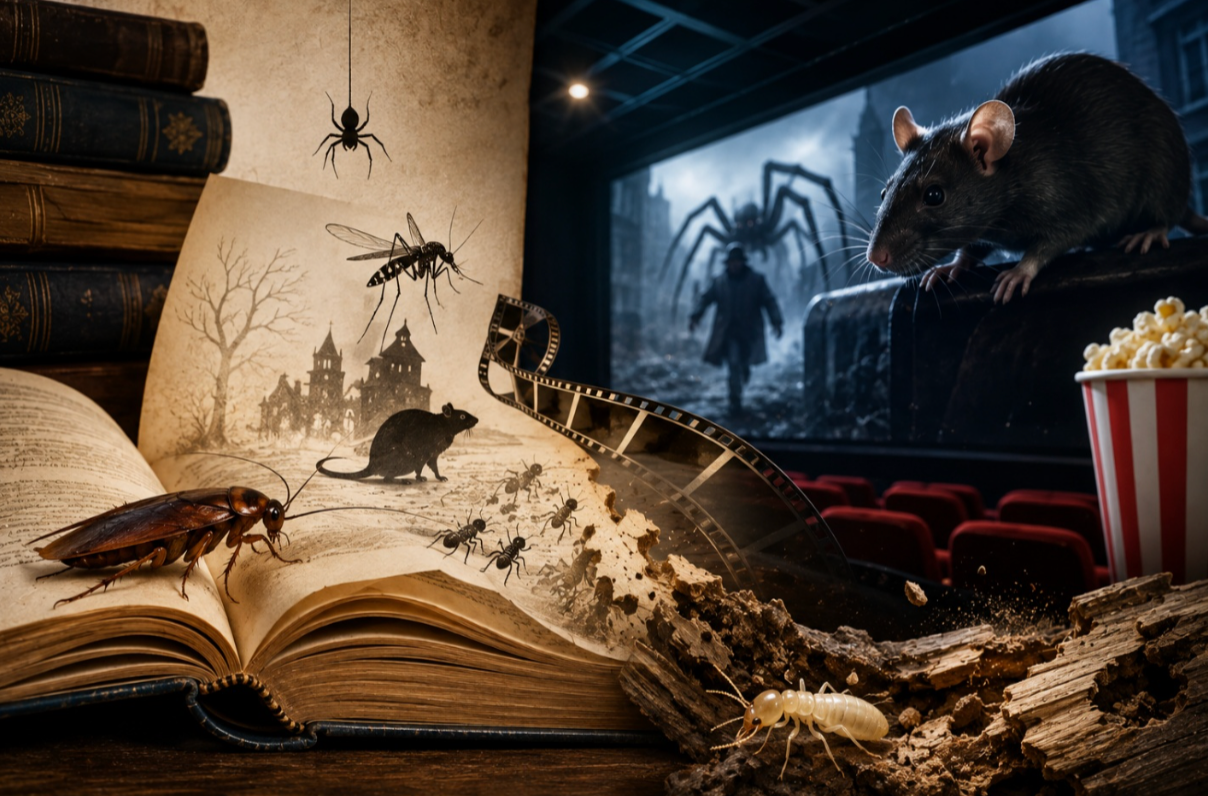
Cockroaches surviving the end of the world. Giant spiders chasing terrified characters. Rats appearing in dark tunnels. Termites destroying a home. Mosquitoes becoming symbols of disease and danger.
For centuries, pests have played surprisingly important roles in human storytelling. From ancient fables and classic literature to horror movies, cartoons, television and modern video games, insects and rodents are often used to represent fear, survival, decay, contamination, transformation and even intelligence.
But popular culture does not always portray pests accurately. Movies exaggerate. Stories turn ordinary insects into monsters. Cartoons give pests human personalities. Urban legends transform pest biology into myths.
So why are we so fascinated by creatures we usually don't want anywhere near our homes? Let's explore the strange relationship between pests and popular culture — and separate entertainment from real pest behaviour.
Why Do Pests Work So Well in Stories?
Storytellers need characters and images that create an immediate emotional response. Pests are perfect for this.
A single cockroach running across a kitchen floor can communicate neglect. A rat appearing in a dark building can suggest decay. A swarm of mosquitoes can represent disease. Termites can symbolize hidden destruction. Bed bugs can represent invasion of personal space.
These associations are so familiar that filmmakers and writers often don't need to explain them. The pest itself tells part of the story.
Cockroaches: The Ultimate Symbol of Survival
Few pests have a stronger pop-culture reputation than the cockroach. Cockroaches are often portrayed as creatures capable of surviving almost anything. Movies, television programs and jokes frequently repeat the idea that "cockroaches will survive the apocalypse."
There is some biological reason behind their reputation for resilience. Cockroaches are highly adaptable insects. Depending on the species, they can survive on many food sources and hide in remarkably small spaces. But popular culture often exaggerates their abilities. Cockroaches are tough. They are not indestructible.
Can Cockroaches Really Survive a Nuclear Explosion?
This is one of the most famous pest myths. Cockroaches can tolerate higher levels of ionizing radiation than humans in some circumstances. But that does not mean a cockroach can casually survive the direct effects of a nuclear explosion. Heat, pressure, fire and extreme radiation can still kill them.
The pop-culture version is much more dramatic than the biological reality. Still, the myth has helped turn the cockroach into a universal symbol of survival.
Cockroaches in Horror Movies
Cockroaches are particularly effective in horror because they trigger disgust rather than simply fear. Filmmakers may show cockroaches emerging from walls, large numbers crawling across floors, insects appearing around food, or cockroaches suddenly covering objects.
Why does this work? Because cockroaches are associated with contamination. The audience doesn't simply think "That insect is dangerous." They think "I don't want that touching me." That emotional response makes cockroaches powerful horror imagery — see our related look at the psychology of pests for more on why they trigger such strong reactions.
Movie myths aside, real cockroach infestations need real solutions. Get a free inspection today.
Book Free Inspection Call NowRats: From Villains to Heroes
Rats have an interesting role in popular culture because they can appear as both villains and sympathetic characters. In darker stories, rats represent disease, sewers, abandoned buildings, poverty, decay and danger.
But animated stories sometimes portray rats as intelligent, resourceful, social, curious and heroic. One of the best-known modern examples is Pixar's Ratatouille, which completely reverses the traditional image of a kitchen rat. Instead of representing contamination, the rat becomes the culinary hero.
Of course, real-world food businesses should still never allow rodents inside kitchens.
Rats in Literature
Rats have appeared in stories for centuries. One famous example is The Pied Piper of Hamelin, the traditional story of a town suffering from a rat problem. The Piper promises to remove the rats and leads them away using music.
Whatever its historical origins, the story shows something interesting: rodent infestations have been part of human urban life for centuries. Wherever humans store food and create shelter, rodents may find opportunities.
The Plague and the Cultural Image of Rats
Rats became strongly associated with historical plague outbreaks. Modern scientific understanding is more complicated than the simplified popular image of "rat equals plague." Fleas and ecological transmission pathways played important roles, and researchers continue studying the details of historical outbreaks.
Nevertheless, centuries of cultural association have made rats powerful symbols of epidemic disease. That association still influences how people react to rodents today.
Spiders: The Stars of Horror
Technically, spiders are arachnids rather than insects. But in popular culture they are among the most frequently used household creatures in horror. Why? Their appearance is visually distinctive:
Movies often exaggerate spiders into enormous monsters. Real spiders, however, are usually much less dramatic. Many species are beneficial predators that consume insects. Fear of spiders — arachnophobia — can nevertheless be intense for some people.
Charlotte: The Spider Who Changed the Story
Not every fictional spider is frightening. E. B. White's Charlotte's Web presents Charlotte as intelligent, caring and compassionate. The story turns an animal many people fear into one of children's literature's most memorable characters.
This demonstrates how storytelling can change our emotional response to animals. The same creature can represent terror in one story and friendship in another.
Mosquitoes: Tiny Villains With Real Consequences
Mosquitoes rarely become movie monsters in the same way spiders do. They don't need to. Their real-world reputation is already serious.
Mosquitoes are associated with diseases including dengue, malaria, chikungunya, Zika and yellow fever. Not every mosquito carries disease, and disease transmission varies by mosquito species and region. But their public-health importance has made mosquitoes symbols of tropical disease and environmental risk.
In cartoons, mosquitoes are often portrayed as tiny flying syringes. It is a humorous exaggeration — but one based on the fact that female mosquitoes of many species require blood meals for egg development.
Flies: The Symbol of Decay
If a filmmaker wants to communicate that something is rotting, one sound is often enough: buzzing flies. Flies have long been associated with garbage, decomposition, waste, spoiled food and poor sanitation. Their presence can immediately communicate decay without dialogue.
This symbolism reflects real fly biology because many fly species breed or feed in decomposing organic materials.
Whatever the on-screen exaggeration, real infestations deserve real inspection. Get a free assessment today.
Book Free Inspection WhatsApp UsTermites: The Invisible Destroyers
Termites rarely receive starring roles in movies. But when they appear, the joke is usually obvious: someone touches a wooden structure, it collapses — termites!
The reality is less dramatic but potentially more serious. Termites can remain concealed while feeding on cellulose-containing materials. They don't usually destroy an entire house overnight. Damage develops over time. This makes termites an effective metaphor for problems that are:
Bed Bugs in Popular Culture
The phrase "Good night, sleep tight, don't let the bed bugs bite" has helped keep bed bugs in popular culture for generations. For many years, some people knew the rhyme without ever encountering an actual bed bug. Today, increased awareness of bed bugs has changed that.
Bed bugs are particularly effective in stories because they invade the place where people feel most vulnerable: the bed. That creates a strong psychological response.
Ants: Small Creatures, Big Societies
Ants are often portrayed differently from other pests. Rather than representing contamination, they frequently symbolize hard work, cooperation, organization, strength and community.
The classic story The Ant and the Grasshopper, traditionally associated with Aesop's fables, uses the ant as a symbol of preparation and hard work. Modern animated films have also portrayed ant colonies as highly organized societies.
There is biological truth behind this idea. Ant colonies genuinely demonstrate sophisticated social organization.
Ants in Animated Movies
Movies such as Antz and A Bug's Life transformed insects into entire fictional societies. They gave insects jobs, personalities, governments, families and friendships.
Obviously, real ants don't have human political systems. But their colony organization provides an excellent foundation for storytelling.
Insects as Symbols of Transformation
Not all insects represent pests or danger.
| Insect | Common cultural symbolism |
|---|---|
| Butterflies | Transformation, beauty, renewal |
| Bees | Industry, cooperation, nature |
| Ants | Work, organization |
| Cockroaches | Survival |
| Termites | Hidden destruction |
Different insects have developed different cultural meanings based partly on their real biology.
Giant Insects in Science Fiction
Science-fiction movies have frequently imagined ordinary insects becoming enormous — giant ants, giant spiders, giant mosquitoes, giant cockroaches.
Why? Taking something small and familiar and making it enormous creates instant discomfort. A cockroach is unpleasant when it is 2 centimetres long. Imagine one the size of a car.
Fortunately, biological and physical constraints mean movie-style giant insects are firmly in the realm of fiction.
Why Movies Make Pests Look More Dangerous
Entertainment needs drama. Real pest control is often not visually dramatic. A technician inspecting cabinet hinges with a flashlight is accurate — but it isn't necessarily exciting cinema. So movies exaggerate:
This creates entertainment, but it can also create misconceptions about real pest behaviour.
Pest Myths Created by Popular Culture
Myth: Cockroaches can survive anything. Reality: They are resilient but can be controlled.
Myth: Every rat carries a dangerous disease. Reality: Rodents can present health risks, but risk varies with species, environment and exposure.
Myth: Every spider is dangerous. Reality: Most spider species are not serious threats to humans.
Myth: Termites destroy houses overnight. Reality: Termite damage generally develops gradually.
Myth: Bed bugs only live in dirty homes. Reality: Bed bugs can infest clean or dirty environments because they primarily require access to hosts and suitable hiding places.
Entertainment simplifies biology. Professional pest management depends on understanding it.
Social Media Has Created a New Type of Pest Pop Culture
Today, pest content isn't limited to books and movies. Short videos showing giant wasp nests, cockroach infestations, rat removal, termite colonies, and bed bug infestations can receive millions of views online.
People are fascinated by pests precisely because they find them disturbing. This creates an unusual relationship:
Why Pest Videos Go Viral
Pest videos combine several powerful emotions:
A video showing hundreds of cockroaches emerging from an appliance immediately makes viewers wonder "Could that happen in my house?" That emotional response encourages people to keep watching and sharing.
Entertainment vs Real Pest Management
Real pest management is usually much less dramatic than movies. Professional pest control focuses on inspection, identification, monitoring, sanitation, exclusion, targeted treatment, and prevention.
The objective isn't to create a dramatic battle between humans and pests. It is to understand the pest's biology and systematically remove the conditions supporting the infestation.
What Pop Culture Gets Right About Pests
Despite exaggerations, stories sometimes capture important truths. Cockroaches really are adaptable. Rats really are intelligent. Ant colonies really are organized. Termites really can cause hidden damage. Bed bugs really are excellent at hiding. Mosquitoes really are important public-health pests.
The problem begins when a biological characteristic is exaggerated into a myth.
Pest Control in the Real World
Unlike fictional monsters, household pests can usually be managed using established pest-management methods. The basic approach is:
Different pests require different strategies. A termite treatment is not a cockroach treatment. A mosquito program is not a rodent program. Correct identification matters.
Common Pest Problems in Bangalore
Homes and businesses in Bangalore may encounter cockroaches, bed bugs, termites, rodents, mosquitoes, ants, flies, and wood borers. Urban development, apartment living, food businesses, construction, drainage systems and seasonal weather can all influence pest activity.
These pests may not be movie monsters — but ignoring an infestation can still create genuine hygiene, property and business problems — see our guide on pest control horror stories for real examples.
Professional Pest Control in Bangalore
Standard Pest Control provides professional pest control services in Bangalore for residential and commercial properties. Services include management of cockroaches, bed bugs, termites, rodents, mosquitoes, ants, wood borers, and general pests.
Services are available for apartments, independent houses, villas, restaurants, hotels, hospitals, offices, schools, factories, and commercial kitchens. Our approach focuses on:
Because pests in movies may need heroes. Pests in your home need professional pest management.
Frequently Asked Questions
Why are pests used so often in horror movies?
Pests can trigger strong reactions such as fear and disgust. Their sudden movement, unusual appearance and association with contamination make them effective visual symbols in horror.
Are cockroaches really able to survive a nuclear explosion?
Cockroaches can tolerate more radiation than humans under some conditions, but they are not capable of surviving every effect of a nuclear explosion. The popular claim greatly exaggerates their resilience.
Why are rats portrayed as dangerous in stories?
Rats have historical associations with disease, sewers, food contamination and urban decay. These cultural associations make them effective symbols of danger, although fictional portrayals often exaggerate the risk.
Why are spiders common in horror?
Their eight-legged appearance, webs, predatory behaviour and rapid movement can trigger fear in some people, making them visually effective horror characters.
Are termites as destructive as movies suggest?
Termites can cause significant damage when infestations remain untreated, but the process usually occurs gradually rather than causing buildings to collapse instantly.
Why are ants often portrayed positively?
Ant colonies display cooperation and complex social behaviour, which has made ants symbols of hard work, organization and teamwork.
Are bed bugs associated with dirty homes?
No. Bed bugs can infest clean properties as well as poorly maintained ones. They are transported through belongings and primarily require access to hosts and suitable harbourages.
Does pop culture make people more afraid of pests?
It can. Dramatic portrayals may strengthen existing fears or misconceptions, although individual reactions depend on personal experience, culture and other factors.
Final Takeaway: From Fictional Monsters to Real Pest Management
Pests have been part of human storytelling for centuries. They have become symbols of fear, survival, disease, decay, organization, and hidden destruction.
From the rats of The Pied Piper to Charlotte in Charlotte's Web, animated ants and apocalypse-surviving cockroaches, popular culture continually transforms small creatures into powerful characters.
Sometimes the stories contain biological truth. Sometimes they are pure imagination. The important thing is knowing the difference.
In real pest management, there are no giant monsters and no magical solutions. There is:
So enjoy the giant insects, terrifying rats and indestructible cockroaches on the screen. But when the credits roll and you find a real pest inside your home, forget the movie myths. Understand the pest — and use the right solution.
Related reading: The Psychology of Pests: Why We Fear and Disgust Them | How Pests Inspire Science and Technology | Pest Control Horror Stories: Real-Life Infestations Gone Wrong | Can Cockroaches Bite Humans? Understanding Their Behavior