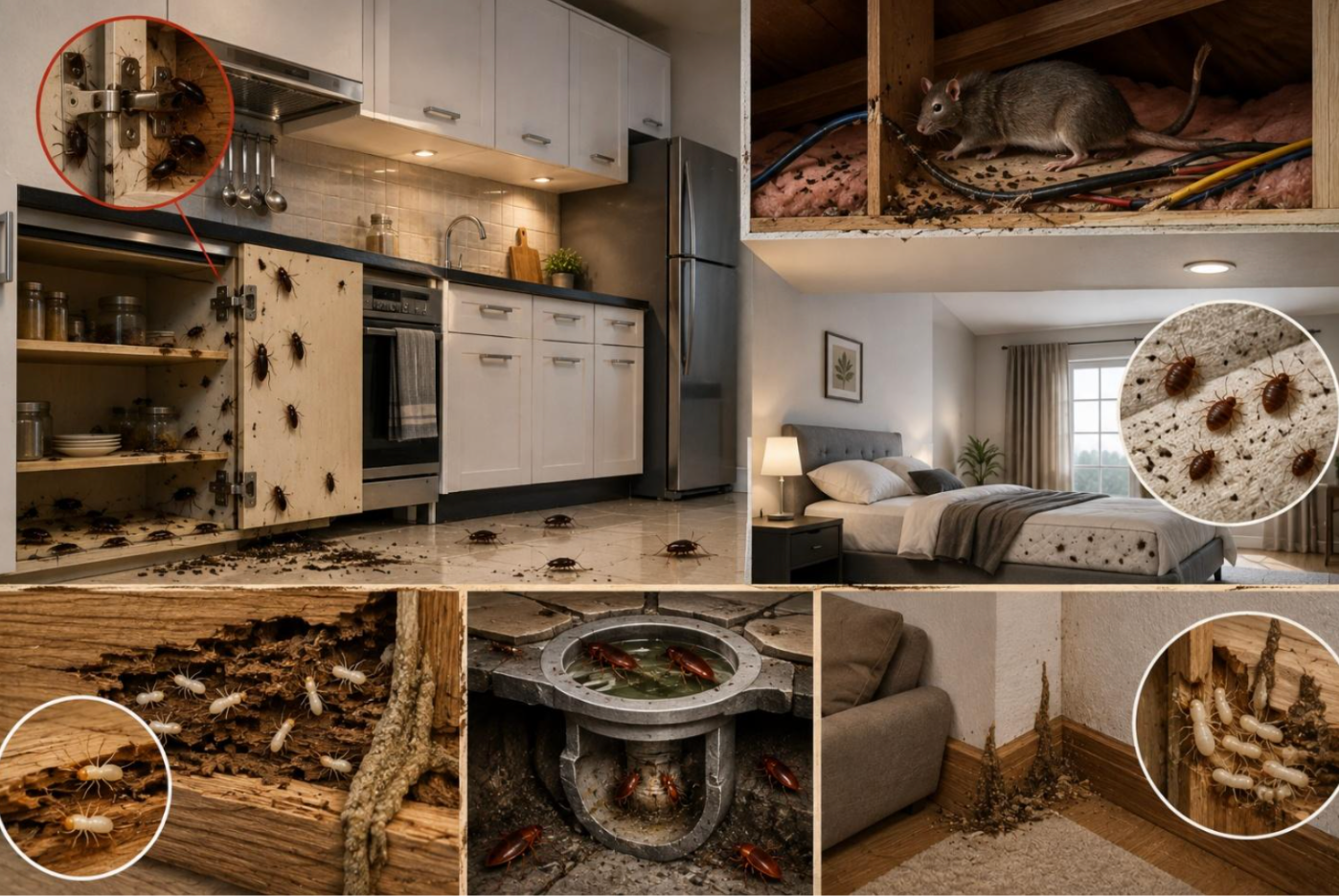
A single cockroach in the kitchen. Scratching sounds above the false ceiling. A few mysterious bites after sleeping. Tiny mud tubes appearing along a wall.
At first, these pest problems may seem minor. But pests rarely announce the full extent of an infestation.
Behind a kitchen cabinet there may be hundreds of cockroaches. Above a ceiling, rodents may be damaging cables. Inside a mattress, bed bugs may have established themselves. Beneath flooring or inside timber, termites may be quietly feeding.
Some of the worst pest infestations begin with one simple decision: "Let's wait and see."
This article looks at realistic pest-control horror scenarios based on situations commonly encountered in homes and businesses — and, more importantly, the lessons they teach us about early detection and professional pest management.
Horror Story 1: The Kitchen That Looked Completely Clean
The apartment looked spotless. The countertops were clean. Food was stored properly. The floor was mopped every day.
But every night, the homeowner noticed two or three small cockroaches near the kitchen sink. Household insecticide spray seemed to solve the problem temporarily. Within a few weeks, the cockroaches returned.
Then something alarming happened. The refrigerator was moved. Behind it were numerous cockroaches, droppings, egg cases, and nymphs hiding around warm, protected areas. The visible cockroaches had represented only a small part of the infestation.
What went wrong? The homeowner treated the cockroaches they could see instead of identifying the hidden harbourage. German cockroaches can hide in extremely narrow spaces around cabinet hinges, drawer tracks, refrigerators, appliances, under sinks, and plumbing gaps. Repeated surface spraying may kill exposed insects without eliminating the population living deeper inside harbourages.
Lesson: One visible cockroach may not represent the size of the hidden infestation. Repeated sightings — especially nymphs — deserve investigation.
Horror Story 2: Cockroaches Inside Kitchen Appliances
Another household noticed cockroaches disappearing behind a microwave and refrigerator. Instead of arranging an inspection, insecticide was repeatedly sprayed around the appliances. The cockroach activity continued.
Eventually, significant activity was discovered around warm appliance areas. Cockroach debris had accumulated in places that were difficult to clean.
What went wrong? Electrical and electronic equipment can provide warmth, darkness, and shelter. Kitchen equipment may also have nearby food residue and moisture. Cockroaches don't typically chew electrical wires like rodents, but heavy infestation and accumulated debris around equipment can create contamination and potentially contribute to equipment problems — see our guide on cockroaches and electrical damage for more.
Lesson: Never spray pesticide directly into electrical equipment unless the product is specifically labelled for that use. If cockroaches repeatedly disappear into appliances, arrange professional inspection.
Recognize any of these warning signs at home? Get a free inspection before a small problem grows.
Book Free Inspection Call NowHorror Story 3: The Bed Bug Problem That Spread Through the House
It started with a few itchy marks after sleeping. The family changed the bedsheets and sprayed the mattress. For several days, things seemed better. Then the bites returned. More spray was used.
Eventually, bed bugs were found not only around the mattress but also in bed-frame joints, headboard gaps, furniture, and cracks near the bed. The infestation had become much harder to manage.
What went wrong? Bed bugs are excellent hiding insects. They can shelter in extremely narrow spaces and may spread beyond the obvious areas around a mattress. Treating only visible insects can miss hidden bugs and eggs.
Lesson: Repeated unexplained night-time bites combined with physical signs of bed bugs should be investigated early. Early treatment is generally easier than dealing with an infestation that has spread through several rooms.
Horror Story 4: The Termite Damage Nobody Could See
The house looked normal. There were no obvious insects crawling across the floor. Then a wooden door frame began sounding hollow.
Further inspection revealed termite activity within concealed areas. The damage had been developing without obvious surface signs.
What went wrong? Subterranean termites can remain concealed while travelling between the soil and structural food sources. Warning signs may include mud tubes, hollow-sounding wood, damaged timber, swarming termites, discarded wings, and blistering or damaged surfaces. Because termites often remain hidden, visible damage may appear only after activity has been present for some time.
Lesson: No visible termites does not necessarily mean no termite activity. Early inspection is particularly important when suspicious signs appear.
Horror Story 5: The Rat in the False Ceiling
At first, the office staff heard occasional scratching above the ceiling. Everyone assumed it was something minor. Then noises became more frequent.
Eventually, rodent droppings were found and activity was detected around the false ceiling and service areas. The concern was no longer simply noise. Rodents can contaminate environments and damage materials through gnawing. Electrical cables are particularly concerning because rodents have continuously growing incisors and regularly gnaw hard materials.
What went wrong? Early warning signs were ignored. These can include scratching sounds, droppings, gnaw marks, grease marks, damaged packaging, and unusual odours.
Lesson: Rodent noises inside ceilings or walls should not be ignored. Find the source before the population becomes established.
Hearing scratching, finding droppings, or seeing gnaw marks? Ask about our rodent inspection and treatment plans.
Book Free Inspection WhatsApp UsHorror Story 6: The Restaurant Cockroach Seen by a Customer
The kitchen team had occasionally noticed cockroaches late at night. Because customers had never seen them, the problem was considered manageable. Then one evening, a cockroach appeared in the dining area. A customer noticed it.
Suddenly the issue was no longer just pest control. It became a reputation problem.
What went wrong? Visible daytime or customer-area activity may indicate that a larger population exists behind the scenes. Restaurants provide excellent cockroach conditions — food, water, warmth, and shelter, with potential harbourages in refrigerators, cooking equipment, drains, storage areas, cabinets, and waste zones.
Lesson: Commercial pest management should be preventive rather than reactive. Waiting for customers to see pests is waiting too long.
Horror Story 7: The Mosquito Problem That Fogging Couldn't Solve
Residents in an apartment community complained about mosquitoes. Fogging was arranged. For a short period, residents noticed fewer mosquitoes. Then they returned. Fogging was repeated. Again, mosquitoes returned.
Eventually, inspections identified multiple standing-water sources around the property.
What went wrong? The program concentrated primarily on adult mosquitoes while breeding continued. Mosquito management should address the entire problem: breeding sites, larvae, adult mosquitoes, and monitoring. Fogging may have a role in appropriate situations, but it does not automatically eliminate eggs, larvae, pupae, or future breeding sites — see our guide on community-wide mosquito control programs for more.
Lesson: When mosquitoes repeatedly return, look for the source. Stop breeding first.
Horror Story 8: The DIY Bug Bomb That Made Cockroaches Harder to Find
A homeowner discovered a significant cockroach infestation and wanted a quick solution. A total-release fogger or "bug bomb" seemed convenient. The product was used. Visible activity initially changed, but cockroaches remained. Some had moved deeper into protected harbourages.
What went wrong? Foggers distribute insecticide into open spaces. Cockroaches often live deep inside cabinet gaps, appliances, wall voids, plumbing spaces, and cracks and crevices. The insecticide may not reach these harbourages effectively. Incorrect fogger use can also create unnecessary pesticide exposure and safety hazards — see our guide on the danger of bug bombs for cockroaches for more.
Lesson: A heavy cockroach infestation needs targeted pest management, not simply more pesticide in the air.
Horror Story 9: Ants Kept Returning From the Same Wall
Every few days, ants appeared along the kitchen counter. The trail was sprayed. The ants disappeared. A few days later, they returned. The process continued: ants, spray, disappear, return. The real colony had never been addressed.
What went wrong? For many ant problems, killing only foraging workers does not necessarily eliminate the colony. Ants may nest outdoors, inside wall voids, under flooring, around landscaping, or near structural gaps.
Lesson: Persistent ant trails require identification of the species, nesting area, food source, and entry route.
Horror Story 10: The Wood Borer Nobody Noticed
A piece of wooden furniture looked perfectly normal. Then fine powder began appearing underneath it. The powder was cleaned. A few days later, it returned. Small holes eventually became visible in the wood.
What went wrong? The first warning sign was repeatedly cleaned away instead of investigated. Possible wood-borer signs include small exit holes, powder or frass, weakening timber, and repeated fresh dust underneath wood.
Lesson: Fresh recurring powder around timber deserves inspection. The earlier the source is identified, the easier it is to determine an appropriate treatment.
Whatever the pest, waiting rarely makes it smaller. Get a free inspection today.
Book Free Inspection Call NowHorror Story 11: The Apartment That Kept Getting Cockroaches
One apartment was professionally treated. Activity declined. Several weeks later, cockroaches appeared again. The occupants maintained good hygiene, yet the problem continued. Further investigation suggested that cockroaches could be moving through shared building infrastructure.
What went wrong? The infestation was treated as an isolated apartment problem. Multi-unit buildings can allow cockroach movement through plumbing shafts, utility conduits, wall voids, drainage systems, structural gaps, and common service areas.
Lesson: Sometimes one apartment cannot solve a building-wide pest problem alone. Coordinated pest management may be necessary.
Horror Story 12: Pest Control Without Sanitation
A commercial kitchen received regular pest-control treatments. Yet cockroaches kept returning. Why? Because underneath equipment were food crumbs, grease, standing moisture, waste, and difficult-to-clean harbourages. Pesticides were being asked to compensate for environmental conditions that continuously supported the infestation.
Lesson: Professional pest control works best when combined with sanitation. Think of it as treatment plus cleaning plus moisture control plus exclusion plus monitoring. Pesticides alone cannot correct every pest-conducive condition — see our guide on cockroaches and food contamination for more on kitchen sanitation.
The Biggest Pest-Control Horror Story: Waiting Too Long
Across cockroaches, rodents, termites, bed bugs, mosquitoes, ants, and wood borers, one pattern appears repeatedly:
By this point, the infestation may require more time, treatment, disruption, and expense. Early action can change the story.
Warning Signs You Should Never Ignore
Pay attention to cockroach nymphs, cockroach egg cases, repeated daytime cockroach sightings, rodent droppings, scratching inside ceilings, gnaw marks, recurring unexplained bites, bed bug spotting around mattresses, termite mud tubes, hollow timber, fresh wood-borer powder, persistent ant trails, and repeated mosquito breeding.
These signs may indicate that the visible problem is only part of a larger infestation — see our guide on when to call a professional for cockroach control for a fuller breakdown.
Why DIY Pest Control Sometimes Fails
DIY products can be useful for certain minor pest situations when used correctly. Problems arise when people treat only visible pests, use the wrong product, apply too much pesticide, ignore breeding sites, ignore harbourages, fail to identify the pest, ignore structural entry points, skip follow-up, or combine products improperly.
Successful pest control starts with understanding why the pest is there.
Don't Mix Pest-Control Chemicals
Never create homemade pesticide mixtures by combining different insecticides or household chemicals. Mixing products can create unexpected chemical reactions, increased exposure, unsafe residues, and application problems.
Always follow product labels. When professional treatment is required, use appropriately trained pest-management personnel.
Professional Pest Control Is More Than Spraying
A good professional pest-control program should follow:
The technician should ask where the pest is hiding, what is allowing it to survive, how it is entering, what treatment is appropriate, and how to prevent recurrence. That is fundamentally different from simply spraying every visible insect.
Integrated Pest Management Prevents Horror Stories
Integrated Pest Management (IPM) combines several control methods: inspection to find pest activity, identification to determine the pest species, sanitation to remove food and waste, moisture management to repair leaks and remove standing water, exclusion to seal appropriate entry points, targeted treatment where pests actually live, and monitoring to check whether activity is declining.
This creates a more sustainable approach than repeatedly reacting to visible pests — see our guide on the benefits of Integrated Pest Management for more.
Pest Problems in Bangalore Homes
Bangalore's dense urban development, apartment living, construction activity, commercial kitchens, drainage networks, warm periods, and seasonal rainfall can create opportunities for many pests. Common problems can include cockroaches, bed bugs, rodents, termites, mosquitoes, ants, and wood borers.
Apartment residents should also remember that some pests can move through shared building infrastructure. Recurring infestations may therefore require more than treating a single room or flat.
Pest Problems in Businesses
Commercial infestations can have consequences beyond pest damage. A pest sighting may affect hygiene, reputation, customer confidence, and operations. Hotels, restaurants, hospitals, offices, schools, warehouses, factories, and commercial kitchens benefit from preventive pest-management programs.
Waiting for a customer, patient, employee, or auditor to discover the problem is not an effective pest strategy.
Professional Pest Control in Bangalore
Standard Pest Control provides professional pest control services in Bangalore for residential and commercial properties. Services include management programs for cockroaches, bed bugs, rodents, termites, mosquitoes, ants, wood borers, and other common pest problems.
Services are available for apartments, independent houses, villas, restaurants, hotels, hospitals, offices, schools, factories, commercial kitchens, and other commercial properties. Our approach focuses on:
Because the best pest-control horror story is the one that gets stopped before it becomes a horror story.
Frequently Asked Questions
Can a small pest problem become a serious infestation?
Yes. Some pests reproduce quickly or remain hidden for long periods. Repeated sightings, droppings, nymphs, egg cases, damage, or other evidence should not be ignored.
Does seeing one cockroach mean I have an infestation?
Not necessarily. However, repeated sightings, nymphs, egg cases, droppings, or daytime activity can indicate a larger hidden population.
Why do cockroaches return after spraying?
Surface spraying may kill exposed cockroaches while leaving insects and egg cases inside protected harbourages. Food, moisture, entry points, and neighbouring infestations can also contribute to recurrence.
Can rats damage electrical wiring?
Yes. Rodents gnaw materials, including electrical cables. Suspected wiring damage should also be assessed by a qualified electrical professional.
Why do mosquitoes return after fogging?
Fogging primarily targets exposed adult mosquitoes. If breeding sites remain, new mosquitoes can continue emerging.
Can bed bugs spread to other rooms?
Yes. Established bed bug infestations can spread beyond the original sleeping area, particularly when they are disturbed or transported with belongings.
Can termites damage a building without being seen?
Yes. Subterranean termites can remain concealed within structural areas and soil-connected pathways, which is why early warning signs and professional inspection matter.
Is DIY pest control always bad?
No. Appropriate DIY prevention and correctly labelled products can help with some minor problems. Professional assistance becomes important when infestations are established, recurring, difficult to identify, or involve significant property or hygiene risks.
What is the biggest mistake people make with pest infestations?
Ignoring early warning signs and repeatedly treating visible pests without identifying the source are two of the most common mistakes.
Final Takeaway: Don't Wait Until a Pest Problem Becomes a Horror Story
Most serious infestations don't begin dramatically. They begin with one cockroach, one scratching sound, one mud tube, one mysterious bite, or one small pile of wood powder.
The problem starts when those warning signs are repeatedly ignored. Effective pest management means acting early:
Don't wait until cockroaches are spreading through the kitchen, rodents are living above the ceiling, bed bugs have reached multiple rooms, or termites have already damaged timber.
When pests repeatedly return, stop asking "How can I kill the pest I can see?" Start asking "Where is the infestation coming from?"
Finding that answer is often the difference between a small pest problem and a pest-control horror story.
Related reading: The Psychology of Pests: Why We Fear and Disgust Them | When to Call a Professional for Cockroach Control | The Benefits of Integrated Pest Management (IPM) for Cockroaches | The Danger of Bug Bombs for Cockroaches