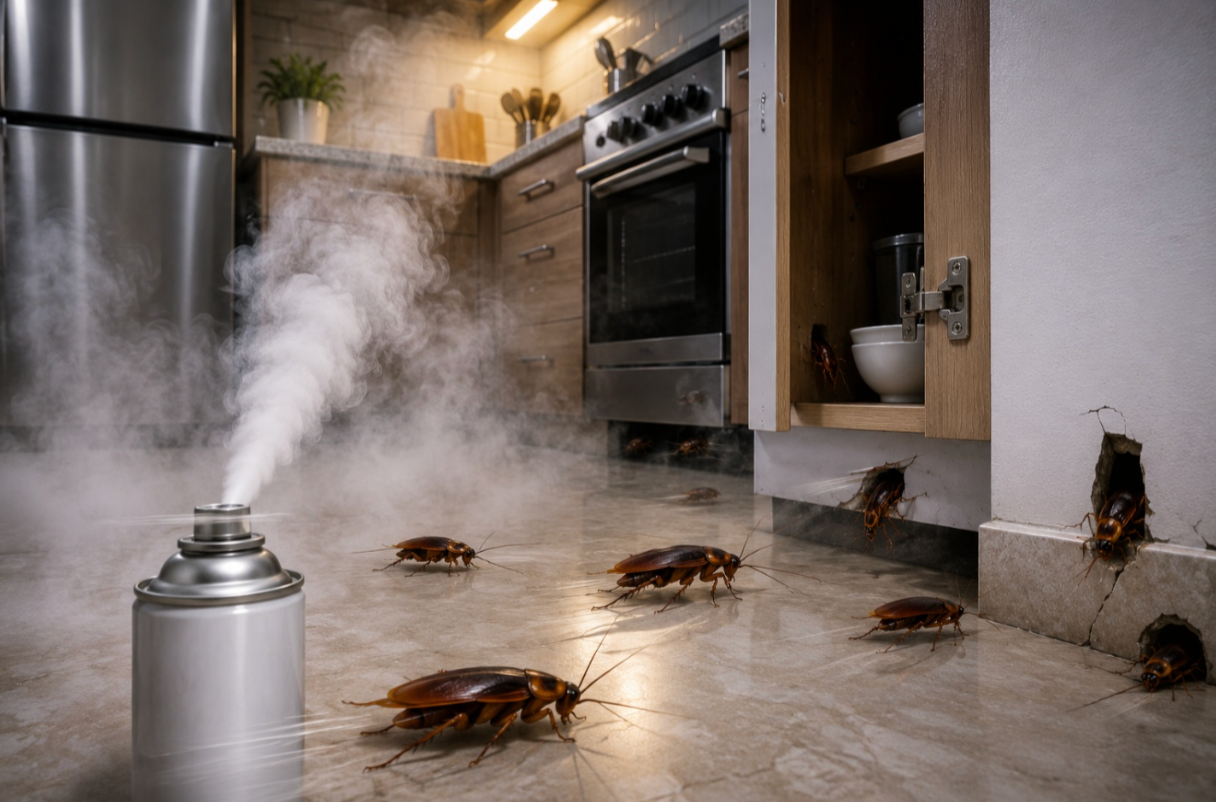
When homeowners discover cockroaches in the kitchen, their first instinct is often to find the fastest possible solution. One DIY product people may consider is a bug bomb, also called a total-release fogger.
The idea sounds simple: activate the fogger, leave the room, and allow insecticide to spread throughout the space.
But when it comes to cockroach infestations, bug bombs may not reach the places where cockroaches are actually hiding. Instead, they can expose people and pets to unnecessary pesticide residues and may drive surviving cockroaches deeper into cracks, cabinets, wall voids, or neighbouring areas.
Understanding why this happens can help homeowners choose safer and more effective cockroach control methods.
What Is a Bug Bomb?
A bug bomb or total-release fogger is a pesticide product designed to release an insecticide aerosol into an enclosed area. Once activated, pesticide droplets disperse through the air and eventually settle onto exposed surfaces.
This creates an important limitation: the pesticide mainly reaches exposed areas — not necessarily the hidden harbourages where cockroaches spend most of their time. Cockroaches commonly hide inside extremely narrow spaces where airborne droplets may have difficulty reaching them.
Where Do Cockroaches Actually Hide?
Cockroaches don't normally sit in the middle of your kitchen waiting to be sprayed. They prefer dark, warm, protected locations close to food and moisture. Common cockroach harbourages include behind refrigerators, under kitchen sinks, inside cabinet gaps, around cabinet hinges, behind modular kitchen units, around plumbing openings, under appliances, inside cracks and crevices, around drainage areas, wall and floor junctions, and utility shafts and other protected voids.
A fogger may fill the visible room with pesticide while leaving many of these protected areas inadequately treated.
Why Bug Bombs May Not Solve a Cockroach Infestation
1. Cockroaches Hide Deep Inside Cracks
The biggest problem with fogging an indoor room for cockroaches is penetration. Cockroaches can squeeze into very narrow cracks and protected harbourages. Aerosol droplets released into open air may settle onto countertops, floors, furniture, and other exposed surfaces rather than penetrating deeply enough into cockroach hiding places.
As a result, some exposed cockroaches may die while much of the hidden population survives.
2. Bug Bombs Can Disturb Cockroach Harbourages
When cockroaches encounter irritating or repellent insecticide exposure, surviving insects may move away from the treated area. Instead of eliminating the entire infestation, inappropriate treatment can potentially redistribute cockroach activity. Cockroaches may retreat:
In apartment buildings, movement through shared plumbing, ducts, service shafts, and structural gaps can make cockroach management even more complicated. This is one reason professional cockroach treatment focuses on targeting harbourages, rather than simply filling a room with insecticide.
3. Hidden Egg Cases May Survive
Cockroach control isn't only about killing adult cockroaches. A population can include:
Egg cases are often located in protected areas. Even when a DIY treatment kills some active cockroaches, surviving individuals and protected egg cases can allow activity to continue or return. This can create a familiar situation: "I treated the entire kitchen, but the cockroaches came back."
The problem may not be that new cockroaches suddenly entered the house. The original infestation may never have been completely controlled.
4. Pesticide Can Settle on Unnecessary Surfaces
A total-release fogger disperses pesticide through the room rather than applying it only where cockroaches are hiding. Residues can potentially settle on exposed surfaces and belongings. This is particularly important in kitchens and food-handling areas.
Using more pesticide throughout a room does not automatically mean better pest control. Modern pest management aims for:
Targeted application is generally preferable to unnecessary pesticide exposure.
Already tried a fogger and cockroaches are still there? Get a free inspection and targeted treatment plan.
Book Free Inspection Call NowBug Bomb Safety Risks
Bug bombs should never be treated as harmless household products simply because they are commercially available. Incorrect use can create serious safety hazards. Depending on the product and circumstances, risks can include pesticide exposure, contamination of surfaces, respiratory or eye irritation, and fire or explosion hazards when aerosol products are used incorrectly around ignition sources.
Always follow the product label exactly. Never use more foggers than instructed in an attempt to obtain "stronger" treatment.
Fire and Explosion Risk
Some total-release foggers contain flammable propellants. Using them improperly near gas stoves, pilot lights, electrical sparks, open flames, or certain appliances or ignition sources can create a serious hazard.
This is another reason DIY pesticide treatments should never be improvised.
More Chemical Does Not Mean Better Cockroach Control
A common misconception in pest management is: "If a little pesticide works, more pesticide will work better." That is not how responsible pest management works.
Excessive or inappropriate pesticide use can increase unnecessary exposure without solving the underlying infestation. Effective cockroach control depends much more on finding the insects and understanding their behaviour. A trained technician asks where they are hiding, where they are feeding, where the moisture source is, how they are entering, and how severe the infestation is.
Treatment can then be concentrated where it is actually needed.
Why Targeted Cockroach Gel Treatment Can Be More Effective
For many indoor cockroach situations — particularly German cockroach infestations — professional baiting can be an important treatment method. Instead of releasing pesticide throughout the room, small quantities of suitable cockroach gel bait are strategically placed near cockroach harbourages and activity areas.
Potential placement areas can include cabinet hinges, cracks and crevices, under sinks, behind appliances, kitchen cabinet corners, plumbing-adjacent areas, and other protected cockroach activity points. Cockroaches encounter the bait while moving through their normal harbourage and feeding areas.
Treatment selection should always depend on the species, infestation level, site conditions, and product label — see our guide on professional cockroach treatment options for more on how gel baits, sprays and IGRs work.
Spraying Everything Is Not the Answer Either
Avoiding bug bombs doesn't mean every surface should be sprayed instead. Heavy indiscriminate spraying can create many of the same problems. Professional cockroach management often uses a combination of:
Depending on the property, treatment may involve baiting, carefully targeted crack-and-crevice applications, traps or monitoring devices, sanitation recommendations, and entry-point management.
The objective is not to cover the property in pesticide. The objective is to control the infestation effectively while minimizing unnecessary exposure.
Why German Cockroaches Need Special Attention
German cockroaches are among the most troublesome cockroaches found in residential kitchens, restaurants, hotels, and food-handling environments. They reproduce quickly and live close to food, warmth, and moisture. Common hiding locations include refrigerator motors and surrounding areas, kitchen cabinets, drawer tracks, cabinet hinges, under sinks, food preparation equipment, cracks around countertops, and appliances.
Because these locations are protected, simply releasing an aerosol into the room may fail to reach a large part of the infestation. Careful inspection and targeted treatment are especially important.
German cockroaches breeding behind your cabinets or appliances? Ask about our species-specific gel bait plans.
Book Free Inspection WhatsApp UsWhat Should You Do Instead of Using a Bug Bomb?
If you have a cockroach problem, start by making the environment less favourable for them.
1. Remove Food Sources
Clean crumbs, food spills, grease, and residue from kitchen surfaces. Store food in properly closed containers.
2. Reduce Moisture
Repair leaking taps and pipes. Keep sinks and countertops reasonably dry, especially overnight.
3. Remove Garbage
Empty kitchen waste regularly and keep bins clean and covered.
4. Seal Entry Points
Seal suitable cracks and openings around plumbing, cabinets, walls, doors, and utility lines. This helps reduce cockroach movement and reinfestation.
5. Avoid Random Pesticide Mixing
Never mix different household insecticides or cleaning chemicals to create a "stronger" cockroach treatment. Mixing products can be dangerous and may produce harmful fumes or unexpected chemical reactions.
6. Get a Professional Inspection
If cockroaches continue appearing despite sanitation and prevention measures, the infestation may already be established. A professional technician can identify harbourages and recommend a targeted treatment plan.
Special Concern for Bangalore Apartments
Cockroach control can be particularly challenging in apartment buildings. Individual flats may be connected through plumbing shafts, drainage systems, electrical conduits, utility ducts, common garbage areas, and structural openings.
If a treatment simply pushes cockroaches away from one location without eliminating the infestation, activity may appear elsewhere. This is why apartment cockroach control should consider both the affected home and potential movement routes. In buildings with widespread infestation, coordinated treatment may be more effective than treating individual flats separately.
Bug Bombs vs Targeted Professional Treatment
Bug bomb approach: Pesticide is released broadly into the room. It may contact some exposed cockroaches but may have limited penetration into protected harbourages.
Targeted pest management approach: The technician first identifies where cockroaches are hiding. Treatment is then directed toward those activity areas using appropriate methods.
This difference can be summarized simply:
When Should You Call a Professional?
Professional cockroach pest control in Bangalore should be considered when cockroaches appear regularly, small cockroaches are visible throughout the kitchen, you see cockroaches during daytime, droppings are present inside cabinets, egg cases are found, cockroaches return after DIY treatment, activity is spreading into several rooms, cockroaches are present around electrical appliances, or the infestation affects a restaurant or commercial kitchen.
Recurring cockroach activity is usually a sign that simply killing visible insects isn't enough — see our guide on when to call a professional for cockroach control for a fuller checklist of warning signs.
Professional Cockroach Control in Bangalore
Standard Pest Control provides professional cockroach control services in Bangalore for homes, apartments, offices, restaurants, hotels, commercial kitchens, shops, and other properties. Our approach focuses on identifying:
Based on the inspection, technicians can recommend an appropriate treatment strategy. The goal is to control the infestation at its source rather than simply spraying the visible cockroaches.
Frequently Asked Questions
Do bug bombs kill cockroaches?
They may kill some cockroaches that receive sufficient exposure, but hidden cockroaches may survive. This means a fogger should not automatically be expected to eliminate an established infestation.
Do bug bombs make cockroaches scatter?
Inappropriate or repellent insecticide exposure can disturb cockroach harbourages and potentially cause surviving insects to move into other protected locations. The exact response depends on the product, species, and infestation.
Why do cockroaches come back after fogging?
Hidden cockroaches, protected harbourages, surviving egg cases, food and water sources, and untreated entry points can all contribute to recurring activity.
Are bug bombs safe to use in kitchens?
Total-release foggers are pesticides and must be used strictly according to their labels. Because kitchens contain food-contact surfaces, appliances, and potential ignition sources, incorrect use can create additional concerns.
Is cockroach gel better than fogging?
For many indoor cockroach infestations, targeted baiting can be an important treatment option because bait can be placed close to harbourages instead of dispersing pesticide throughout the entire room. The appropriate method depends on the infestation.
Can I use more than one bug bomb for a stronger treatment?
Never exceed the amount specified on the product label. Using additional foggers can increase pesticide exposure and may increase fire or explosion risks without improving pest control.
Final Verdict: Think Before You Bomb
Bug bombs may look like a quick and powerful solution to a cockroach infestation, but filling a room with pesticide does not guarantee that the product will reach the cockroaches hiding deep inside cracks, cabinets, appliances, and wall voids. In some situations, disturbing harbourages can also cause surviving cockroaches to relocate.
For long-term control, focus on the infestation rather than simply the room.
If DIY treatments repeatedly fail, professional inspection and targeted cockroach treatment are usually a better next step than repeatedly increasing pesticide use.
Related reading: When to Call a Professional for Cockroach Control: Signs of a Serious Problem | Understanding Professional Cockroach Treatment Options: Baits, Sprays and IGRs | The Benefits of Integrated Pest Management (IPM) for Cockroaches | What to Expect During a Professional Cockroach Extermination Service