When cockroaches appear in a home or commercial property, simply killing the insects you can see is rarely enough. Cockroaches spend much of their time hidden inside cracks, kitchen cabinets, appliances, plumbing areas, drains, and other protected spaces.
Professional cockroach control therefore requires more than simply "spraying the house." Depending on the cockroach species, infestation level, property type, and harbourage locations, pest-management professionals may use cockroach baits, targeted insecticide sprays, Insect Growth Regulators (IGRs), or a combination of methods.
Understanding how these treatments work can help you know what to expect when booking professional cockroach pest control in Bangalore.
Why Professional Cockroach Treatment Starts With Inspection
Before deciding between bait, spray, or another treatment, the technician should first understand the infestation. A professional inspection may look for cockroach species, adult cockroaches, nymphs, egg cases, droppings, harbourage locations, food sources, moisture sources, entry points, and infestation severity.
This information matters because not every cockroach problem should be treated in exactly the same way. For example, German cockroaches breeding inside kitchen cabinets require a different strategy from larger cockroaches entering through drainage or outdoor areas. The correct approach is:
Option 1: Cockroach Gel Baits
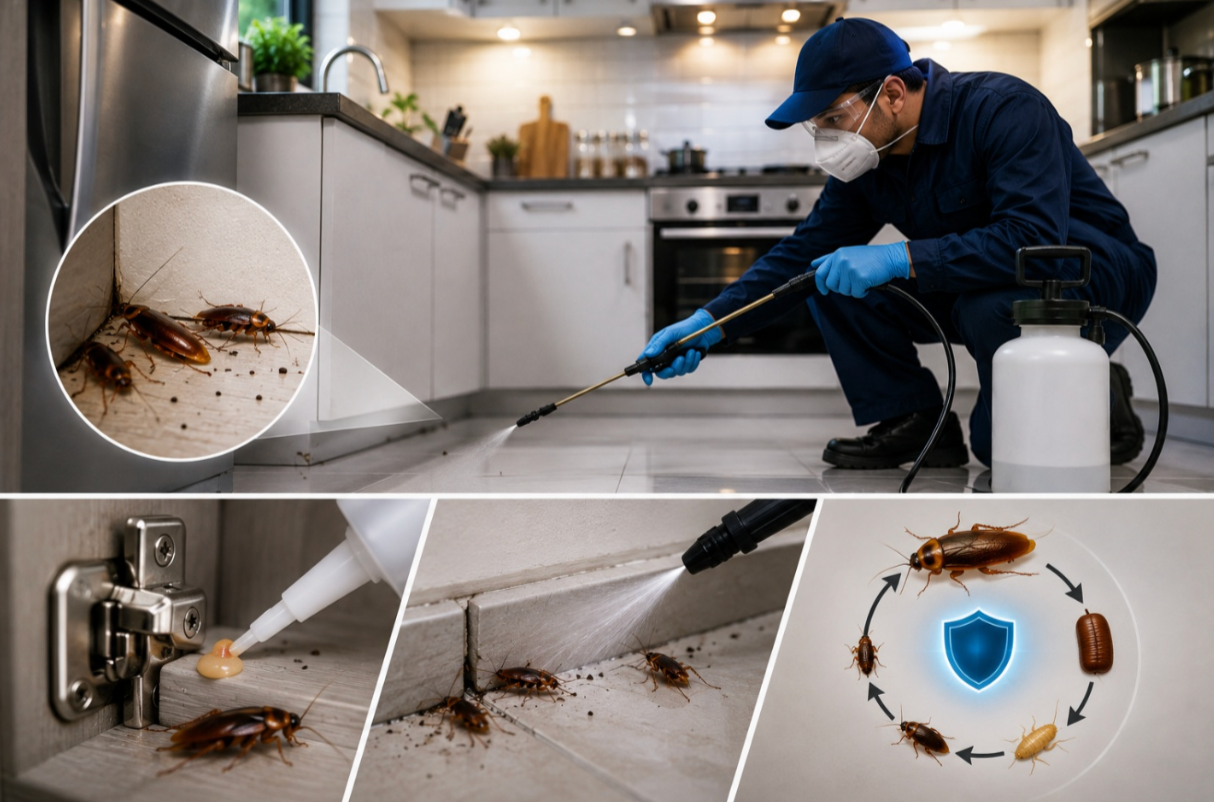
Gel bait is one of the most commonly used professional treatments for indoor cockroach infestations. Instead of spraying large exposed surfaces, technicians apply small quantities of bait in strategic locations where cockroaches are likely to encounter it.
How Does Cockroach Gel Bait Work?
Cockroach gel contains a food-based bait combined with an insecticidal active ingredient. Cockroaches locate and consume the bait. The effectiveness of baiting depends heavily on correct placement.
Professional technicians may place gel in small amounts around cabinet hinges, drawer tracks, under sinks, behind refrigerators, appliance areas, cracks and crevices, kitchen cabinet corners, plumbing openings, and other identified harbourages.
The objective is to place bait close to cockroach activity while avoiding unnecessary application to exposed surfaces.
Advantages of Cockroach Gel Baits
Gel bait offers several practical advantages: targeted application in small quantities directly near cockroach activity; minimal disruption compared with broad-area spraying; particular usefulness in kitchens and other sensitive indoor areas; and the ability to reach hidden cockroaches, since cockroaches leave their harbourages to search for food and can encounter strategically placed bait that is difficult to contact directly with sprays.
Limitations of Gel Baits
Gel bait is not simply something that should be placed randomly throughout a property. Poor placement can reduce effectiveness, and other food sources can also compete with bait — this is why kitchen sanitation is important.
Grease, crumbs, uncovered food, garbage, and other accessible food sources can reduce the likelihood that cockroaches will feed on bait. Bait may also require monitoring and replenishment depending on infestation levels and product instructions — see our guide on cockroaches and food contamination for more on kitchen sanitation.
Not sure which treatment is right for your property? Get a free inspection and tailored treatment plan.
Book Free Inspection Call NowOption 2: Professional Cockroach Sprays
Professional insecticide sprays can also play an important role in cockroach management. However, professional spraying should not mean covering every wall, floor, countertop, and cabinet with pesticide. The emphasis should be on targeted treatment.
Where Are Professional Sprays Used?
Depending on the infestation and product label, treatment may be directed toward cracks and crevices, wall-floor junctions, plumbing areas, utility spaces, cockroach harbourages, external entry points, drainage-related areas, and other identified activity locations. The exact treatment depends on the species and site.
Why Targeted Spraying Is Better Than Random Spraying
Cockroaches spend much of their time hidden. Spraying only visible insects may produce immediate kills without addressing the population living inside harbourages. At the same time, excessive or inappropriate spraying can create unnecessary pesticide exposure.
Professional pest management therefore focuses on:
More pesticide does not automatically mean better control.
Repellent vs Non-Repellent Treatment
Some insecticide formulations may cause insects to avoid treated areas, while others have different behavioural characteristics. Product selection is particularly important when sprays are being combined with baits — inappropriate spray application around bait placements may interfere with cockroach feeding behaviour.
This is one reason homeowners should avoid adding household sprays after professional gel treatment unless specifically advised by the technician. The overall treatment program should be designed so that different control methods work together rather than against each other.
Option 3: Insect Growth Regulators (IGRs)
Insect Growth Regulators are an interesting component of professional cockroach management. Unlike conventional insecticides designed primarily to kill insects directly, IGRs interfere with normal insect development or reproduction.
How Do IGRs Work?
Cockroaches develop through stages:
IGRs target aspects of insect growth and development. Depending on the active ingredient, they can interfere with the ability of immature cockroaches to develop normally or affect reproductive processes. This makes IGRs potentially useful as part of a broader cockroach-management program.
Do IGRs Kill Cockroaches Immediately?
Usually, immediate knockdown is not their main purpose. IGRs are generally used to help disrupt the cockroach population over time. That means customers should not expect an IGR treatment to produce the same immediate visible effect as a contact insecticide. Its value lies in population management.
Established infestation that needs more than a single spray? Ask about our combined gel, spray and monitoring program.
Book Free Inspection WhatsApp UsWhy Professionals May Combine Baits, Sprays and IGRs
A serious cockroach infestation can contain:
No single treatment method is ideal for every situation. A professional may therefore develop an integrated strategy — gel bait targets cockroaches feeding and moving near harbourages, targeted spray treats appropriate cracks, crevices, entry routes, or other selected areas, IGRs help interfere with population development and reproduction, monitoring determines whether activity is declining and identifies remaining hotspots, sanitation removes competing food and water sources, and exclusion reduces cockroach entry and movement.
Together, these measures form part of Integrated Pest Management (IPM).
What Is Integrated Pest Management?
Integrated Pest Management is an approach that combines multiple control methods instead of relying entirely on pesticide application. For cockroaches, IPM may include:
The objective is to achieve effective pest control while reducing unnecessary pesticide use.
Which Treatment Is Best for German Cockroaches?
German cockroaches are among the most common indoor cockroach pests in kitchens, restaurants, food-service facilities, and similar environments. They prefer warm, protected locations close to food and moisture. Typical harbourages include cabinet hinges, behind refrigerators, under sinks, drawer tracks, appliances, countertop gaps, and cracks and crevices.
Because German cockroaches live so close to food-preparation areas, targeted baiting is often an important part of professional treatment. Depending on the infestation, additional methods such as carefully selected crack-and-crevice treatment, monitoring, sanitation, and IGRs may also be considered.
What About American Cockroaches?
Larger cockroach species may behave differently. American cockroaches, for example, can be associated with drainage systems, basements, utility areas, outdoor environments, and other damp locations. Treatment may therefore focus more heavily on entry points, drainage areas, plumbing, utility spaces, exterior harbourages, and moisture management.
This demonstrates why cockroach identification matters before treatment begins.
Why Sanitation Is Part of Professional Treatment
Even the best bait or insecticide program can struggle when cockroaches have unlimited access to food and water. Before and after treatment: remove food crumbs, clean grease deposits, keep food covered, empty garbage regularly, fix leaking taps, repair leaking pipes, reduce standing water, and clean underneath appliances.
Think of cockroach management as removing the resources that support the infestation.
Reduce these three factors and professional treatment has a better chance of providing lasting control.
Why Sealing Entry Points Matters
Treatment controls cockroaches currently present. Exclusion helps reduce future entry. Inspect areas around plumbing pipes, doors, windows, electrical conduits, kitchen cabinets, wall cracks, floor gaps, and utility lines.
Appropriate openings can be sealed after important harbourages have been identified and treated. In apartment buildings, this is particularly important because cockroaches may move between units through shared structural pathways.
Should You Spray After Professional Gel Treatment?
Generally, avoid applying additional household insecticide sprays around professional bait placements unless the pest-control technician specifically recommends it. Random spraying can potentially interfere with the treatment strategy.
Instead, follow the technician's instructions and allow the professional treatment program to work as designed. If cockroach activity continues, contact the pest-control provider rather than adding multiple DIY pesticides.
Why Follow-Up Monitoring Matters
Professional treatment doesn't necessarily end when the technician leaves. Cockroach populations should be monitored — this may involve visual inspections, sticky monitoring traps, checking bait consumption, inspecting previous harbourages, looking for fresh droppings, and tracking nymph activity.
If activity remains high in one location, treatment can be adjusted. This makes professional pest management a process rather than a single spray visit — see our guide on what to expect during professional cockroach extermination for more on the full service process.
Treatment Options at a Glance
| Method | Best suited for | Main advantage | Important factor |
|---|---|---|---|
| Cockroach gel bait | Many indoor infestations, particularly kitchen harbourages | Highly targeted placement | Good sanitation and correct bait positioning |
| Professional spray | Selected harbourages, cracks, crevices, entry areas | Targeted control in appropriate locations | Avoid unnecessary broad application |
| Insect Growth Regulators | Supporting longer-term population management | Interferes with insect development or reproduction | Results are not based on immediate knockdown |
| Integrated treatment | Established or difficult infestations | Addresses multiple aspects of the population and environment | Requires inspection-led planning |
What Treatment Should You Choose?
You don't necessarily need to choose. A professional technician should determine the treatment after inspecting the property. The decision may depend on:
A small apartment kitchen with German cockroaches should not automatically receive the same treatment as a restaurant, hotel, warehouse, or drainage-related infestation. Customized treatment is one of the key advantages of professional pest management.
Professional Cockroach Treatment in Bangalore
Standard Pest Control provides professional cockroach pest control in Bangalore for residential and commercial properties. Services are suitable for apartments, independent houses, villas, offices, restaurants, hotels, hospitals, shops, commercial kitchens, and other commercial premises.
Our cockroach-management approach focuses on identifying the infestation before selecting the treatment. Depending on the site, this may involve gel baiting, targeted insecticide treatment, monitoring, sanitation recommendations, exclusion measures, and other appropriate professional methods.
The objective is not simply to kill visible cockroaches. It is to control the population at its source and reduce the conditions that allow it to return.
Frequently Asked Questions
Which is better for cockroaches: gel or spray?
Neither method is automatically best for every infestation. Gel bait can be particularly useful for indoor harbourages, while targeted sprays may be appropriate in other locations. Professional inspection should determine the treatment.
What is an IGR for cockroaches?
An Insect Growth Regulator is a pest-management product designed to interfere with insect development or reproduction. It may be used as part of an integrated cockroach-control program.
Does cockroach gel work immediately?
Baits are not necessarily designed to produce instant visible knockdown. Cockroaches need to locate and consume the bait, so results occur over time.
Can I spray household insecticide after gel treatment?
Avoid spraying around professional bait placements unless advised by your technician. Additional sprays can interfere with the overall baiting strategy.
Is cockroach gel safe for kitchens?
Professional products should be used strictly according to their labels. Technicians apply small amounts in suitable protected locations rather than on food or food-contact surfaces.
Why am I still seeing cockroaches after treatment?
Some activity can continue while the treatment affects the population. Hidden cockroaches and nymphs may emerge from harbourages. Persistent or increasing activity should be reported to the pest-control provider for reassessment.
Can professional treatment prevent cockroaches forever?
No treatment can guarantee that cockroaches will never enter a property again. Long-term prevention requires sanitation, moisture control, exclusion, monitoring, and treatment when necessary.
Final Takeaway
Professional cockroach treatment isn't simply about choosing between gel or spray. Effective control begins with understanding the infestation.
Baits target feeding cockroaches. Sprays provide targeted treatment where appropriate. IGRs can help interfere with population development. Sanitation removes food and water. Exclusion reduces future entry. Monitoring tells us whether the program is working.
The most effective strategy is often not one product but an Integrated Pest Management approach tailored to the property and cockroach species.
Related reading: When to Call a Professional for Cockroach Control: Signs of a Serious Problem | The Benefits of Integrated Pest Management (IPM) for Cockroaches | What to Expect During a Professional Cockroach Extermination Service | Cockroaches and Food Contamination: Protecting Your Kitchen