If you have never booked professional cockroach control before, you may have several questions. What will the technician do? Will everything be sprayed? Do I need to leave the house? How long will treatment take? Will cockroaches disappear immediately?
Professional cockroach treatment should involve much more than simply arriving at your property and spraying insecticide. A good cockroach-control service typically follows a systematic process:
Understanding these steps can help you prepare for your appointment and know what to expect before, during, and after professional cockroach pest control.
Step 1: Initial Discussion With the Technician
The service should begin with a short discussion about the cockroach problem. The technician may ask when you first noticed cockroaches, where you usually see them, whether they're mostly seen at night, whether you've noticed daytime activity, whether you're seeing nymphs, whether you've found droppings or egg cases, whether you've already used household sprays, gels, or foggers, and whether neighbouring apartments are experiencing similar problems.
Give the technician as much information as possible. Your observations can help locate infestation hotspots.
Step 2: Detailed Cockroach Inspection
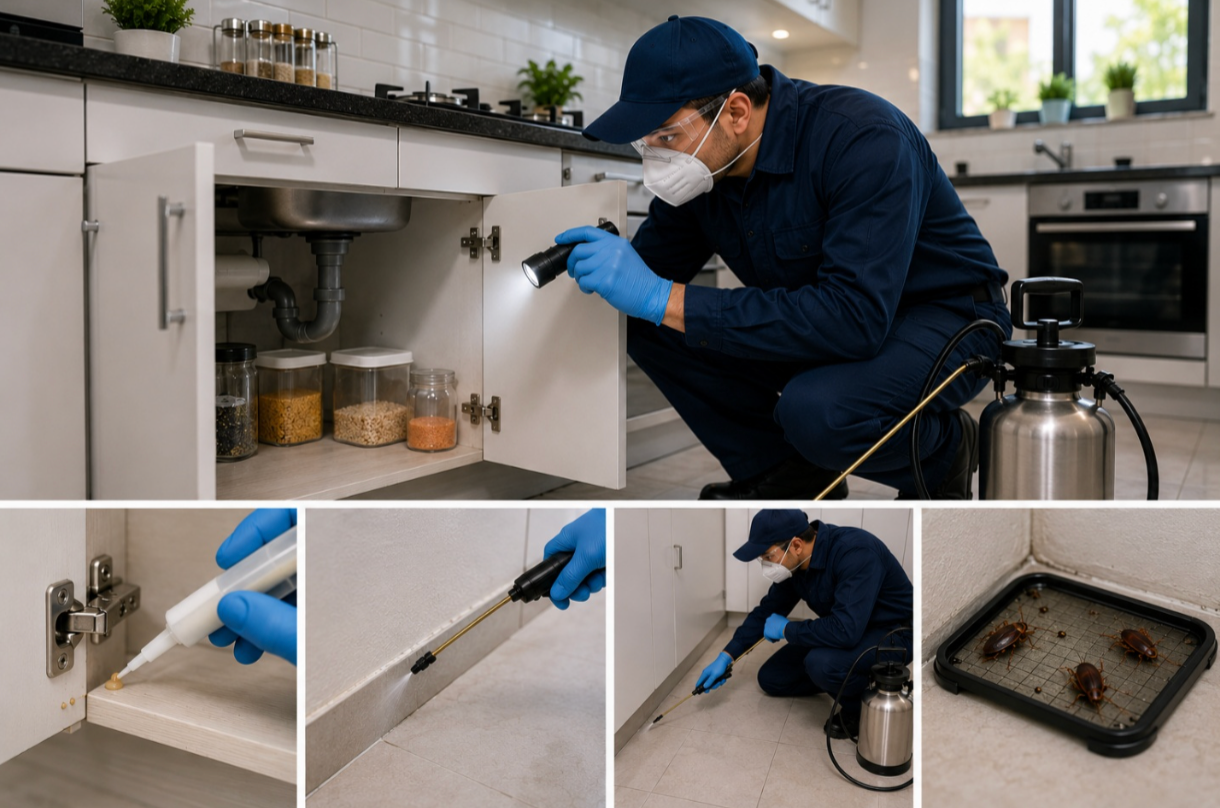
Inspection is one of the most important parts of professional cockroach control. Cockroaches spend much of their time hidden, so technicians should not focus only on the insects walking across the floor.
Common inspection locations include kitchen cabinets, cabinet hinges, drawer tracks, under sinks, behind refrigerators, around cooking appliances, plumbing openings, cracks and crevices, bathroom drains, utility areas, storage spaces, and garbage areas.
The technician may use a flashlight and other inspection tools to check difficult-to-see areas.
Step 3: Identifying Signs of Infestation
During the inspection, technicians look for evidence that helps determine the location and severity of the infestation. Signs may include live cockroaches, dead cockroaches, nymphs, egg cases, droppings, shed skins, harbourage areas, food residue, and moisture sources.
The pattern of these signs can help determine where cockroaches are concentrated.
Step 4: Identifying the Cockroach Species
Not all cockroach problems are the same. Correct identification can influence the treatment plan.
German cockroaches are commonly associated with kitchens and food-handling areas. They often hide around cabinet hinges, refrigerators, appliances, under sinks, drawer tracks, and cracks and crevices.
Larger cockroach species may be associated with drains, basements, utility areas, outdoor environments, plumbing systems, and damp locations.
Knowing the species helps technicians select appropriate control methods.
Step 5: Assessing the Infestation Level
The technician will determine whether the problem appears to be:
- Light — occasional sightings with limited evidence
- Moderate — regular activity, droppings, or nymphs concentrated in particular areas
- Heavy — frequent sightings, daytime activity, multiple harbourages, egg cases, and cockroaches spreading through several areas
Infestation level can influence the amount of treatment, number of treatment locations, monitoring requirements, and need for follow-up visits.
Ready to book your first professional inspection? Get a free assessment and treatment plan.
Book Free Inspection Call NowStep 6: Developing a Treatment Plan
Once the inspection is complete, the technician should decide which treatment method is appropriate. Professional cockroach management may involve:
In some situations, Insect Growth Regulators (IGRs) or other approved professional methods may also form part of the program. Not every property needs every treatment — the strategy should depend on the actual infestation.
Step 7: Professional Cockroach Gel Treatment
Gel bait is commonly used for certain indoor cockroach infestations, particularly German cockroaches. The technician applies small quantities of professional cockroach bait near harbourages and activity areas — potential placement locations include cabinet hinges, drawer tracks, under sinks, behind appliances, kitchen cabinet corners, and cracks and crevices.
The bait should be placed strategically rather than randomly throughout the property. Cockroaches encounter and consume the bait while moving and feeding.
Step 8: Targeted Cockroach Spray Treatment
Professional spraying should not mean soaking the entire house with pesticide. Where appropriate and permitted by the product label, treatment may be directed toward cracks and crevices, wall-floor junctions, plumbing areas, utility spaces, selected entry routes, and other identified cockroach activity areas.
The objective is targeted application. More pesticide does not automatically mean better pest control — professional treatment should focus on using the right product in the right place.
Step 9: Treating Kitchen Harbourages
For many homes, the kitchen requires the most attention. Technicians may inspect and treat around:
The exact treatment depends on where activity is found. Because kitchens contain food and food-contact surfaces, professional products must be applied carefully according to their labels — see our guide on cockroaches and food contamination for more on protecting food-preparation areas.
Step 10: Bathroom and Drain Inspection
Cockroaches can also be associated with bathrooms and drainage systems. Technicians may inspect floor drains, washbasins, pipe openings, utility connections, and damp areas.
Drain covers, plumbing gaps, and moisture problems may be identified as part of the prevention plan.
Step 11: Identifying Food and Water Sources
Professional cockroach treatment should also address the conditions supporting the infestation. Cockroaches need:
The technician may identify food crumbs, grease, uncovered food, garbage, pet food, leaking taps, leaking pipes, and standing water. Removing these resources helps make the environment less favourable for cockroaches.
Step 12: Identifying Cockroach Entry Points
Another important part of the service is identifying how cockroaches may be entering or moving through the property. Common entry points include gaps around plumbing, wall cracks, spaces underneath doors, drain openings, utility conduits, gaps behind cabinets, and window openings.
The technician may recommend sealing appropriate gaps after important harbourages have been treated.
Want a technician who explains every step? Book your inspection today.
Book Free Inspection WhatsApp UsDo You Need to Leave the House During Treatment?
It depends on the treatment method. For some targeted gel-bait services, occupants may experience minimal disruption. For other pesticide applications, occupants and pets may need to leave treated areas temporarily.
There is no single re-entry time that applies to every treatment. Always follow the technician's instructions and the pesticide product label.
How Long Does Cockroach Treatment Take?
Treatment time varies depending on property size, infestation level, number of rooms affected, cockroach species, treatment method, and accessibility of harbourages.
A small apartment with localized activity may require less time than a large home, restaurant, hotel, or heavily infested commercial kitchen. A thorough inspection is more important than rushing the service.
Will Cockroaches Disappear Immediately?
Not necessarily. Customers sometimes expect every cockroach to disappear as soon as treatment is completed, but professional pest management does not always work that way.
Gel bait, for example, requires cockroaches to find and consume the bait. Hidden cockroaches may also emerge from harbourages after treatment. You may therefore continue to notice some activity for a period after the service. The important factor is whether activity progressively declines.
Is It Normal to See More Cockroaches After Treatment?
In some situations, treatment can disturb harbourages and make cockroaches more noticeable temporarily. This does not automatically mean the treatment has failed. However, activity should be monitored — if cockroach numbers remain high, increase, or continue beyond the expected treatment period, contact your pest-control provider.
What Should You Do Immediately After Treatment?
Follow all instructions provided by your technician. Depending on the treatment, these may include respecting the recommended re-entry period, ventilating the property if instructed, avoiding immediate deep cleaning, leaving gel bait undisturbed, keeping children and pets away from treated areas as directed, and avoiding DIY insecticide sprays.
Do not remove professional treatment before it has had an opportunity to work.
Don't spray over professional gel bait. If gel bait has been applied, avoid using household cockroach spray around the bait unless instructed by the technician. Random spraying can interfere with the treatment strategy.
If you continue to see cockroaches, contact the service provider rather than adding multiple DIY products.
Cleaning After Cockroach Treatment
Customers often ask, "When can I mop?" There is no universal answer because it depends on where and what products were applied.
You may generally continue normal cleaning of untreated food-contact areas as instructed, but avoid immediately washing away treatments placed in cracks, crevices, corners, or other targeted locations. Ask the technician for specific post-treatment cleaning instructions before they leave.
Follow-Up Inspection and Treatment
Some cockroach infestations can require follow-up. This is particularly true when the infestation is heavy, German cockroaches are well established, nymphs are present, egg cases are found, multiple rooms are affected, the property has abundant harbourages, or nearby apartments are also infested.
During follow-up, technicians may inspect previous hotspots, check monitoring traps, reassess cockroach activity, replenish bait where appropriate, identify remaining harbourages, and modify the treatment strategy.
Cockroach control is sometimes a process rather than a one-time event.
Why Monitoring Is Important
Professional pest management can use monitoring to measure results. Sticky monitoring traps may help determine where cockroaches remain active, whether activity is decreasing, which areas need additional treatment, and whether new activity has appeared. A treatment program might show:
This evidence-based approach is an important part of Integrated Pest Management.
What Results Should You Expect?
The goal of professional cockroach treatment is a substantial and sustained reduction in cockroach activity, followed by continued prevention and monitoring. Results depend on several factors:
Professional treatment works best when customers also reduce food, water, and harbourage opportunities.
What You Need to Do After the Service
Continue good prevention practices:
- Keep food covered — use properly closed containers
- Remove garbage — empty waste regularly
- Clean grease and crumbs — pay particular attention to kitchens and areas underneath appliances
- Repair leaks — reduce water availability
- Keep drains properly managed — use appropriate drain covers where necessary
- Seal entry points — close suitable cracks and gaps after treatment recommendations have been followed
- Monitor activity — report recurring cockroach activity promptly
Cockroach Treatment in Bangalore Apartments
Apartment infestations can be more challenging because cockroaches may move between flats. Potential pathways include plumbing shafts, drainage systems, utility ducts, electrical conduits, common garbage areas, and structural gaps.
If cockroaches repeatedly return after treatment, the source may not be limited to your apartment. Building-level inspection or coordinated pest management may be required.
What to Expect From a Good Pest-Control Company
Professional cockroach control should involve more than arriving, spraying, and leaving. Look for a service provider that follows a process such as:
The technician should also be willing to explain what treatment is being used, which areas are being treated, what preparation is required, when occupants can re-enter, when cleaning can resume, what activity to expect afterwards, and whether follow-up is recommended.
Clear communication is an important part of professional pest management.
Professional Cockroach Control in Bangalore
Standard Pest Control provides professional cockroach pest control services in Bangalore for residential and commercial properties. Services are available for apartments, independent houses, villas, restaurants, hotels, hospitals, offices, schools, shops, commercial kitchens, and other commercial properties.
Our approach focuses on understanding the infestation before selecting the treatment. Depending on site conditions, the service may involve inspection, gel baiting, targeted treatment, monitoring, sanitation recommendations, and exclusion advice.
The objective is not simply to kill visible cockroaches. It is to identify and control the areas where cockroaches are hiding, feeding, breeding, and entering.
Frequently Asked Questions
What happens during professional cockroach treatment?
A technician typically inspects the property, identifies cockroach activity and harbourages, assesses the infestation, selects appropriate treatment, provides prevention recommendations, and advises whether follow-up is necessary.
Does professional cockroach treatment involve spraying the whole house?
Not necessarily. Modern cockroach management often uses targeted methods such as gel bait and crack-and-crevice treatment rather than indiscriminate broad spraying.
Do I have to leave my home during cockroach treatment?
It depends on the treatment and product used. Follow the re-entry instructions provided by your technician.
How soon will cockroaches disappear after treatment?
The timeline varies. Some cockroaches may remain visible while treatments such as bait take effect. Overall activity should decline as the treatment program progresses.
Why am I seeing cockroaches after pest control?
Hidden cockroaches may emerge after treatment, and bait treatments require cockroaches to encounter and consume the bait. Persistent or increasing activity should be reported to your provider.
Should I clean immediately after cockroach treatment?
Avoid immediately removing treatment from targeted areas. Ask your technician which surfaces can be cleaned and when.
Can I spray cockroach killer after professional treatment?
Avoid applying additional household pesticides around professional treatments unless advised by the pest-control technician.
Will one cockroach treatment be enough?
It depends on the species, infestation level, property conditions, and treatment method. Established infestations may require follow-up treatment and monitoring.
Final Takeaway
A professional cockroach extermination service should not simply be:
A better approach is:
Professional cockroach control focuses on finding the infestation and selecting treatment according to the actual conditions of your property.
Knowing what to expect can also help you work with your technician, follow post-treatment instructions correctly, and improve the chances of successful long-term cockroach control.
Related reading: The Benefits of Integrated Pest Management (IPM) for Cockroaches | Cockroaches and Food Contamination: Protecting Your Kitchen | Are Cockroaches a Health Risk? Allergies, Asthma and Disease Transmission | The Psychological Impact of Cockroaches: Fear, Disgust and Stress