Ant Control Services in Bangalore
Safe • Effective • Gel Baiting & Crack Treatment for Homes, Kitchens & Offices
Trusted Since 2007
Government Licensed & Experienced Technicians
Safe • Effective • Gel Baiting & Crack Treatment for Homes, Kitchens & Offices
Trusted Since 2007
Government Licensed & Experienced Technicians
Ants are one of the most common household pests found in kitchens, dining areas, gardens, bathrooms, offices, restaurants, and commercial properties. They are attracted to food particles, sugar, moisture, and damp areas, and can quickly form large colonies inside walls, cracks, wooden structures, electrical points, and hidden spaces. A single ant colony can contain thousands to millions of individual ants that work around the clock, foraging for food and expanding their nest throughout your property.
Although ants may seem harmless, they can contaminate food, damage property, and create unhygienic conditions inside homes and workplaces. Certain species such as red ants and carpenter ants may cause painful bites and damage wooden structures over time.
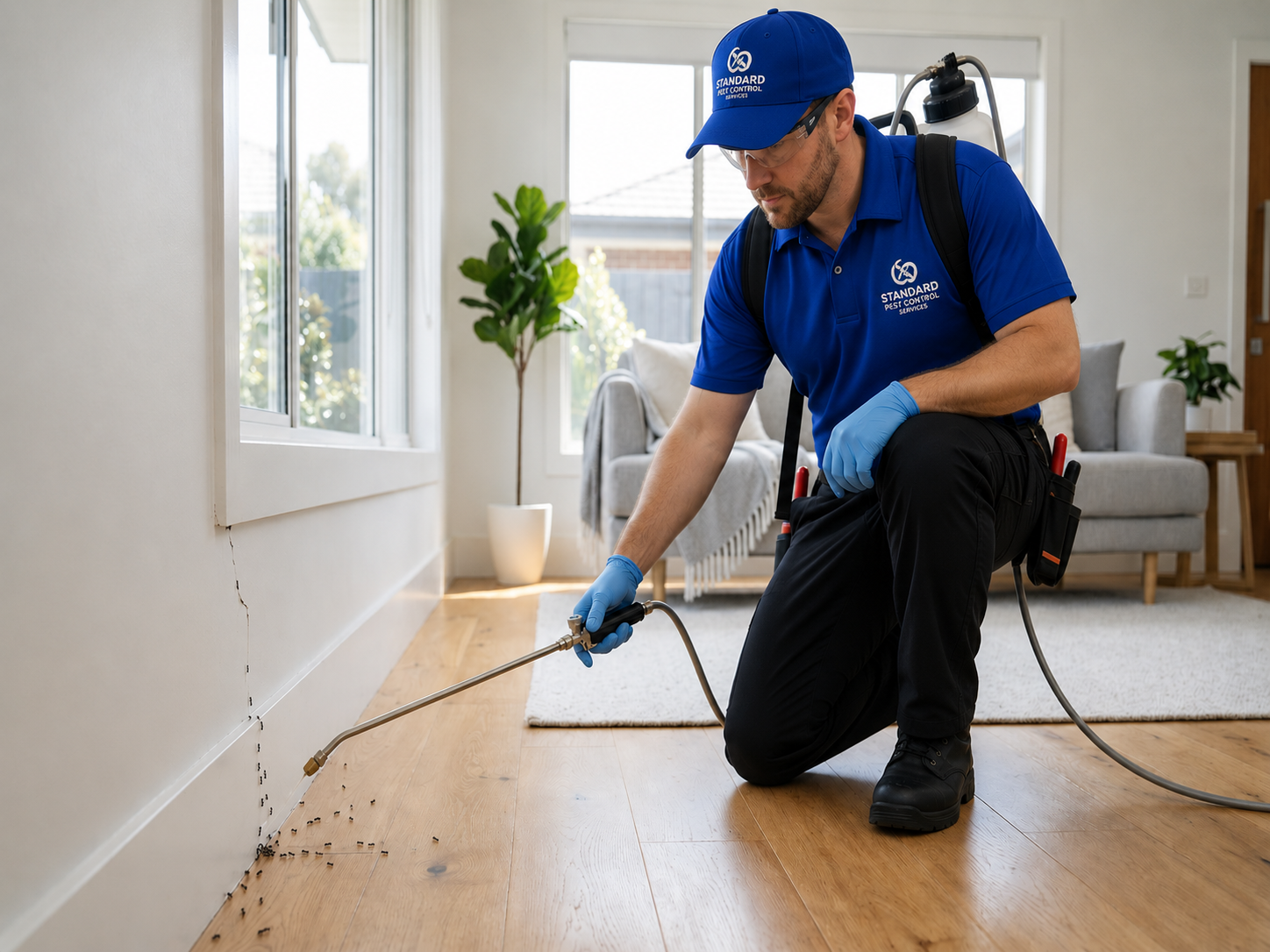
At Standard Pest Control, we provide professional Ant Control Services in Bangalore using advanced pest management techniques and targeted ant treatment solutions to eliminate ants from the source. Our trained technicians identify ant colonies, nesting areas, and entry points to provide effective and long-lasting ant control.
Our Ant Pest Control Service includes crack and crevice treatment, gel baiting, chemical spraying, and preventive pest management solutions for both indoor and outdoor areas. We treat kitchens, wall corners, cupboards, drainage areas, gardens, storage spaces, and hidden nesting locations where ants commonly breed. We offer safe treatments for homes, apartments, villas, restaurants, hotels, offices, schools, warehouses, and commercial properties across Bangalore.
Aggressive ants that deliver painful, burning bites. They nest in gardens, lawns, and soil mounds and frequently enter homes through cracks and gaps in search of food and moisture.
The most common household ant in Bangalore. They form large colonies in walls, under floors, and in kitchens. Attracted to sweet foods, grease, and moisture, they contaminate food surfaces and storage areas.
Carpenter ants tunnel through wood to build nests, weakening wooden structures, furniture, doors, and window frames. They are especially destructive in older homes and buildings in Bangalore.
Attracted to sugary foods, sweets, and crumbs. Commonly found in kitchens and pantries. They nest under floor tiles, concrete slabs, and in wall voids near warm areas and food sources.
Ants leave invisible chemical pheromone trails for others to follow. Cleaning removes the ants but not the trail. Professional gel baiting destroys the colony at the source, eliminating the trail permanently.
Carpenter ants can cause significant structural damage by tunnelling through wooden beams, door frames, and furniture. Large colonies can also weaken wall insulation and damage electrical conduit areas over time.
Colour, size, and behaviour are the quickest clues — red ants deliver painful bites, black ants swarm food, carpenter ants leave sawdust near wood. Our technicians identify the species during inspection to pick the right treatment.
If ant trails persist despite regular cleaning, you're seeing winged ants indoors, or you suspect carpenter ants in wooden structures, it's time to call in a professional treatment.
A professional ant control treatment typically provides protection for 3–6 months. Annual preventive treatments are recommended, especially before monsoon season when ant activity increases significantly across Bangalore.
Gel baits are carried back to the colony by worker ants, killing the queen and nest at the source, while sprays kill ants on contact — we combine both for faster visible results plus long-term colony elimination.
Carpenter ant treatment targets nests inside wood using injection and dust formulations that reach galleries drilled deep into structural timber, in addition to standard baiting for foraging workers.
Baits can underperform if placed away from active trails, if competing food sources are left out, or if the wrong bait type is used for the ant species — professional placement avoids these common mistakes.
For larger colonies, a follow-up visit within 2–3 weeks helps confirm the colony has been eliminated and re-treats any newly discovered nesting or entry points.
Yes. We use low-toxicity, WHO-approved ant control chemicals. Gel baits are placed in targeted locations away from children and pets. The treated area is safe to use within 2–3 hours after application.
Yes, gel baits are placed discreetly in cracks and corners away from food-contact surfaces, and any spray treatment is applied to non-food areas so your kitchen stays safe to use.
As a precaution, we recommend pregnant occupants stay out of the room during application and ventilate the space for a few hours afterward.
No, ant control treatment does not typically require vacating the property. We recommend keeping food covered and pets away from freshly treated surfaces for a few hours.
Yes, we use registered pest management products applied strictly according to label instructions and dosage guidelines by trained, licensed technicians.
Pricing depends on property size, ant species involved, and severity of infestation. Call us or request a callback for a free, transparent quote tailored to your property.
Yes, we provide a free, no-obligation quote after understanding your property size and the extent of the ant problem.
Yes, our Annual Pest Control AMC plans cover ants along with other common pests for year-round protection at a bundled cost.
Yes, commercial spaces such as restaurants and warehouses are typically larger and may need additional treatment zones, which is reflected in the quote.
Store food in sealed containers, wipe up spills promptly, seal cracks and gaps around doors and windows, and fix leaky pipes to remove the food and moisture ants are drawn to.
Natural deterrents like cinnamon, vinegar, or lemon can offer mild, short-term relief by masking pheromone trails, but they don't reach the colony itself — professional baiting is needed for lasting results.
Wiping the trail with soapy water or vinegar removes the pheromone scent temporarily, but new trails will form again unless the colony itself is treated at the source.
Sugar, grease, crumbs, and standing moisture near sinks are the biggest draws. Even small, unnoticed food residue is enough to attract scout ants and start a new trail.
Yes, especially for carpenter ants — periodic inspections catch new nesting activity in wood early, before structural damage becomes extensive.
Yes, visible ant trails in food preparation areas can violate FSSAI and municipal hygiene norms. Regular ant control is essential for restaurants, cloud kitchens, and food processing units.
Yes, we work with commercial clients to schedule treatment before opening hours, after closing, or on off-days to avoid disrupting business operations.
Areas with older buildings, gardens, or proximity to green cover tend to see more ant activity, along with neighbourhoods with dense food businesses.
Yes, heavy rain floods outdoor nests and drives ant colonies indoors seeking dry shelter and food, making ant complaints spike noticeably during Bangalore's monsoon months.
Yes, Standard Pest Control provides ant control services across Bangalore, including Whitefield, Koramangala, Indiranagar, HSR Layout, Electronic City, Jayanagar, and surrounding localities.
Common questions about ant biology, behaviour and colony control.
Ants usually enter buildings in search of food, water, shelter, warmth, or nesting sites. Kitchens, bathrooms, balconies, wall cracks and utility areas are common problem locations.
There is no single most common house ant everywhere. The dominant species varies by region and building type. Common household ants may include odorous house ants, pharaoh ants, ghost ants, crazy ants and others.
Yes. Most ant colonies have one or more queens responsible for reproduction. Some species have a single queen, while others can have multiple queens.
Ants communicate mainly through pheromones, which are chemical signals. They also use touch, vibrations and body movements.
Many ants follow a pheromone trail laid by other workers leading to food, water or the nest.
Wiping the trail with soapy water or another suitable household cleaner can help remove the pheromone trail temporarily. This does not eliminate the colony if the nest remains active.
Most household ants are mainly a nuisance, but some can bite, sting, contaminate food or damage property. The level of risk depends on the species.
Carpenter ants excavate galleries inside wood to build nests. They do not eat wood like termites, but they can weaken damp or damaged timber over time.
Colony control usually requires targeting the nest and reproductive ants, not only the visible workers. Properly selected slow-acting baits can sometimes be carried back to the colony and shared.
Baits may fail if the bait type does not match the colony’s current food preference, if competing food is available, if the bait dries out, or if the wrong product is used for the species.
Yes. Some ant species can nest inside wall cavities, electrical voids, insulation, ceilings and other concealed areas, especially when moisture is present.
Flying ants are reproductive ants, usually males and future queens, that leave mature colonies during mating flights.
Lifespan varies widely by species and caste. Workers may live from weeks to months or longer, while queens of some species can survive for several years.
Ants have periods of rest and inactivity, although these are not exactly the same as human sleep. Activity patterns vary by species and caste.
Common attractants include sugar, grease, crumbs, pet food, spills, moisture and food waste.
Yes. Some ants bite with their mandibles, while some species can also sting. Many household ants, however, are not medically significant.
Keep food sealed, clean spills, remove crumbs, fix leaks, manage garbage and seal cracks or other access points where possible.
Some strong-smelling substances may act as temporary deterrents, but they usually do not eliminate the colony or queen.
A supercolony is a very large network of interconnected nests whose workers show little aggression toward one another over a broad area.
Yes. Ants have small but functional brains and nervous systems that allow them to process chemical, visual and tactile information.
No. Ants breathe through a system of tubes called tracheae, connected to external openings called spiracles.
Some species can swim or move across water, while others can float for limited periods. Ability varies greatly by species.
No. Ants do not have ears like humans. They detect vibrations and movement through their legs, antennae and body.
Ants can carry many times their own body weight, but the exact figure varies by species, size and task. Claims such as “50 times body weight” should be treated as a broad comparison rather than a universal rule.
Ants have a circulatory fluid called hemolymph, not blood like humans.
Yes. Many ant species are highly adapted to hot, dry environments and can survive extreme desert conditions.
Yes. Ant colonies are organised into castes and behavioural roles, such as workers, soldiers, nurses, foragers, males and queens, depending on the species.
A drone is a male reproductive ant whose primary role is mating with a queen.
The number varies by species and size. It is better to say that ants have small but highly organised nervous systems, rather than using one fixed brain-cell count for all ants.
Yes. Some ants cultivate fungi, while others protect aphids and other sap-feeding insects in exchange for honeydew.
Some ant species maintain close relationships with other insects, especially aphids and scale insects. Calling them “pets” is a useful analogy, but scientifically these are mutualistic relationships.
Some ant species raid neighbouring colonies and capture brood that later works in the raiding colony. This behaviour is sometimes called dulosis or social parasitism, rather than literal slavery.
Many ants remove dead colony members and place them in refuse piles or specific disposal areas. These are sometimes compared to cemeteries, but the main purpose is colony hygiene.
They use a combination of pheromone trails, visual landmarks, sun position, step counting and environmental cues, depending on the species.
Some ants have good low-light vision, while others rely more on chemical and tactile cues. Some species have very limited eyesight.
Ants do not have teeth like mammals. They use strong mandibles for cutting, carrying, defence and food handling.
Many ants can survive falls that would injure larger animals because their small size and low mass reduce impact forces.
Ants have a dorsal vessel, including a simple heart-like structure that helps circulate hemolymph through the body.
Yes. Some species may nest in or around electrical equipment, switches, appliances and electronics, especially where warmth or protected spaces are available.
Ant predators include birds, lizards, spiders, frogs, beetles, other ants and mammals such as anteaters, depending on the region.
Yes. Some cultures traditionally consume certain ant species and their larvae. Food safety depends on the species and preparation method.
Yes. Ants can learn and remember routes, landmarks, food locations and chemical cues for varying periods.
Laboratory studies show that some ant species can navigate mazes and learn efficient routes to food.
Ant colonies can engage in organised conflicts over territory, food, nest sites and colony expansion. These can involve many workers.
Some ants are adapted to flooding. Fire ants, for example, can form floating rafts made from their own bodies to survive temporarily.
No. Ants detect odours mainly using sensory receptors on their antennae.
Some ants may survive temporarily in cool environments, but most household species prefer warmer conditions. Cold temperatures usually slow their activity.
Many ants have tiny sensory hairs called setae on their bodies that help detect touch, airflow and chemicals.
Certain parasitic fungi can infect ants and alter their behaviour in ways that help the fungus reproduce. The popular term “zombie ant” refers to this phenomenon.
Ants do not have tongues like humans. Their mouthparts include structures used for licking, sucking, chewing and manipulating food.
Yes. Ants may enter or nest in cars, particularly when food crumbs, moisture or protected spaces are available.
Some ant species show social behaviours such as grooming, wound care, removal of infected individuals or reduced contact with sick ants. These behaviours vary by species.
There is no strong consensus that ants have human-like mirror self-recognition. Some studies have reported unusual responses, but the evidence is not conclusive.
Yes. Ant legs have small claw-like structures that help them grip surfaces and climb.
Yes. Many species nest in trees, branches or leaves. Weaver ants, for example, construct nests by pulling leaves together.
Individual workers can show consistent behavioural differences, such as being more active, bold or exploratory than others. Scientists sometimes describe these as individual behavioural tendencies.
Ants do not speak, but they communicate through pheromones, vibrations, touch and body movements.
Ant legs have several joints. While they do not have knees identical to humans, their legs have articulated joints that function in a similar mechanical way.
Yes. If a colony has suitable food, moisture and nesting conditions, some ant infestations can persist for months or years without effective control.
Ant predators and competitors include spiders, birds, lizards, frogs, beetles, other ants and some mammals. Which enemies matter most depends on the species and environment.
If you are searching for the Best Ant Control Services in Bangalore, Standard Pest Control provides reliable, safe, and affordable ant management solutions for homes, apartments, offices, restaurants, and commercial properties across Bangalore. Call us today for a free inspection.