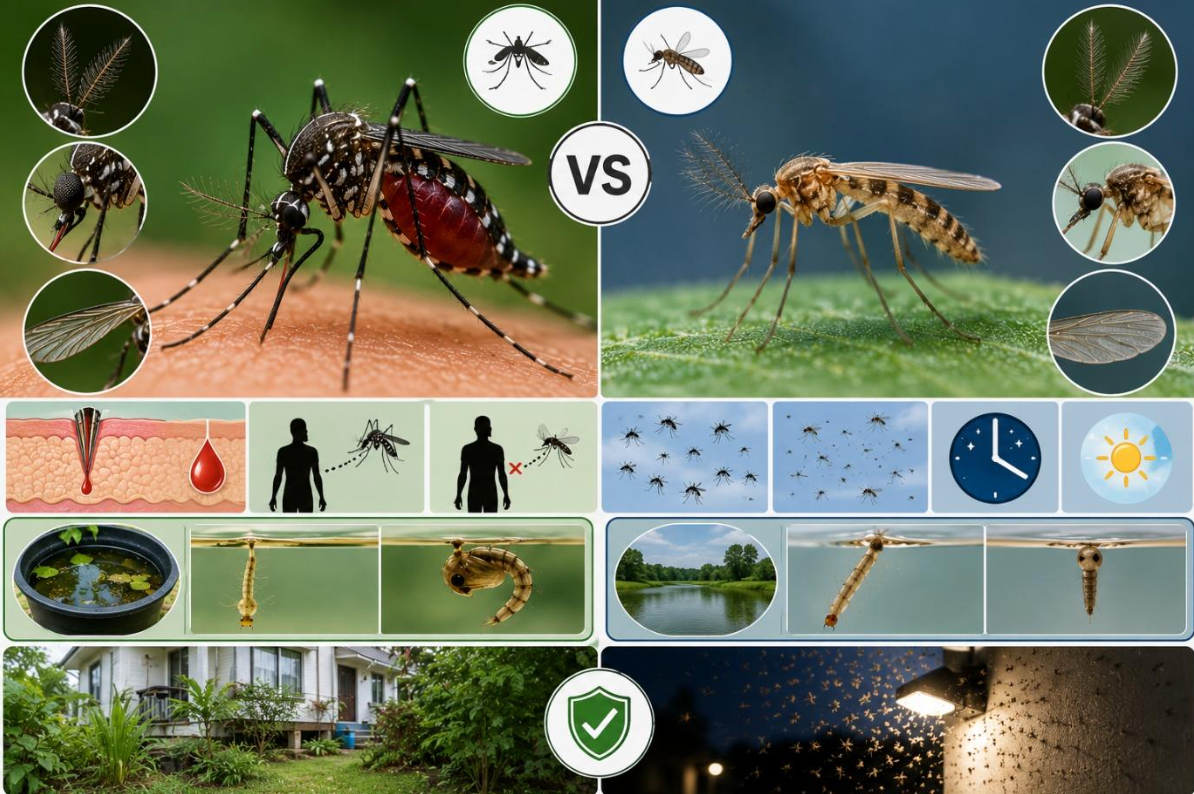
Small flying insects around your home, garden, balcony or commercial property are often immediately called "mosquitoes." But not every tiny, mosquito-like insect is actually a mosquito.
Midges and mosquitoes can look surprisingly similar, especially when viewed from a distance. However, their feeding behaviour, mouthparts, breeding habitats and importance to people can be very different.
Correct identification matters because arranging mosquito control for insects that are actually non-biting midges may not address the real source of the problem. For persistent mosquito activity in Bangalore, professional Mosquito Pest Control Bangalore should begin with inspection and identification before treatment.
What Is a Mosquito?
Mosquitoes are small flies belonging to the family Culicidae. Adult mosquitoes typically have:
- A slender body
- Long legs
- One pair of narrow wings
- A prominent proboscis
- Antennae
- Scales on the wings and body
Female mosquitoes of many species take blood meals to obtain nutrients needed for egg development. Mosquitoes are particularly important because some species can transmit pathogens responsible for diseases such as dengue, malaria, chikungunya and Japanese encephalitis. This public-health significance is one reason effective mosquito control is important.
What Are Midges?
"Midge" is a broad common name applied to several groups of small flies. One group frequently confused with mosquitoes is the family Chironomidae, commonly called non-biting midges.
Adult non-biting midges may look mosquito-like because they also have slender bodies, long legs and delicate wings. However, these midges do not take blood meals from people. They may nevertheless become a considerable nuisance when large numbers emerge around homes, apartments, lakes, ponds and outdoor lighting.
Mosquito vs. Midge: Quick Comparison
| Feature | Mosquito | Non-Biting Midge |
|---|---|---|
| Appearance | Small, slender flying insect | Often very mosquito-like |
| Long legs | Yes | Yes |
| Functional piercing proboscis | Female mosquitoes have specialized blood-feeding mouthparts | No mosquito-style blood-feeding proboscis |
| Bites humans | Females of many species do | No |
| Blood feeding | Common among females of many species | No |
| Aquatic immature stages | Yes | Yes |
| Often swarms | Can occur | Very common in some midges |
| Attracted to lights | Some mosquitoes can be | Often strongly noticeable around lights |
| Public-health significance | Some species transmit important diseases | Non-biting midges generally do not transmit mosquito-borne diseases |
This comparison applies primarily to non-biting chironomid midges. Some insects commonly called biting midges belong to different families and can bite.
How to Tell Them Apart
1. Look at the Mouthparts
One of the most important differences is the mouth area. Female mosquitoes have a conspicuous proboscis containing specialized mouthparts used for blood feeding. From the side, this can appear as a long, needle-like projection extending from the mosquito's head.
Non-biting midges do not possess the same blood-feeding apparatus. Of course, examining such tiny insects closely is not always practical without magnification, so other behavioural clues are also useful.
2. Are the Insects Actually Biting You?
This sounds obvious, but it can provide an important clue. If mosquito-like insects are gathering around lights in large numbers but nobody is being bitten, non-biting midges become one possibility worth considering.
If insects are repeatedly landing on exposed skin and blood feeding, mosquitoes or another biting insect may be involved. However, unexplained skin reactions should not be used as the only identification method.
3. Large Swarms May Point Toward Midges
Non-biting midges can sometimes form very noticeable swarms. You may see clouds of tiny insects:
- Near ponds
- Around lakes
- Above vegetation
- Near drains or water bodies
- Around buildings close to aquatic habitats
- Around outdoor lights
Mosquitoes can also occur in large numbers, so swarming alone does not provide definitive identification. But large clouds of mosquito-like insects that are not biting people are worth investigating as possible midges.
Not sure if it's mosquitoes or midges swarming around your property? Get a professional inspection before you book a fogging service.
Book Free Inspection Call Now4. Pay Attention to Outdoor Lights
One of the most common complaints associated with midges is their presence around lighting. They may gather around balcony lights, exterior wall lights, security lights, entrance lights and illuminated windows.
For homes or businesses close to lakes or other aquatic environments, this can become particularly noticeable during periods of heavy emergence. Turning off unnecessary exterior lighting or modifying lighting practices may help reduce nuisance activity, depending on the situation.
This is different from conventional mosquito control, where breeding-source management and adult mosquito reduction may be more important.
5. Antennae Can Provide Another Clue
Male mosquitoes and male midges can both have conspicuous feathery antennae, which makes identification confusing. Because these insects are small, antennae alone are not a reliable field-identification method for most homeowners.
Professional identification should consider several characteristics together rather than relying on one feature.
Mosquito and Midge Life Cycles
Both mosquitoes and many midges have aquatic immature stages. Their general development follows: Egg → Larva → Pupa → Adult.
But the environmental conditions and breeding habitats preferred by different species can vary substantially. This is important because the visible adult insects may be coming from an aquatic source some distance from where they are gathering.
Where Do Mosquitoes Breed?
Depending on species, mosquito breeding habitats can include:
- Buckets
- Plant saucers
- Water-storage containers
- Blocked drains
- Tyres
- Roof gutters
- Construction materials
- Ponds
- Other standing-water environments
Understanding the breeding source is fundamental to effective mosquito control.
Where Do Midges Come From?
Non-biting midge larvae generally develop in aquatic or semi-aquatic environments. Depending on species, they may occur in lakes, ponds, streams, reservoirs, wet sediments and other aquatic environments.
This creates an important practical difference. A homeowner may see hundreds of midge adults around an exterior light even though there is no breeding source inside the property itself. They may be emerging from a nearby water body and then being attracted toward the building.
Why Correct Identification Matters Before Pest Control
Imagine an apartment building close to a lake. Residents report hundreds of "mosquitoes" around balcony lights. A company immediately performs mosquito treatment without identifying the insects.
But if the insects are actually non-biting midges emerging from the lake, conventional mosquito control may have limited impact on the source. A better professional process is: Inspect → Identify → Locate source → Understand behaviour → Select control strategy → Monitor.
Correct identification prevents unnecessary treatment and helps customers spend money on measures appropriate to the actual pest.
Common Mosquito Types in Bangalore
Several mosquito groups are important in urban pest management.
Aedes
Aedes mosquitoes often have distinctive dark-and-pale markings. Important species can bite during daylight hours and may breed in small artificial containers — the same habits behind most dengue mosquito prevention advice.
Culex
Many Culex mosquitoes are active from evening into nighttime and some species are associated with stagnant or organically enriched water.
Anopheles
Certain Anopheles species are malaria vectors and have distinctive behavioural and resting characteristics.
Why Mosquito Identification Is Important for Mosquito Control
Even after confirming that the insects are mosquitoes, identification can provide useful clues about where to inspect. For example, finding container-breeding mosquitoes should prompt inspection of plant saucers, buckets, tyres, water storage, gutters and small rainwater collections.
Other mosquito species may direct attention toward different aquatic habitats. Professional Pest Control Services Bangalore should therefore treat pest identification as an important part of the service—not simply spray whatever insect happens to be flying.
Dealing with recurring mosquito or midge activity? Ask us about source inspection and structured mosquito-control programs.
Book Free Inspection WhatsApp UsMosquito Control Around Bangalore Homes
If mosquitoes are the problem, start by inspecting the property for water. Check the areas below — the same checklist covered in our Best Mosquito Control Tips for Apartments guide:
- Balconies — Look beneath plant pots and inside unused containers.
- Gardens — Inspect decorative pots, plant saucers and water features.
- Terraces — Check drains, buckets and items collecting rainwater.
- Roof Gutters — Remove leaves and debris preventing proper drainage.
- Water Storage — Keep appropriate containers securely covered.
- Parking Areas — Look for blocked drains and standing water.
- Construction Areas — Inspect materials and containers that can retain rainwater.
Source reduction is one of the most important parts of sustainable mosquito control.
Mosquitoes and Midges Around Bangalore Apartments
Apartment communities can experience both mosquito and midge problems. Buildings close to lakes, stormwater drains, wetlands, ponds and large landscaped areas may experience significant numbers of flying insects — a pattern we see often in community-wide mosquito control programs.
Before repeatedly fogging the property, identify what insect is actually present. For mosquitoes, inspect common areas for breeding. For non-biting midges originating from an external aquatic environment, management may need to focus more heavily on lighting, entry prevention and nuisance reduction, depending on the source.
Can Window Screens Help?
Yes. Physical exclusion can help reduce both mosquitoes and midges entering buildings. Inspect window mesh, balcony doors, ventilation openings, door gaps and damaged screens.
Repairing screens can provide an important non-chemical layer of protection. This is particularly valuable where flying insects originate outside the property.
What About Mosquito Fogging?
Fogging may form part of professional adult mosquito control in appropriate circumstances, as covered in our guides on mosquito control through spraying and fogging and safe spraying & fogging tips. However, it should not automatically be used for every small flying insect.
If insects are non-biting midges continuously emerging from a nearby water body, repeatedly treating adults around a building may provide only temporary nuisance reduction. Again, identification comes first.
Frequently Asked Questions
Are midges the same as mosquitoes?
No. They are different groups of flies, although some non-biting midges can closely resemble mosquitoes.
Do midges bite humans?
Non-biting midges in the family Chironomidae do not blood feed. However, other insects called "biting midges" can bite, so correct identification matters.
How can I quickly tell a mosquito from a non-biting midge?
Look at several clues together: the presence of a mosquito-like proboscis, biting behaviour, swarming behaviour and where the insects are gathering. Professional identification may be necessary for tiny specimens.
Why are there hundreds of mosquito-like insects around my lights?
Large numbers of non-biting midges can be attracted to outdoor lighting, particularly near aquatic habitats. Mosquitoes are another possibility, so identification is recommended.
Can mosquitoes and midges breed in water?
Yes. Both groups have aquatic immature stages, although their preferred habitats vary considerably between species.
Should I arrange mosquito control if I see midges?
Not automatically. First confirm what insect is present and identify its source. The appropriate management strategy can differ significantly.
How can I reduce mosquitoes around my home?
Remove unnecessary standing water, maintain drains and gutters, cover suitable water-storage containers, use screens and consider professional mosquito control when activity remains high.
Mosquito or Midge? Identify Before You Treat
When hundreds of tiny flying insects appear around a home or business, the natural reaction is: "We have mosquitoes—we need mosquito treatment." But good pest management begins one step earlier: what insect is it?
Mosquitoes and non-biting midges may look similar, but their behaviour and management can be very different. If mosquitoes are confirmed, effective mosquito control should focus on breeding-source reduction, environmental management, exclusion, monitoring and appropriate professional treatment. If the insects are midges, finding the aquatic source and understanding why adults are gathering around the property may be more important than conventional mosquito treatment.
For professional assistance, visit Mosquito Pest Control Bangalore or explore Standard Pest Control for residential and commercial pest-management services in Bangalore.
Related reading: Mosquito Control Bangalore Guide: Effective Dengue Mosquito Prevention Methods | Best Mosquito Control Tips for Apartments | Reclaiming Your Outdoors: Mosquito Control Through Spraying and Fogging | Community-Wide Mosquito Control Programs | The Future of Mosquito Control: Innovations and Challenges | The Anatomy of a Mosquito: What Makes Them Such Effective Biters? | How to Identify a Mosquito Bite vs. Other Insect Bites | Understanding the Mosquito Life Cycle: From Egg to Adult | Common Mosquito Species in Bangalore: A Visual Guide to Identification and Control | Understanding Professional Mosquito Treatment Options: Barrier Sprays, Larvicides & More