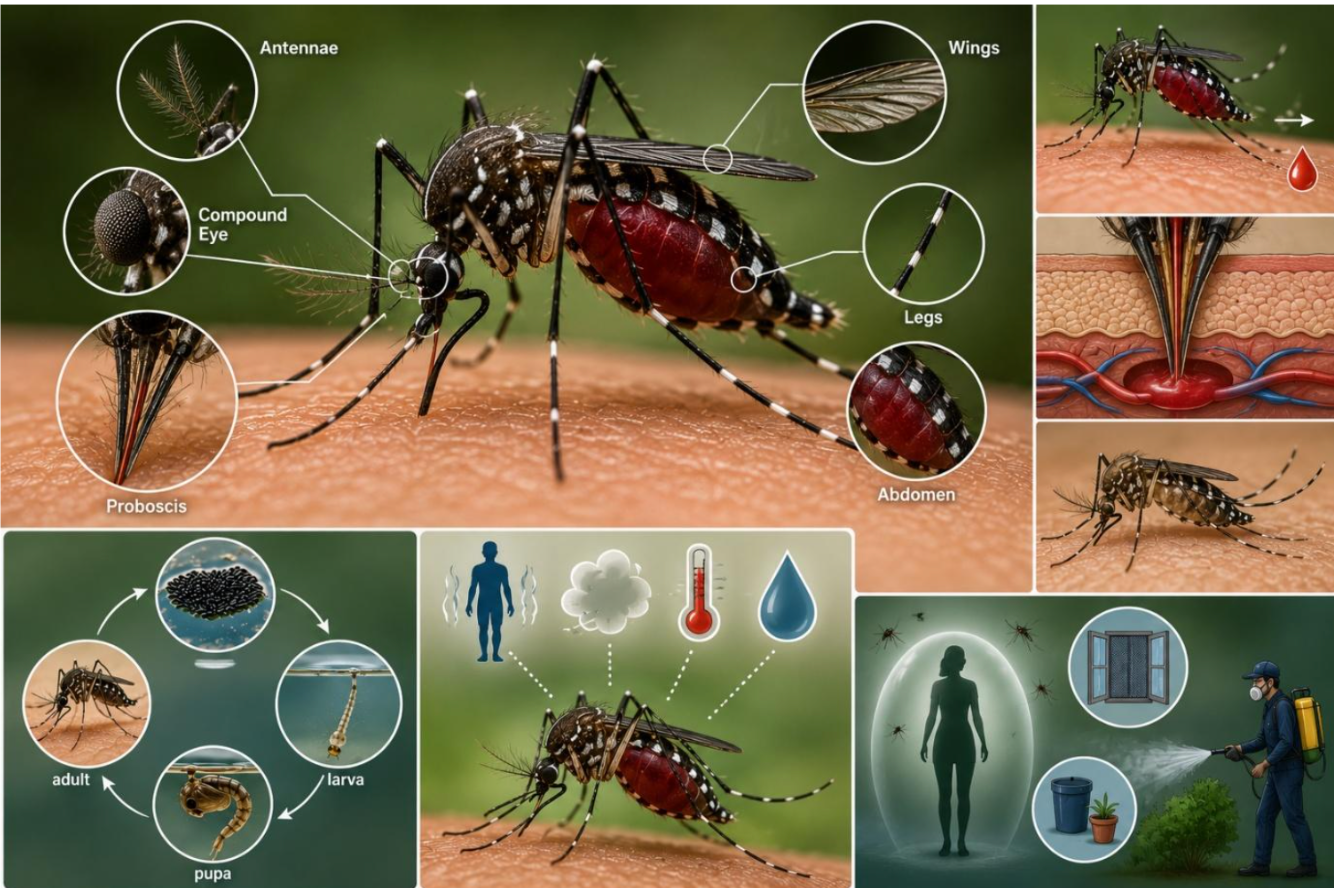
Mosquitoes may look like simple, delicate insects, but their bodies are highly specialized for finding hosts, feeding, flying and reproducing. Their sensory organs can detect cues associated with potential hosts, while the female mosquito's mouthparts are adapted to pierce skin and obtain a blood meal.
Understanding mosquito anatomy helps explain why these insects can be difficult to avoid—and why effective mosquito control needs to address more than the mosquitoes you see flying around your home.
For recurring mosquito problems, professional Mosquito Control Bangalore should include inspection, breeding-source identification, prevention and appropriate treatment.
Understanding the Basic Anatomy of a Mosquito
An adult mosquito's body consists of three main sections: Head → Thorax → Abdomen. Each section performs different functions.
The head contains the eyes, antennae and mouthparts. The thorax supports the wings and legs and contains the muscles responsible for movement. The abdomen contains much of the digestive and reproductive systems.
Together, these structures make mosquitoes remarkably effective at locating hosts and surviving in different environments.
10 Anatomical Features That Make Mosquitoes Effective Biters
1. The Mosquito Head: A Sophisticated Sensory Centre
The mosquito's head contains much of the equipment it uses to interact with its environment. Important structures include:
- Compound eyes
- Antennae
- Palps
- Proboscis
- Sensory receptors
These structures help mosquitoes detect environmental cues and locate suitable hosts, food sources and breeding environments. This sophisticated sensory system is one reason mosquito control cannot rely solely on trying to swat individual mosquitoes.
2. Compound Eyes Help Mosquitoes Detect Movement
Mosquitoes have large compound eyes made up of many individual visual units. Their vision contributes to detecting movement, contrast and environmental features.
Visual cues work alongside other sensory information when mosquitoes navigate their surroundings. This means a mosquito does not depend on a single sense when looking for a host.
3. Mosquito Antennae Are Powerful Sensory Organs
The antennae are among the mosquito's most important sensory structures. They help mosquitoes detect various chemical and environmental cues.
Female mosquitoes can use sensory information associated with carbon dioxide, body odours, heat, moisture and visual cues to help locate potential hosts. This combination makes mosquitoes effective at finding people even in complex environments.
4. Carbon Dioxide Helps Mosquitoes Locate Hosts
Humans and animals release carbon dioxide when they breathe. Mosquitoes can detect changes in carbon dioxide concentration and use this information as one of several cues when searching for hosts.
Once they move closer, additional cues such as body odour, warmth and visual information become increasingly important. This explains why simply switching off a light does not necessarily prevent mosquitoes from finding you.
5. The Proboscis: The Mosquito's Feeding Apparatus
One of the mosquito's most remarkable anatomical features is its proboscis. To the naked eye, it looks like a single needle-like structure.
In reality, the female mosquito's feeding apparatus contains several specialized mouthparts working together. The outer structure helps support and guide the internal piercing components during feeding. This complex arrangement allows a female mosquito to pierce the skin and locate blood vessels.
6. Why Do Female Mosquitoes Bite?
Both male and female mosquitoes obtain energy from plant sugars such as nectar. However, females of many mosquito species also take blood meals because nutrients obtained from blood support egg development. Male mosquitoes do not take blood meals.
This is why the mosquito biting your arm is female. After obtaining a suitable blood meal, the female can eventually develop eggs and search for an appropriate egg-laying location. Effective mosquito control therefore also aims to interrupt this reproductive cycle.
7. Why Does a Mosquito Bite Itch?
During feeding, a mosquito introduces saliva containing substances that help facilitate blood feeding. Your immune system can react to components in that saliva. The resulting reaction may cause:
- Itching
- Redness
- Swelling
- A raised bump
Different people can react differently. Some develop very small marks, while others experience more noticeable local swelling. The appearance of a skin reaction alone, however, cannot always confirm that a mosquito caused it.
8. Six Long Legs Help Mosquitoes Land and Move
Like all insects, mosquitoes have six legs. Their long, lightweight legs help them land on surfaces—including human skin—and move efficiently. The legs also contain sensory structures that help mosquitoes interact with their surroundings.
Different mosquito species can also have distinctive leg markings. For example, many Aedes mosquitoes have noticeable black-and-white banding.
9. Mosquito Wings and Flight
Mosquitoes have one functional pair of wings. Behind them are small structures called halteres, which help with balance and flight control. This lightweight flying system allows mosquitoes to:
- Move between resting and feeding locations
- Enter buildings
- Search for hosts
- Locate breeding sites
- Navigate vegetation
Some mosquitoes may originate from breeding sites on the same property, while others can arrive from surrounding areas. That is why professional Pest Control Services Bangalore should consider both the building and its surroundings.
10. The Abdomen Expands During Blood Feeding
The mosquito's abdomen contains important digestive and reproductive organs. When a female mosquito takes a blood meal, the abdomen can expand considerably.
The nutrients obtained from the meal can then contribute to egg development. After the eggs develop, the female searches for a suitable egg-laying environment. If standing water is available nearby, the mosquito life cycle can continue.
Want to know exactly where your mosquitoes are breeding? Get a professional inspection that looks at the source, not just the adults you can see.
Book Free Inspection Call NowFrom Bite to Breeding: Understanding the Complete Cycle
Mosquito anatomy makes more sense when considered alongside the life cycle: Egg → Larva → Pupa → Adult → Blood Feeding → Egg Development → Egg Laying.
The immature larval and pupal stages occur in water. This creates one of the most important opportunities for mosquito control: stop mosquitoes before they become adults. Removing unnecessary standing water can interrupt breeding before another generation of mosquitoes begins biting.
Why Mosquitoes Are So Good at Finding Humans
Mosquitoes do not rely on one single signal. They integrate several environmental cues.
Carbon Dioxide
Breathing provides a useful long-range host cue.
Body Odour
Chemical compounds associated with skin and sweat can influence mosquito attraction.
Heat
Body warmth can help mosquitoes identify suitable landing and feeding locations at closer range.
Moisture
Humidity and moisture around the body can provide additional information.
Visual Cues
Contrast and movement can also contribute to host location. Combined, these systems create a highly effective host-finding mechanism.
Aedes, Culex and Anopheles: Different Mosquitoes, Different Behaviours
Although adult mosquitoes share the same basic anatomy, different mosquito groups can behave differently.
Aedes
Often recognized by contrasting black-and-white markings. Important Aedes species may bite during daylight hours and frequently use container habitats for breeding — the same species behind most dengue mosquito prevention advice.
Culex
Many appear comparatively brownish and are often active during evening and nighttime periods. Some species use stagnant or organically enriched water.
Anopheles
Certain Anopheles species transmit malaria. Many have a distinctive angled resting posture.
These differences matter because successful mosquito control should consider which mosquito is present and where it is likely to breed. Not every mosquito-like insect is a mosquito at all — see Mosquitoes vs. Midges: Telling the Difference if large numbers are gathering around your lights. For professional assistance, visit Mosquito Pest Control Bangalore.
Why Killing Adult Mosquitoes Alone Isn't Enough
Imagine that you eliminate most of the adult mosquitoes around your garden tonight. But nearby there is:
- A bucket containing water
- A blocked gutter
- A plant saucer
- An unused tyre
- A water-filled container
Larvae may already be developing in those locations. New adult mosquitoes can then emerge and the problem returns. This is why modern mosquito control combines adult control with breeding-source management.
Dealing with recurring mosquito bites at home or work? Ask us about a structured mosquito-control program for your property.
Book Free Inspection WhatsApp UsThe Role of Source Reduction in Mosquito Control
Inspect your property regularly for water accumulation. Pay particular attention to:
- Plant saucers
- Buckets
- Roof gutters
- Bird baths
- Open containers
- Tyres
- Drains
- Tarpaulin folds
- Construction materials
- Decorative water features
- Water-storage areas
Remove unnecessary standing water and maintain water-holding features appropriately. During Bangalore's rainy periods, repeat inspections after rainfall.
Mosquito Control for Bangalore Homes
Mosquitoes around individual homes can originate from gardens, terraces, neighbouring properties, drains or small containers. A practical home mosquito control program should include: Inspection → Standing-water reduction → Drain maintenance → Screens → Environmental management → Appropriate treatment → Monitoring.
Door and window screens can also help reduce adult mosquito entry — the same source-reduction checklist covered in our Best Mosquito Control Tips for Apartments guide.
Mosquito Control for Apartments
Apartment complexes require a broader approach because breeding sources may be located in common areas. Inspect:
- Basement drains
- Terrace areas
- Gardens
- Utility areas
- Parking spaces
- Stormwater drains
- Plant containers
- Construction areas
Apartment associations can benefit from coordinated mosquito control rather than responding only to individual flat complaints, as covered in our guide to community-wide mosquito control programs.
Mosquito Control for Commercial Properties
Hotels, hospitals, restaurants, offices, factories and schools may require structured mosquito-management programs. Professional programs can include:
- Site inspection
- Mosquito activity assessment
- Breeding-source identification
- Environmental recommendations
- Appropriate treatment
- Monitoring
- Follow-up
Businesses can explore Professional Pest Control Services Bangalore for broader commercial pest-management solutions.
Frequently Asked Questions
Why do mosquitoes bite humans?
Female mosquitoes of many species take blood meals to obtain nutrients required for egg development.
Do male mosquitoes bite?
No. Male mosquitoes do not take blood meals; they obtain energy primarily from plant sugars.
What part of a mosquito bites you?
The female mosquito uses specialized mouthparts contained within its proboscis to pierce the skin and obtain blood.
How does a mosquito find me?
Mosquitoes combine several cues, including carbon dioxide, body odours, heat, moisture and visual information.
Why does a mosquito bite become itchy?
The immune system reacts to components of mosquito saliva introduced during feeding, which can cause itching, redness and swelling.
Can mosquitoes breed inside a house?
Suitable water-holding locations in or around buildings can support mosquito development, depending on the mosquito species and conditions.
Is fogging enough for mosquito control?
Fogging can target exposed adult mosquitoes when appropriately used, but it does not replace breeding-source management.
What is the best way to control mosquitoes?
Effective mosquito control generally combines source reduction, environmental management, exclusion, monitoring and appropriate professional treatment when necessary.
Understanding the Mosquito Helps Us Control It
A mosquito's effectiveness comes from a combination of specialized anatomy and behaviour. Its antennae and other sensory structures help locate hosts, its wings provide mobility, its specialized mouthparts enable blood feeding, and its reproductive biology allows populations to develop wherever suitable breeding habitats are available.
Understanding these features changes the way we approach mosquito control. Instead of concentrating only on the mosquito flying around your bedroom, ask: Where did it come from? Where is it breeding? How is it entering the property?
Addressing those questions can provide a much stronger foundation for long-term mosquito management. For professional Mosquito Control Bangalore, visit Standard Pest Control's Mosquito Pest Control Bangalore page.
Related reading: Mosquitoes vs. Midges: Telling the Difference | Dengue Mosquito Prevention Methods | Best Mosquito Control Tips for Apartments | Community-Wide Mosquito Control Programs: What They Involve and Why They Matter | Reclaiming Your Outdoors: Understanding Mosquito Control Through Spraying and Fogging | How to Identify a Mosquito Bite vs. Other Insect Bites | Understanding the Mosquito Life Cycle: From Egg to Adult | Common Mosquito Species in Bangalore: A Visual Guide to Identification and Control