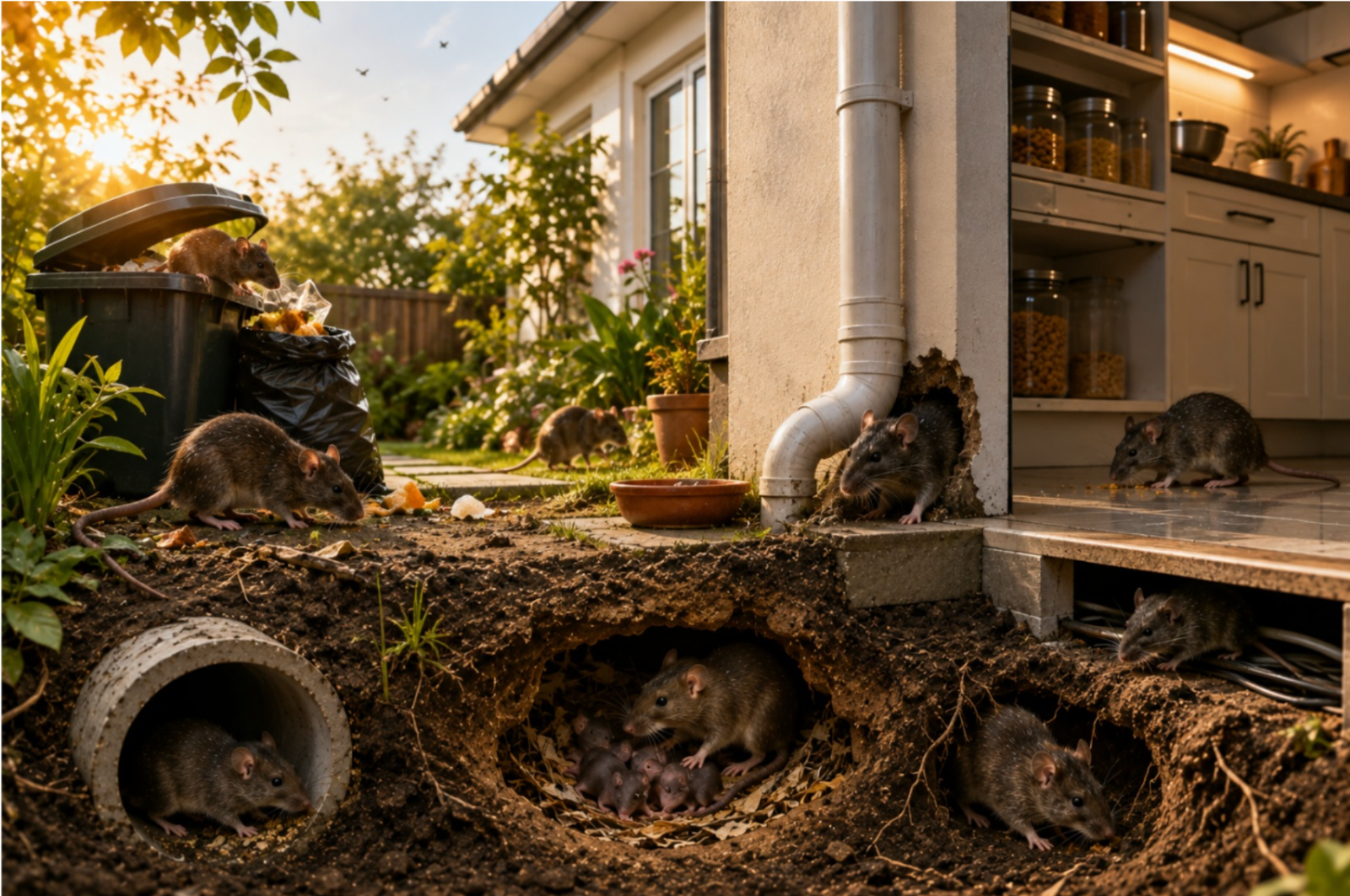
Summer brings warmer temperatures, longer days and increased outdoor activity. Gardens grow, food waste can accumulate faster, outdoor dining increases, and water becomes an important resource for wildlife.
These conditions can also influence rats and mice. While cooler weather may encourage rodents to seek protected indoor shelter, warmer conditions can increase activity around gardens, drains, garbage areas, food businesses, construction sites and other outdoor environments. Summer can also provide favourable conditions for rodent reproduction when sufficient food, water and shelter are available.
For homeowners and businesses in Bangalore, this means rodent prevention shouldn't stop simply because the weather becomes warmer. Rodents may be outside — but they can still be surprisingly close to your building. Understanding summer rodent activity, breeding behaviour and outdoor harbourages can help prevent outdoor populations from becoming indoor infestations.
Are Rodents More Active During Summer?
Rats and mice can remain active throughout the year. Their behaviour changes according to temperature, food availability, water, shelter, breeding opportunities, human activity and other environmental conditions.
During warmer periods, rodents may spend more time moving through outdoor environments where food and shelter are available. Common locations include gardens, drains, garbage areas, storage yards, markets, construction sites, restaurants, landscaping and vacant properties.
Summer doesn't eliminate rodents. It can simply change where you are most likely to encounter them.
Summer Can Mean More Outdoor Rodent Activity
During favourable weather, rats and mice may explore wider outdoor areas. They may travel between shelter, food, water and a nesting site in a single circuit. For example, a rat could shelter near a drain, feed around a garbage area and then move through vegetation toward a nearby building.
This is why rodent management should consider the entire property rather than only indoor rooms.
Rodent Breeding During Warm Weather
Rodents can reproduce rapidly when environmental conditions are favourable. Adequate food, water and shelter together can support breeding populations. House mice and common pest rats are capable of producing multiple litters under suitable conditions.
This means a small population can potentially become much larger if it remains unnoticed and has continuous access to resources. Summer prevention should therefore focus on reducing the conditions that allow rodent populations to thrive.
Noticed more rodent activity around your garden or garbage area this summer? Get a free inspection before it moves indoors.
Book Free Inspection Call NowWhy Food Availability Matters
Rodent populations are strongly influenced by access to food. Summer may create additional outdoor food opportunities, including outdoor dining waste, garbage, fallen fruit, pet food, bird feed, restaurant waste, market waste, compost and food spills.
A reliable food source can encourage rodents to remain in one area. Removing accessible food is therefore one of the foundations of rodent prevention.
Garbage Areas Become Important Hotspots
Garbage management deserves particular attention during warmer periods. Rodents can be attracted to open bins, overflowing garbage, food waste, torn garbage bags, restaurant waste and apartment waste rooms.
A garbage area may provide both food and shelter. For apartment communities and businesses, these areas should be included in routine pest-management inspections — see our detailed guide on rodent control for apartment garbage areas for a room-by-room checklist.
Keep Garbage Bins Properly Managed
Where practical: use suitable covered bins, avoid overflowing waste, clean food spills, remove waste regularly, keep surrounding areas clean, and inspect for rodent droppings and burrows.
If rats repeatedly appear around a waste area, simply placing traps indoors will not address the complete problem. The external food source also needs attention.
Water Becomes Especially Important During Hot Weather
Rodents need access to water, although requirements vary between species and diets. During hot and dry periods, dependable water sources can become particularly attractive — leaking outdoor taps, drainage areas, standing water, pet bowls, irrigation systems, AC drainage and open containers.
Repair leaks and remove unnecessary standing water where practical. Reducing water availability can make an environment less supportive of rodent activity — and it has a second benefit: leftover standing water is also a common breeding site for mosquitoes, so addressing it helps with more than one pest at once.
Gardens Can Provide Excellent Rodent Shelter
A beautiful garden can unintentionally provide rodents with hiding opportunities. Dense vegetation may create shade, shelter and concealed movement. Inspect thick shrubs, ground cover, wood piles, compost, stored garden materials and areas underneath outdoor structures.
The objective isn't to remove all vegetation. It is to prevent landscaping from becoming an undisturbed rodent harbourage — see our full guide on landscaping for rodent prevention for a plant-by-plant breakdown.
Trim Vegetation Near Buildings
Vegetation touching walls or roofs can create movement routes for climbing rodents. Where appropriate: trim branches touching roofs, reduce dense vegetation against walls, maintain landscaping, and remove unnecessary debris.
This is particularly important when roof rats are present. Roof rats are capable climbers and may access upper building areas using nearby structures and vegetation.
Fallen Fruit Can Attract Rodents
Fruit trees can create an easily overlooked food source. Mangoes, guavas and other fallen fruit left on the ground may attract various animals, including rodents. Regularly collect fallen fruit and don't allow decomposing fruit to accumulate underneath trees.
Pet Food Is Rodent Food Too
Outdoor pet feeding can unintentionally provide a dependable food source. If pets are fed outside: remove leftovers, clean feeding areas, store food securely, and avoid leaving bowls full overnight.
Rodents do not care whether food was intended for them. Accessible calories are simply an opportunity.
Bird Feeders Can Also Attract Rodents
Bird feeding can be enjoyable, but spilled seeds may accumulate underneath feeders. These seeds can attract mice and rats. If you use bird feeders: clean spilled seed, avoid excessive feeding, store feed securely, and inspect underneath the feeding area.
The objective is to feed birds without unintentionally creating a rodent feeding station.
Not sure which outdoor spot is drawing rodents in? Our technicians can map the activity for you.
Book Free Inspection WhatsApp UsDrains and Rodent Activity
Drains can provide rodents with protected movement routes and access to food and water. Norway rats in particular are often associated with lower-level environments, drainage systems and burrows.
Look for signs around drains such as droppings, burrows, gnawing, repeated sightings and damaged drain covers. Damaged infrastructure should be repaired appropriately.
Construction Sites Can Disturb Rodents
Summer construction and redevelopment can change rodent behaviour. Excavation, demolition or clearing vegetation may disturb existing harbourages. Rodents may then move toward neighbouring properties looking for new shelter, food and water. If major construction begins beside your home or business, increased rodent monitoring can be worthwhile.
Vacant Properties Can Become Rodent Harbourages
Unused buildings and vacant plots may provide vegetation, garbage, shelter, burrows and undisturbed nesting locations. Rodents from these areas may explore surrounding properties. Neighbourhood-level environmental conditions can therefore influence rodent activity even when your own property is clean.
Summer Rodent Activity By Property Type
How you check for summer rodent activity should reflect what kind of property you're managing.
Apartments
Apartment communities provide multiple outdoor rodent opportunities. Inspect garbage rooms, basements, parking areas, gardens, drains, utility shafts and food-waste areas. Rodents may move from external harbourages into the building through service infrastructure. Good apartment rodent control therefore requires attention to both common areas and individual flats.
Villas and Independent Houses
Villas and independent homes usually have larger external areas requiring inspection. Check the garden, compound, drain, garbage, utility area, roofline and building exterior in sequence, paying particular attention to areas where food, water and shelter occur together.
Restaurants
Restaurants can experience strong rodent pressure because food is constantly available. External areas are particularly important — inspect garbage storage, delivery areas, back doors, drains, food-storage areas, loading zones and landscaping. Rodent control should begin outside the kitchen whenever external activity is contributing to the infestation. Outdoor dining areas generate crumbs, spills, waste and beverage residue and should be cleaned thoroughly after service; even small amounts of food left overnight can support pest activity.
Warehouses and Industrial Properties
Large industrial sites can contain many rodent harbourages, including pallet storage, scrap areas, loading bays, landscaping, drainage, waste zones and perimeter walls. A professional rodent-management program should include perimeter monitoring rather than focusing only on indoor rooms.
Signs of Summer Rodent Activity
Look for the following around the property, not only indoors:
- Burrows: holes in soil around buildings, drains or vegetation may indicate rodent activity.
- Droppings: fresh droppings indicate recent movement.
- Gnaw marks: check bins, doors, packaging and utility materials.
- Rodent pathways: repeated movement may create visible tracks through vegetation or along walls.
- Grease marks: frequently used routes can sometimes develop dark rub marks.
- Night-time sightings: rats are often easier to observe after dark.
- Damaged food or garbage bags: gnawed packaging is a strong warning sign.
See our full guide on signs of rodent infestation for detail on each of these.
Night vs Daytime Rodent Sightings
Many common pest rodents are primarily nocturnal. They may emerge when human activity decreases, buildings become quiet, food waste is available, or outdoor areas are less disturbed. Seeing a rat running across a garden or garbage area at night may indicate nearby harbourage, and repeated sightings deserve investigation.
A daytime rat sighting does not automatically prove a severe infestation — rodents can appear during daylight for several reasons. However, repeated daytime activity may justify closer inspection, particularly when combined with fresh droppings, burrows, food damage or multiple sightings. Evidence should be considered together.
Summer Rodent Prevention Starts At The Perimeter
Instead of waiting until rats enter your kitchen, create layers of prevention: neighbourhood, property perimeter, building exterior, then interior. The further away from the kitchen you identify rodent activity, the easier it may be to prevent an indoor infestation.
Seal Building Entry Points
Even when rodents spend more time outside, buildings remain attractive sources of shelter. Inspect door gaps, pipe openings, cable penetrations, vent openings, wall damage and roof gaps. Appropriate structural proofing reduces the chance of outdoor rodents becoming indoor pests — see our detailed guide on rodent exclusion and on how small a hole a rodent can squeeze through for exact gap sizes to check.
Don't Forget The Roof
Roof rats can climb. Inspect tree branches, cables, pipes, roof edges and upper-level openings. Rodent proofing should therefore look up as well as down.
Remove Outdoor Clutter
Rodents prefer protected environments. Reduce unnecessary cardboard, wood piles, scrap materials, old furniture, packaging and stored debris. Keep storage organized and, where practical, away from building walls.
Found droppings, a burrow or gnaw marks around your property? Get it assessed before the population grows.
Book Free Inspection Call NowProfessional Monitoring vs Random Poisoning
Large properties and commercial sites benefit from systematic monitoring. Professional programs may use appropriately placed monitoring devices, mechanical traps and secured bait stations where suitable, to understand where rodents are moving, when activity occurs, and whether the population is increasing or decreasing. Monitoring turns rodent control into a measurable process.
Seeing a rat and placing poison nearby may appear to solve the immediate problem. But ask: where did the rat come from? If the property still contains garbage, water, shelter and entry points, another rodent may replace it. Rodenticides also require careful handling to reduce risks to children, pets and non-target animals — see our guide on the dangers of secondary rodenticide poisoning. Long-term rodent management requires more than poison.
Integrated Pest Management For Summer Rodents
Integrated Pest Management (IPM) combines several strategies:
- Inspection — locate outdoor and indoor rodent activity.
- Sanitation — remove accessible food.
- Water management — repair leaks and reduce unnecessary standing water.
- Habitat modification — reduce vegetation and clutter harbourages.
- Control — use appropriate rodent-management methods.
- Exclusion — block suitable entry points.
- Monitoring — track continuing activity.
The goal is to make the environment less attractive and less accessible to rodents — see our guide on sanitation and rodent control for more on removing food and water sources.
Summer Rodent Prevention Checklist
Use this quick checklist around your property.
Garden
- ☐ Trim dense vegetation
- ☐ Collect fallen fruit
- ☐ Remove unnecessary debris
- ☐ Inspect for burrows
- ☐ Keep branches away from roofs
Food
- ☐ Remove outdoor food waste
- ☐ Store pet food securely
- ☐ Clean outdoor dining areas
- ☐ Clean spilled bird seed
Garbage
- ☐ Keep bins appropriately covered
- ☐ Avoid overflowing waste
- ☐ Clean spilled garbage
- ☐ Inspect waste areas regularly
Water
- ☐ Repair leaking taps
- ☐ Check drainage
- ☐ Remove unnecessary standing water
- ☐ Check irrigation leaks
Building
- ☐ Inspect door gaps
- ☐ Check pipe openings
- ☐ Inspect utility penetrations
- ☐ Check roofline access
- ☐ Repair structural damage
Monitoring
- ☐ Look for fresh droppings
- ☐ Check for burrows
- ☐ Record sightings
- ☐ Look for gnaw marks
- ☐ Inspect outdoor activity at night
Professional Rodent Control In Bangalore
Standard Pest Control provides professional rodent control services in Bangalore for residential and commercial properties, suitable for apartments, villas, independent houses, restaurants, hotels, hospitals, offices, warehouses, factories and commercial kitchens.
Our approach focuses on inspection, identification, activity mapping, control, proofing and monitoring. Summer rodent management should not begin only after a rat enters the building. The better strategy is to identify outdoor activity and prevent rodents from reaching the interior.
Frequently Asked Questions
Are rats more active outdoors during summer?
Rodents can be active throughout the year, but warmer weather and outdoor food, water and shelter can support increased outdoor movement in some environments.
Do rats breed more during summer?
Rats can reproduce throughout the year when conditions are favourable. Abundant food, water and shelter can support successful breeding and population growth during warm periods.
Where do rats hide during hot weather?
Rodents may shelter in burrows, drains, dense vegetation, garbage areas, storage spaces and other cool or protected locations.
Does hot weather kill rats?
Normal summer temperatures do not eliminate rat populations. Rodents adapt by seeking shade, water and protected harbourages.
What attracts rats to gardens?
Fallen fruit, pet food, bird seed, garbage, water, dense vegetation, compost and sheltered areas can all contribute to rodent activity.
Can rats enter homes during summer?
Yes. Even if rodents are active outdoors, buildings still provide food, water and shelter. Openings in the structure can allow them indoors.
Why am I seeing rats around my garbage bins?
Food waste provides an attractive and reliable food source. Poorly managed garbage can support rodent populations.
Should I put rat poison in my garden?
Rodenticides can create risks to children, pets and non-target wildlife if used incorrectly. Professional assessment is recommended when rodent activity is persistent or significant.
How can I prevent summer rodent infestations?
Manage garbage, secure food, remove outdoor clutter, trim vegetation, repair leaks, inspect drains, seal building entry points and monitor for fresh activity.
When should I call professional rodent control?
Consider professional inspection if you repeatedly see rodents, discover burrows or fresh droppings, notice gnaw damage, or continue experiencing activity despite improving sanitation and proofing.
Final Takeaway: Summer Rodent Control Starts Outside
Summer can create excellent opportunities for rats and mice. Gardens provide shelter. Garbage provides food. Leaks provide water. Vegetation provides hidden pathways. And nearby buildings provide additional shelter.
The solution is not to wait until rodents enter your kitchen. Start outside: remove food, reduce water, manage vegetation, control garbage, inspect burrows, monitor activity, and seal entry points.
Summer rodent prevention is about making your property less attractive before rodents establish themselves — because the rat you see running across the garden tonight could become the rat you hear inside your ceiling tomorrow. For persistent rodent activity, Standard Pest Control provides pest-management services for homes and businesses across Bangalore.
Related reading: Rodents in Spring: Emerging From Winter Hiding Spots | Winter Rodent Invasions: Why Rats and Mice Seek Shelter Indoors | Apartment Rodent Control: Garbage Areas | Landscaping for Rodent Prevention | Sanitation and Rodent Control: Eliminating Food and Water Sources | Rodent Exclusion: Sealing Entry Points to Keep Pests Out | Signs of Rodent Infestation You Should Never Ignore