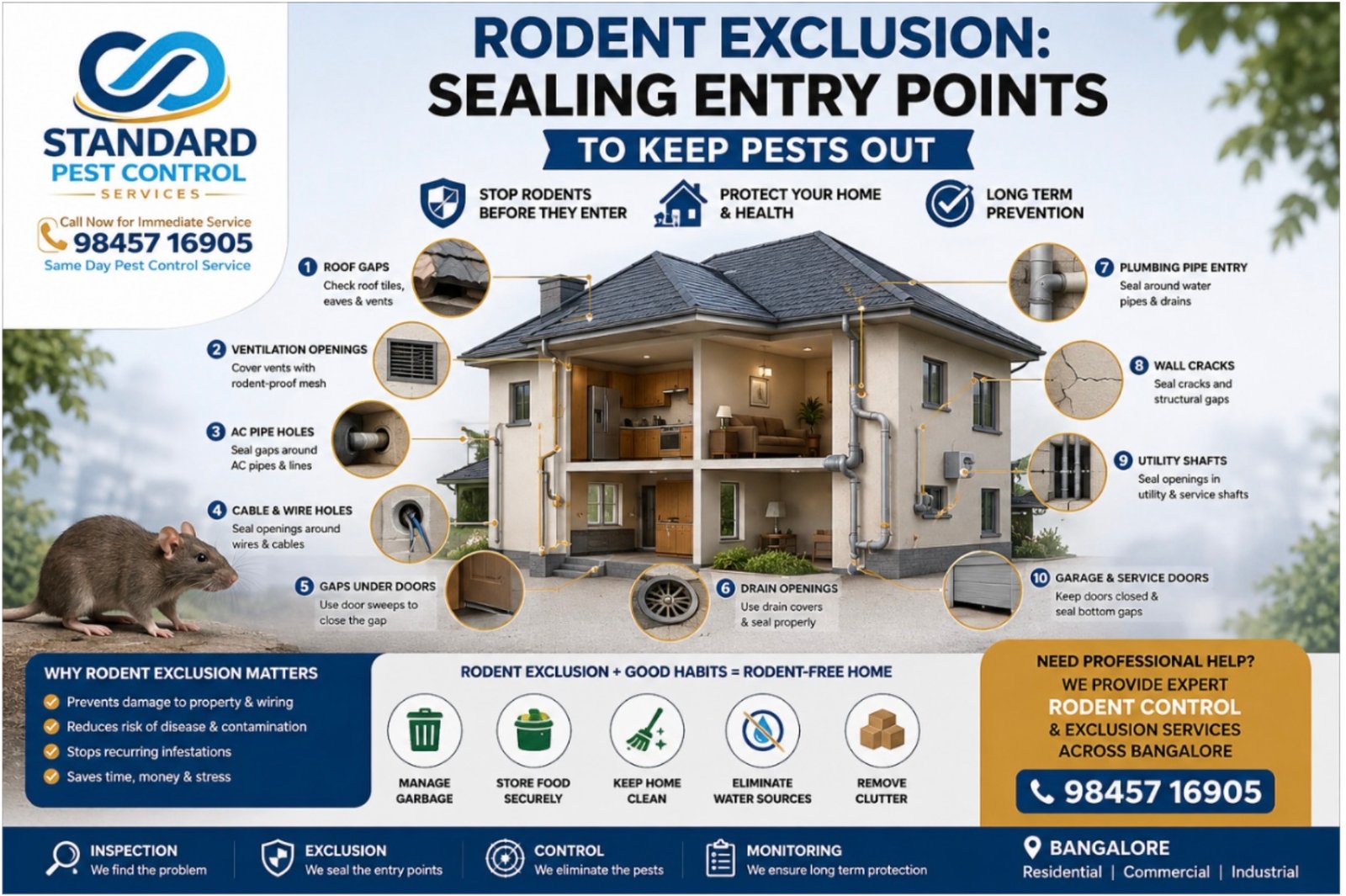
Rats and mice don't necessarily enter a property because it is dirty. In many cases, they enter because the building gives them an opportunity.
A small gap around a pipe, an opening below a door, a damaged vent or an unprotected utility penetration can provide rodents with a potential route indoors.
This is where rodent exclusion becomes important.
Rodent exclusion is the process of identifying and closing potential entry points to help prevent rats and mice from entering a building. Instead of focusing only on eliminating rodents already inside, exclusion addresses one of the underlying causes of recurring infestations: access.
For homes and businesses dealing with repeated rodent activity, combining professional rodent control in Bangalore with proper exclusion can provide a stronger long-term pest-management strategy.
What Is Rodent Exclusion?
Rodent exclusion means physically preventing rats and mice from gaining access to a property. The process typically involves inspecting the property, identifying entry points, sealing them, and monitoring for continued activity.
A detailed inspection is carried out to locate possible rodent entry points. Suitable materials and structural modifications can then be used to close accessible openings. Exclusion may include sealing or protecting:
- Wall gaps
- Pipe penetrations
- Door gaps
- Utility openings
- Ventilation points
- Roof gaps
- Drain-related openings
- Cable entry points
- Service ducts
- Structural cracks
Rodent exclusion works best when combined with sanitation, monitoring and appropriate rodent-control measures.
Why Is Rodent Exclusion So Important?
Many rodent-control attempts focus only on the rats or mice currently inside the building. But consider this situation: you catch one rat, a few days later another appears, you remove that rat, and a week later scratching sounds return.
Why? The entry route may still be open. If rodents can continue entering the building, simply removing individual animals may become an endless cycle.
Effective rodent management therefore addresses two separate questions: how do we manage the rodents already inside, and how do we prevent new rodents from entering? The second question is where exclusion becomes essential.
How Do Rats And Mice Enter Buildings?
Rodents are highly adaptable animals. Mice can exploit particularly small openings, while rats can take advantage of gaps that homeowners may not immediately recognise as potential access points.
They may enter through areas around plumbing, doors, windows, drains, roof structures, utility cables, ventilation systems, service shafts, and building joints. They may also use pipes, walls, vegetation and structural features to reach higher levels of a property.
This means rodent inspections should cover the entire building, not just the room where the rodent was seen.
Not sure where rodents are getting in? Get a free inspection to locate entry points.
Book Free Inspection Call Now10 Common Rodent Entry Points You Should Check
1. Gaps Under Doors
A visible space underneath an exterior door can provide rodents with an opportunity to enter. Check main doors, kitchen doors, utility doors, basement doors, garage doors and service entrances. Damaged or poorly fitted door sweeps should be repaired or replaced with suitable rodent-resistant solutions.
2. Gaps Around Plumbing Pipes
Pipes frequently pass through walls, cabinets and floors. If the opening around the pipe is larger than necessary, rodents may use the remaining space as an entry route. Inspect underneath kitchen sinks, bathroom sinks, wash areas, utility rooms, water heaters and external plumbing connections. Pipe penetrations are particularly easy to overlook because they are often hidden inside cabinets.
3. Drainage And Sewer Openings
Drainage infrastructure may provide rodent movement routes in some buildings. Inspect floor drains, basement drains, waste lines, sewage connections, drain covers and utility drainage points. Broken or improperly fitted drain covers should be addressed promptly. If rats repeatedly appear near drains, professional inspection is recommended.
4. AC And Cable Entry Points
Modern buildings have numerous cables and service lines entering through exterior walls — air-conditioning pipes, internet cables, electrical wiring, CCTV cables, telephone lines and solar-system wiring. Installers sometimes create openings larger than necessary. Once installation is completed, these penetrations should be properly sealed with materials suitable for the particular location.
5. Ventilation Openings
Ventilation is necessary, so these openings cannot simply be blocked. Instead, vents should be inspected for broken covers, missing screens, damaged mesh, and gaps around frames. Suitable rodent-resistant screening can help maintain airflow while reducing pest access.
6. Roof Gaps And Eaves
Rodent prevention should not stop at ground level. Roof rats are capable climbers and may access elevated areas using trees, pipes, cables and structural surfaces. Inspect roof edges, eaves, tile gaps, false-ceiling access points, roof ventilation openings and service penetrations. If you regularly hear scratching noises above the ceiling, an inspection of roof-level entry points may be necessary.
7. Cracks And Structural Gaps
Buildings naturally develop gaps over time due to construction joints, repairs, renovations and wear. Inspect exterior walls for cracks, broken masonry, gaps between structures, openings around extensions and damaged wall sections. Even when a crack does not appear large enough for a rat, it may still provide access for smaller rodents.
8. Windows And Window Frames
Poorly fitted windows may create small openings around their edges. Check window frames, screens, basement windows, utility windows and ventilator windows. Repair damaged screens and seal unnecessary structural gaps.
9. False Ceilings And Service Shafts
In apartments, offices, hotels and commercial buildings, rodents may move through concealed infrastructure. False ceilings can provide protected pathways between different areas. Service shafts containing plumbing and electrical lines can also connect multiple floors. This is why rodent activity in one room may actually originate somewhere else in the building.
10. Trees And Vegetation Touching The Building
Sometimes the problem is not a hole at ground level — it is a bridge. Tree branches touching roofs, windows or balconies may help climbing rodents reach elevated parts of a building. Trim branches where appropriate and prevent dense vegetation from creating concealed pathways directly against the structure.
Found a gap you're not sure about? Ask our technicians during a free inspection.
Book Free Inspection WhatsApp UsWhat Materials Can Be Used For Rodent Proofing?
The correct material depends on the location, size and function of the opening. Possible exclusion materials may include:
- Metal mesh
- Hardware cloth
- Metal flashing
- Suitable door sweeps
- Cement or mortar
- Protective vent screens
- Metal plates
- Appropriate construction sealants used with resistant materials
The objective is not simply to make an opening look closed. The repair should be durable and suitable for an animal that naturally gnaws.
Why Soft Materials Alone May Not Be Enough
Rodents have continuously growing incisors and are natural gnawers — see our guide on rodent anatomy for more on why this matters. Some soft materials can therefore be damaged relatively easily. For important structural entry points, exclusion should use materials appropriate for rodent resistance and the surrounding construction.
Rodent Exclusion For Bangalore Apartments
Apartment rodent problems can be challenging because one flat is only part of a larger building. Rodents may travel through plumbing shafts, electrical ducts, basements, garbage rooms, false ceilings, drainage systems, utility areas and common service passages.
Sealing one apartment can help, but widespread activity may require coordinated management across common areas. Apartment associations should pay particular attention to basement waste areas, utility shafts and food-waste management.
Rodent Exclusion For Independent Houses And Villas
Independent properties may have more external entry opportunities than apartments. Inspect the entire perimeter, including:
- Ground level: doors, drains, utility pipes and wall gaps.
- Garden level: vegetation, outdoor waste and storage areas.
- Upper levels: balconies, AC lines and windows.
- Roof level: eaves, tiles, vents and branches touching the structure.
A complete exterior inspection often reveals potential access points that are not visible from inside.
Rodent Exclusion For Restaurants And Commercial Kitchens
Rodent exclusion is particularly important for food businesses. Restaurants and commercial kitchens provide rodents with the three things they need: food, water and shelter.
Entry routes may exist around delivery doors, drainage systems, kitchen plumbing, exhaust areas, utility penetrations, storage rooms, garbage areas and back doors. Commercial rodent management should combine exclusion with strict sanitation and regular monitoring.
Rodent Exclusion For Warehouses
Warehouses present different challenges because doors may remain open during loading and unloading. Common risks include loading bays, roller shutters, damaged walls, utility penetrations, storage clutter, exterior vegetation and food or packaging materials.
Regular inspection and monitoring can help identify activity before rodents spread throughout stored materials.
Can You Seal Entry Points While Rodents Are Still Inside?
This needs to be handled carefully. Closing every opening without determining whether rodents remain inside can potentially trap animals within the structure.
For an established infestation, the preferred approach is generally: inspect, assess activity, implement control, plan exclusion, seal appropriate entry points, then monitor. Professional assessment can help determine the safest and most effective sequence for the specific property.
Signs That Your Property Needs Rodent Exclusion
Look for:
- Repeated rat or mouse sightings
- Droppings near walls or entry points
- Gnaw marks around openings
- Scratching sounds in ceilings
- Grease or rub marks
- Damaged door edges
- Burrows outside
- Gaps around pipes
- Open utility penetrations
- Damaged vent covers
If rodents return repeatedly after control measures, unresolved access points should be investigated.
DIY Rodent Proofing Vs Professional Rodent Exclusion
Basic DIY exclusion can help with obvious gaps, but complicated infestations may require professional assessment.
| DIY Rodent Proofing | Professional Rodent Exclusion |
|---|---|
| Seal obvious small gaps | Detailed structural inspection |
| Replace damaged screens | Identify hidden entry routes |
| Improve door sealing | Inspect roof and service areas |
| Trim vegetation | Assess rodent pathways |
| Manage garbage | Combine exclusion with control |
| Reduce clutter | Establish monitoring programme |
Professional assistance becomes particularly useful when the entry route cannot be easily identified.
Rodent Exclusion And Rodent Control In Bangalore
Effective rodent control in Bangalore should not focus only on killing or trapping rodents. Long-term management involves understanding why they are present.
A comprehensive programme may include:
- Inspection — Identify rodent activity and species.
- Entry-point assessment — Locate structural gaps and access routes.
- Control — Manage existing rodent activity appropriately.
- Exclusion — Close suitable entry points using durable methods.
- Sanitation — Reduce accessible food, water and shelter.
- Monitoring — Check for signs of continued or new activity.
This is an Integrated Pest Management (IPM) approach to rodent control.
Frequently Asked Questions About Rodent Exclusion
What is rodent exclusion?
Rodent exclusion is the process of identifying and sealing potential entry points to help prevent rats and mice from entering a building.
Does sealing holes stop rats?
Sealing genuine entry points can significantly reduce rodent access, but it should be combined with sanitation, monitoring and control of any rodents already inside.
Where should I look for rat entry points?
Inspect doors, plumbing penetrations, drains, vents, roof edges, utility cables, windows, wall cracks, false ceilings and service shafts.
Can mice enter through very small gaps?
Yes. House mice can exploit very small openings, which is why even minor structural gaps deserve attention during an inspection.
Why do rats keep returning after treatment?
Recurring activity may be caused by unresolved entry points, accessible food, water, shelter or rodent populations around the property.
Can rats enter through the roof?
Yes. Climbing species such as roof rats can use vegetation, pipes and structural surfaces to access roof areas and upper levels.
Should I seal rat holes immediately?
If there is an active infestation, determine whether rodents remain inside before closing all potential exits. Professional assessment is advisable for complicated situations.
Is rodent exclusion better than trapping?
They serve different purposes. Trapping can help manage existing rodents, while exclusion helps reduce future entry. Combining appropriate methods generally provides stronger long-term control.
How often should rodent entry points be inspected?
Regular inspection is recommended, particularly after renovations, plumbing work, cable installation, construction or when new rodent activity is detected.
Who provides rodent control and exclusion in Bangalore?
Standard Pest Control provides professional rodent inspection, control, monitoring and prevention services for residential and commercial properties across Bangalore.
Seal The Entry Point, Not Just The Problem
If rodents repeatedly enter your home or business, removing the visible rat is only part of the solution. Ask the more important question: "How did it get inside?"
Finding and sealing rodent entry points can help break the cycle of recurring infestations. Remember the four-step approach: inspect, control, exclude, monitor.
Combined with good sanitation and waste management, rodent exclusion can make your property significantly less accessible and attractive to rats and mice.
For recurring rodent problems, professional rodent control in Bangalore can help identify hidden access routes, recommend suitable exclusion measures and establish an ongoing monitoring programme.
Standard Pest Control — Bangalore. Professional rodent control, rodent proofing, inspection and pest-management solutions for homes, apartments, restaurants, offices, warehouses and commercial properties across Bangalore.
Related reading: DIY Rodent Control: Traps, Baits and Repellents | The Dangers of Using Poison for Rodents | How Small of a Hole Can a Rodent Squeeze Through? | Sanitation and Rodent Control: Eliminating Food and Water Sources | Landscaping for Rodent Prevention | 10 DIY Rodent Prevention Tips for a Rodent-Free Home | Signs of Rodent Infestation You Should Never Ignore | Rodents and Electrical Fires: The Danger of Chewed Wires | Preparing Your Home for Rodent Treatment: A Comprehensive Checklist