Rats or mice in your home can quickly become frustrating. You may hear scratching noises at night, discover droppings in the kitchen or notice food packets that have been gnawed.
For many homeowners, the first reaction is to try DIY rodent control.
Traps, commercially available rodent-control products and various repellents are commonly used. Some methods can help with limited rodent activity, but DIY control often fails when the underlying causes of the infestation are not addressed.
The most important principle is:
Don't just remove the rodent. Find out why it is there and how it entered.
A complete rodent-management strategy should consider control + sanitation + exclusion + monitoring.
First: Confirm That You Actually Have Rodents
Before placing traps or trying repellents, look for evidence. Common signs include:
- Rat or mouse droppings
- Gnawed food packaging
- Scratching sounds at night
- Damaged electrical cables
- Greasy rub marks along walls
- Nesting material
- Burrows outside
- Unusual odours
- Actual rat or mouse sightings
Knowing where activity occurs can help determine where rodents are travelling, feeding or hiding.
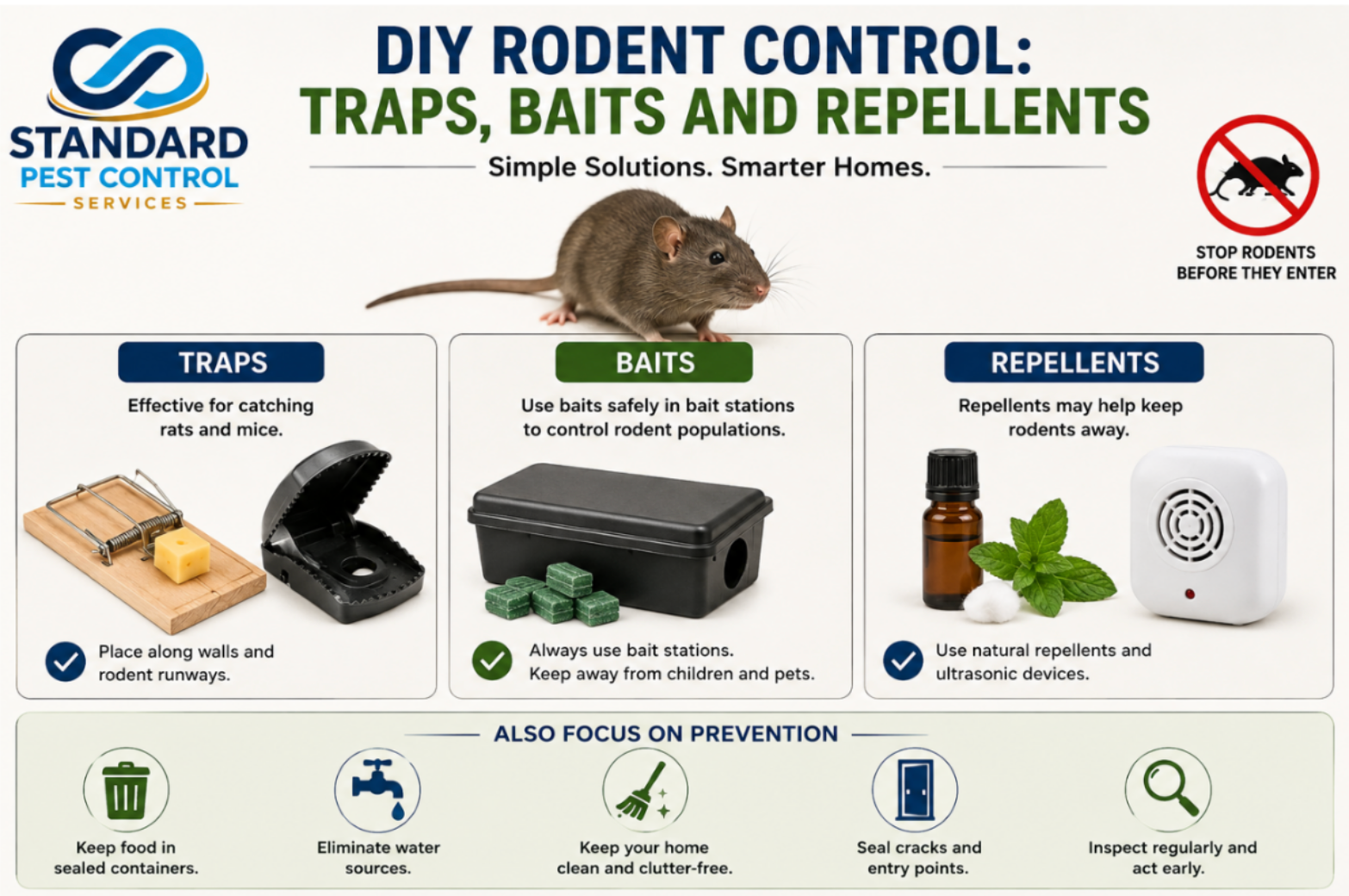
1. Rodent Traps: A Common DIY Option
Trapping can be useful when only a small number of rodents are present and their movement routes are reasonably well understood.
Several types of commercially available traps exist.
Snap Traps
Snap traps are one of the traditional mechanical approaches to rodent control. They are designed to capture rodents when properly positioned along areas of activity.
Simply putting one trap in the middle of a room, however, may not be effective. Rodents often travel along walls and protected edges rather than across exposed spaces.
Before using traps, identify:
- Where droppings are concentrated
- Where food has been damaged
- Where rodents have been seen
- Likely wall-edge travel routes
Always follow the trap manufacturer's directions and place devices where children and pets cannot access them.
Enclosed Rodent Traps
Enclosed traps conceal the trapping mechanism inside a housing. Depending on the product, this may reduce accidental contact with the mechanism and make placement more discreet.
They can be useful in some residential situations, but they still need to be positioned according to evidence of rodent activity.
Live-Capture Traps
Live-capture traps are another option sold for mice and rats. These devices require frequent inspection because an animal may remain alive inside the trap.
Anyone using such a trap should follow applicable local requirements and the manufacturer's instructions for safe and humane handling.
2. Rodent Baits: Why Extra Caution Is Necessary
Rodenticide baits are different from mechanical traps because they contain substances intended to kill rodents. They therefore require considerably more care.
Improper use can create risks for:
- Children
- Pets
- Non-target animals
- Wildlife
For this reason, homeowners should never scatter rodenticide loosely around a home, garden or food-handling area. Any pesticide or rodenticide product should only be used according to its approved label and applicable regulations.
Why Loose Bait Is a Bad Idea
Loose bait can be moved from its original location by rodents or accidentally reached by children, pets or other animals. DIY users should not improvise with pesticides or mix chemicals into homemade food baits.
Where rodenticide use is appropriate, professional pest-control technicians can assess the site and determine a suitable control programme.
Not sure which method is safe for your home? Get a free inspection and a recommendation you can trust.
Book Free Inspection Call Now3. Rodent Repellents: Do They Really Work?
Search online for "how to repel rats" and you will find dozens of suggestions. Common examples include:
- Strong-smelling substances
- Essential oils
- Ultrasonic devices
- Commercial repellent products
- Various home remedies
The difficulty is that repelling a rodent is not the same as preventing an infestation.
Even if a smell temporarily discourages a rodent from one location, the animal may simply move elsewhere if the property continues to provide food, water and shelter.
A repellent also does not close the hole through which the rodent entered.
What About Ultrasonic Rat Repellents?
Ultrasonic devices are marketed as an easy, chemical-free solution for rats and mice. Homeowners should be cautious about relying on these devices as their only rodent-control strategy.
Rodent behaviour can vary, and an established population with access to food, water and harbourage may not disappear simply because a repellent device has been installed.
Treat repellents as supplementary at most — not a replacement for inspection, sanitation and rodent exclusion.
4. Remove Food Sources Before You Set Traps
This is one of the most overlooked parts of DIY rodent control.
If rodents have easy access to food throughout the kitchen, they have little reason to interact with your control measures. Store foods such as:
- Rice
- Flour
- Cereals
- Pulses
- Snacks
- Nuts
- Pet food
in secure containers where practical. Clean crumbs and food residues from:
- Countertops
- Floors
- Under refrigerators
- Behind cooking equipment
- Under cabinets
Also keep garbage properly contained.
Less accessible food = a less attractive environment for rodents.
5. Remove Water Sources
Rodents also need water. Check your property for:
- Leaking taps
- Leaking pipes
- Water underneath sinks
- Standing water
- Outdoor containers
- Poor drainage
Repair plumbing leaks and remove unnecessary standing water.
Sanitation is an important companion to any trapping programme.
6. Find Out How the Rodent Entered
Catching one mouse won't prevent another from entering tomorrow. Inspect potential entry points around:
- Doors
- Pipes
- Drains
- AC lines
- Cable holes
- Vents
- Windows
- Roof gaps
- Wall cracks
- Utility shafts
Mice can exploit surprisingly small structural openings.
This is why rodent exclusion — identifying and appropriately sealing access points — is critical for long-term prevention.
Hearing movement in your ceiling or walls? Ask about our roof rat inspection and rodent exclusion options.
Book Free Inspection WhatsApp Us7. Don't Forget the Roof
Not every rodent enters from ground level. Roof rats are capable climbers. They may use:
- Trees
- Pipes
- Cables
- Creepers
- Walls and structural features
to reach roofs and upper floors.
If you hear scratching inside a false ceiling, inspect both interior spaces and possible exterior roof-level access.
8. Clean Up the Garden
Outdoor conditions can support rodent populations before they enter your home. Reduce:
- Overgrown vegetation
- Fallen fruits
- Garden debris
- Unnecessary clutter
- Open garbage
- Standing water
Trim branches that provide convenient access to roofs or balconies.
A well-maintained exterior makes rodent activity easier to detect and reduces potential harbourage.
Common DIY Rodent-Control Mistakes
DIY efforts frequently fail because homeowners focus only on the visible rodent. Avoid these common mistakes:
- Using only one trap: There may be more than one rodent or several travel routes.
- Random trap placement: Devices should be associated with signs of activity and used according to their instructions.
- Ignoring food sources: Accessible food can continue supporting rodents.
- Ignoring entry points: New rodents can enter even after existing ones are removed.
- Relying entirely on repellents: Moving a rat from one corner doesn't necessarily remove it from the building.
- Using pesticides carelessly: Improper rodenticide use can create unnecessary risks.
- Stopping monitoring too soon: Continue looking for fresh droppings, gnawing or sightings after activity appears to stop.
DIY Rodent Control vs Professional Rodent Control
| DIY Rodent Control | Professional Rodent Control |
|---|---|
| Suitable for basic prevention or limited activity | Better suited to persistent infestations |
| Homeowner identifies obvious signs | Detailed rodent inspection |
| Commercial traps may be used | Site-specific control strategy |
| Basic sanitation | Sanitation assessment |
| Seal obvious accessible gaps | Entry-point assessment |
| Home monitoring | Structured follow-up monitoring |
DIY measures can be helpful, but recurring infestations often indicate that an underlying problem remains unresolved.
When Should You Stop DIY and Call a Professional?
Consider professional rodent control in Bangalore if:
- Rats repeatedly return after trapping
- Droppings continue appearing
- Several rodents are being seen
- You hear activity inside walls or ceilings
- Electrical cables are being gnawed
- You cannot identify the entry point
- Rodents are associated with drains
- Activity occurs throughout an apartment building
- The infestation involves a restaurant or commercial kitchen
- DIY attempts have repeatedly failed
Professional inspection is especially important when rodents are moving through concealed structural spaces.
Professional Rodent Control in Bangalore
A professional rodent-management programme should be based on inspection rather than simply placing control devices everywhere. A structured approach may include:
Inspection
Identify rodent species, droppings, harbourage and movement routes.
Sanitation Assessment
Determine which food and water sources may be supporting activity.
Control
Select suitable measures based on the species, infestation and property.
Rodent Exclusion
Identify potential entry points and recommend appropriate proofing — see our full guide on rodent exclusion and sealing entry points.
Monitoring
Check for continuing activity and modify the programme where necessary.
Together, these elements form an Integrated Pest Management (IPM) approach.
Rodent Control for Bangalore Apartments
DIY rodent control can be particularly difficult in apartment buildings. Rodents may move through shared:
- Plumbing shafts
- Electrical ducts
- Basements
- Garbage rooms
- False ceilings
- Drainage infrastructure
If rodents repeatedly appear in several flats, a building-wide inspection may be necessary.
Treating one apartment without addressing common areas may provide only temporary relief.
Rodent Control for Restaurants and Commercial Properties
DIY rodent control is generally not an appropriate substitute for a structured pest-management programme in food-handling businesses.
Restaurants, hotels, commercial kitchens and warehouses require careful attention to:
- Sanitation
- Exclusion
- Monitoring
- Documentation
- Appropriate control
Regular professional inspections can help identify problems before rodent activity becomes widespread.
Frequently Asked Questions About DIY Rodent Control
What is the best DIY method for rats?
There is no single method that works in every situation. For limited activity, appropriately selected and positioned traps combined with sanitation and exclusion may help.
Are rat traps effective?
Traps can be effective when correctly selected, positioned and monitored. Their success depends heavily on understanding where rodents are travelling.
Should I use rat poison at home?
Rodenticides require careful handling because they can present risks to children, pets and non-target animals. Never use a pesticide contrary to its label, scatter it loosely or create homemade poison mixtures.
Do ultrasonic rodent repellents work?
They should not be relied upon as the sole solution to an established rodent infestation. Removing food, sealing entry points and controlling existing rodents are more important.
Can peppermint oil permanently remove rats?
Strong odours may sometimes affect rodent behaviour temporarily, but they do not address entry points, food availability or established harbourage.
Why isn't my rat trap working?
Possible reasons include poor placement, alternative food sources, unsuitable device selection or rodents avoiding unfamiliar objects.
Why do rats keep coming back?
Repeated activity often means that entry points, food, water or harbourage remain available.
Can I seal a rodent hole immediately?
If an infestation is active, determine whether rodents remain inside before closing all possible exits. Complex situations are better assessed professionally.
Is DIY rodent control safe around pets?
Mechanical devices and pest-control products can pose risks if incorrectly placed. Always follow manufacturer instructions and keep control devices inaccessible to children and pets.
When do I need professional rodent control?
Professional help is advisable for persistent, widespread or difficult-to-access infestations, especially when rodents are active in false ceilings, drains or commercial premises.
The Best DIY Rodent Strategy Isn't Just a Trap
The most effective DIY approach starts with understanding the entire problem.
Think beyond the rat you can see. Ask:
- Where is it entering?
- Where is it hiding?
- What is it eating?
- Where is it getting water?
Then follow this approach:
INSPECT → SANITIZE → CONTROL → EXCLUDE → MONITOR
Traps can help manage individual rodents. Repellents may sometimes alter behaviour. But sanitation, rodent-proofing and monitoring are essential for long-term prevention.
For recurring rat or mouse activity, professional rodent control in Bangalore can help identify hidden entry points, harbourage and the conditions supporting the infestation.
Standard Pest Control — Bangalore. Professional rodent control, rat control, rodent exclusion, inspection and monitoring for homes, apartments, restaurants, hotels, offices, warehouses and commercial properties across Bangalore.
Remember: Don't just catch the rodent. Remove the conditions that allow it to return.
Related reading: 10 DIY Rodent Prevention Tips for a Rodent-Free Home | Rodent Exclusion: Sealing Entry Points to Keep Pests Out | Sanitation and Rodent Control: Eliminating Food and Water Sources | How Small of a Hole Can a Rodent Squeeze Through? | Signs of Rodent Infestation You Should Never Ignore