Rat poison can appear to be a quick and convenient solution when rats or mice invade a home. Place some bait, wait for the rodent to consume it, and the problem seems solved.
But rodenticides require careful handling.
Improper use can expose children, pets and non-target wildlife to unnecessary risks. Depending on the active ingredient, another concern is secondary poisoning — when a predator or scavenger is exposed after consuming a poisoned rodent.
There is also a practical problem: poison alone does not explain how the rodents entered your property or why they are staying there.
Long-term rodent management should therefore focus on more than simply eliminating individual rats.
What Is Rodent Poison?
Rodent poisons, technically called rodenticides, are pesticides intended to control rats and mice.
Different rodenticides work in different ways, and their hazards vary according to their active ingredient, formulation, dose and route of exposure.
Because these products are pesticides, they should always be used strictly according to their approved label and applicable regulations.
Never assume that because a product is available commercially it is harmless to people, pets or wildlife.
What Is Secondary Poisoning?
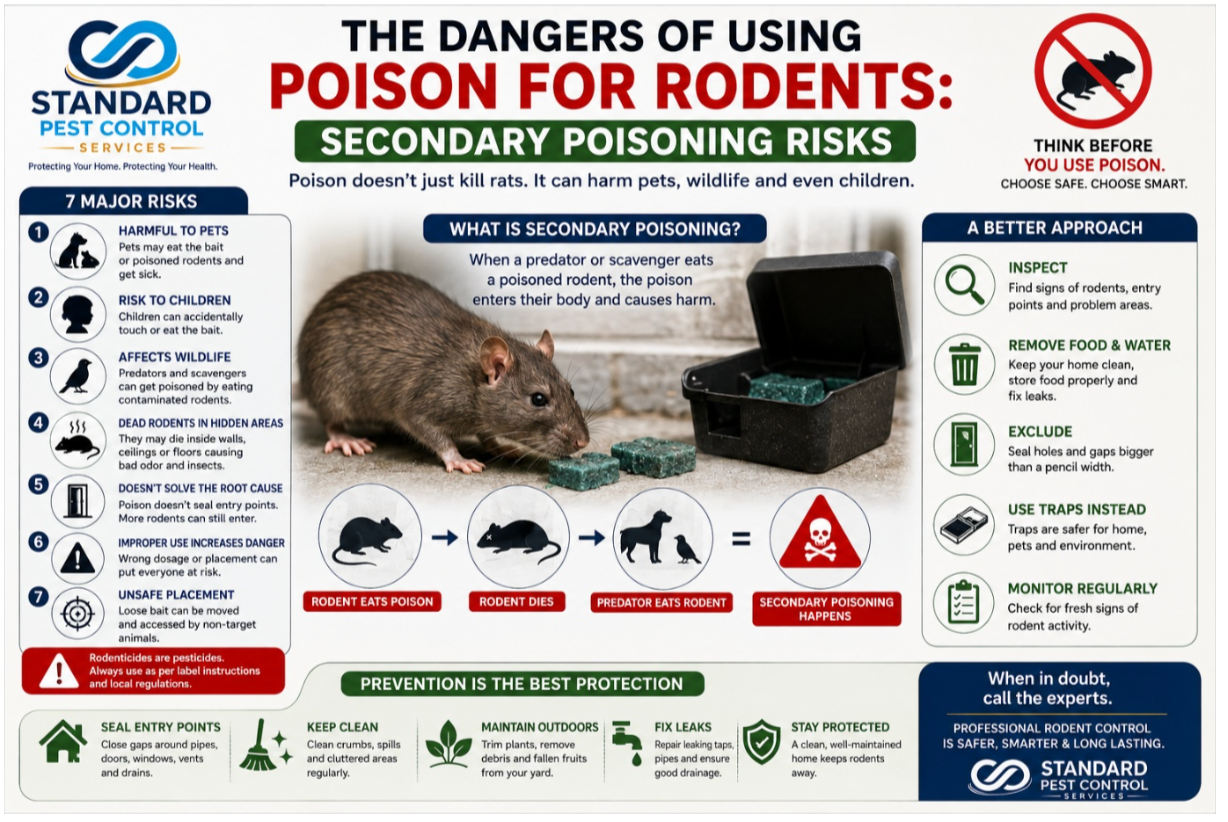
Secondary poisoning occurs when another animal is exposed by consuming a rodent that has ingested a rodenticide. For example:
Rodent consumes rodenticide → Predator or scavenger eats the rodent → Predator may be exposed to the toxic substance
The actual risk depends heavily on the type of rodenticide, the amount consumed by the rodent, how much contaminated prey is eaten and the species involved.
Potentially affected animals may include predators and scavengers that naturally feed on rodents.
This is one reason rodenticide selection and placement should never be treated casually.
Primary vs Secondary Poisoning
It is useful to understand the difference.
Primary Poisoning
Primary poisoning occurs when a person or non-target animal directly consumes or is exposed to the rodenticide. For example, a pet accessing improperly stored bait would be a direct-exposure concern.
Secondary Poisoning
Secondary exposure occurs indirectly, typically when a predator or scavenger consumes poisoned prey.
Both risks should be considered when designing a rodent-management programme.
7 Risks of Careless Rodenticide Use
1. Accidental Exposure to Pets
Dogs and other pets may investigate materials left in accessible locations. This is why rodenticides should never be scattered loosely around a home, garden, parking area or building.
Products must be stored and used according to their labels and kept inaccessible to children and pets.
If you suspect a pet has consumed a rodenticide or poisoned rodent, contact a veterinarian promptly and provide the product packaging or active-ingredient information if available.
2. Risk to Children
Children may not recognise the difference between a pest-control product and something harmless. Rodenticides should never be placed where children can access them.
Do not transfer pesticide products into food containers or unlabelled packages. Store pest-control products securely and retain their original labels.
3. Wildlife Can Be Affected
Rodents are part of the food chain. Predatory and scavenging wildlife can consume rats and mice. Depending on the rodenticide involved, this creates a potential route for secondary exposure.
Responsible rodent management should therefore consider the surrounding environment, not just the target pest.
Concerned about pets or children in the home? Ask us about safer, professionally managed rodent-control options.
Book Free Inspection Call Now4. Rodents May Die in Inaccessible Areas
Another common problem with poison-based DIY rodent control has nothing to do with toxicity. A rodent may consume bait and later die:
- Inside a wall
- Behind a cabinet
- Under flooring
- Inside a false ceiling
- In a service shaft
- Behind fixed equipment
This can lead to unpleasant odours and may attract flies or other insects. Locating the carcass can be difficult if it is inside an inaccessible structural void.
5. Poison Doesn't Seal the Entry Point
Suppose a rat enters through an opening around an AC pipe. You use poison and eliminate the rat. But the hole remains open. Another rat may enter later.
This is why poison alone rarely represents a complete rodent-management strategy. You must identify:
- Where are the rodents entering?
- What food is available?
- Where are they getting water?
- Where are they hiding?
6. Incorrect Use Can Increase Risk
More pesticide does not automatically mean better pest control.
Never increase quantities beyond label directions, combine pesticides, create homemade toxic mixtures or use agricultural/industrial products for household rodent control unless they are specifically approved and labelled for that use.
Incorrect application can increase risks without solving the infestation.
7. Poor Placement Can Undermine Control
Randomly placing bait throughout a building is not professional rodent management. Effective control starts with inspection. Technicians look for:
- Droppings
- Gnaw marks
- Rodent pathways
- Burrows
- Harbourage
- Food sources
- Water sources
- Entry points
Control methods should then be selected based on the site and level of activity.
Are All Rodenticides Equally Dangerous?
No.
Rodenticides can contain different active ingredients and have different toxicological characteristics. This is important because the potential for primary or secondary poisoning is not identical across all products.
For homeowners, the practical rule is simple:
Read and follow the product label exactly.
If you do not understand how a pesticide should be used safely, don't improvise. Professional pest-control assistance is preferable for complicated or persistent infestations.
Why Loose Rat Poison Is Particularly Concerning
Loose placement creates opportunities for bait to be moved, spilled or accessed by unintended animals or people. Rodents themselves may also move some materials.
Never place rodenticide casually:
- On kitchen floors
- Near food
- In children's play areas
- Where pets can reach it
- In open garden locations
- Around food-preparation surfaces
Where rodenticides are legally and appropriately used, suitable secured placement methods may be necessary depending on the product label and site conditions.
Not sure if your current rodent control is being handled safely? Get a free inspection and a safer plan.
Book Free Inspection WhatsApp UsWhat About Rat Poison Inside Apartments?
Apartment rodent control requires additional consideration because rats may move between units through:
- Plumbing shafts
- Electrical ducts
- False ceilings
- Basements
- Garbage areas
- Drainage infrastructure
Applying poison in one apartment may not address the source of the infestation elsewhere in the building.
A building-wide inspection may be necessary when multiple flats experience activity.
Safer Rodent Management Starts With Prevention
The safest rodent is often the one that never enters the building.
Instead of relying primarily on poison, focus first on reducing the conditions that allow rodents to survive.
Step 1: Remove Food Sources
Keep food securely stored and clean crumbs, spills and food waste. Pay attention to:
- Kitchens
- Pet feeding areas
- Garbage
- Store rooms
- Food-storage areas
Step 2: Remove Water Sources
Repair:
- Leaking taps
- Plumbing leaks
- Poor drainage
Remove unnecessary standing water around the property.
Step 3: Reduce Harbourage
Remove unnecessary:
- Cardboard
- Clutter
- Garden debris
- Stored waste
- Dense vegetation
Step 4: Seal Entry Points
Inspect: Doors → Pipes → Drains → Vents → AC lines → Cable openings → Windows → Roof gaps → Structural cracks
Rodent exclusion can significantly reduce the opportunity for new rats and mice to enter.
Step 5: Monitor
Continue looking for fresh:
- Droppings
- Gnaw marks
- Scratching noises
- Burrows
- Rodent sightings
Monitoring helps determine whether the problem has actually been resolved.
Traps vs Poison: Which Is Better?
There is no single control method suitable for every rodent infestation.
Mechanical trapping can have advantages in certain indoor situations because captured rodents can generally be located and removed rather than dying in inaccessible areas. However, traps must also be correctly selected, positioned and monitored.
Rodenticides may have a role in professionally designed programmes where their use is appropriate and lawful, but the decision should account for risks to people, pets and non-target animals. See our comparison of DIY rodent control traps, baits and repellents for a closer look at each method.
The strongest strategy is therefore not simply:
Trap OR Poison
It is:
Inspection + Sanitation + Exclusion + Appropriate Control + Monitoring
What Should You Do With a Dead Rodent?
Avoid unnecessary direct contact. Follow local public-health guidance for safe handling and disposal. Use appropriate protective measures and keep children and pets away from the carcass.
If you believe the rodent may have consumed a rodenticide, preventing pets and wildlife from accessing the carcass is particularly important.
What Should You Do If Poison Is Accidentally Ingested?
Suspected rodenticide exposure should be treated seriously.
For a person, seek urgent medical advice and take the product container or label information with you when possible.
For a pet, contact a veterinarian promptly.
Do not attempt to induce vomiting or administer home remedies unless specifically instructed by a qualified medical or veterinary professional.
Knowing the exact product and active ingredient can be important because different rodenticides require different medical responses.
Professional Rodent Control in Bangalore
A professional rodent control Bangalore programme should begin with inspection rather than automatically using poison. A comprehensive approach may include:
Inspection
Determine the species and level of activity.
Sanitation Assessment
Identify food and water supporting the infestation.
Entry-Point Assessment
Locate potential rodent access routes.
Control Strategy
Select appropriate control measures based on the property and risks.
Rodent Exclusion
Recommend sealing suitable structural openings.
Monitoring
Check for continuing activity and modify the programme where required.
This is the foundation of Integrated Pest Management (IPM).
Frequently Asked Questions About Rodent Poison
What is secondary poisoning from rat poison?
Secondary poisoning is indirect exposure that can occur when another animal consumes a rodent that has ingested a rodenticide.
Can rat poison harm dogs or cats?
Rodenticides can pose risks to pets through direct exposure, and some products may also create secondary-exposure concerns. Suspected exposure requires prompt veterinary advice.
Can rat poison affect wildlife?
Yes, depending on the rodenticide and circumstances. Predators and scavengers may potentially be exposed when consuming poisoned rodents.
Is it safe to scatter rat poison around the house?
No. Rodenticides should never be casually scattered. They must be used strictly according to the approved product label and kept inaccessible to children, pets and non-target animals.
What happens if a rat dies inside the wall?
A dead rodent in an inaccessible area can produce odour and potentially attract flies and other insects until decomposition progresses.
Does rat poison permanently solve an infestation?
Not necessarily. Poison does not seal entry points or remove food, water and harbourage. New rodents may enter if the underlying conditions remain.
Are traps safer than poison?
Mechanical traps can avoid some poisoning risks, but they still require correct placement and safe handling. The appropriate method depends on the situation.
Should I use homemade rat poison?
No. Homemade toxic mixtures can create unpredictable risks to people, pets and wildlife. Use only legally approved products according to their labels.
What should I do if my pet eats rat poison?
Contact a veterinarian promptly and provide the product label or active ingredient information if available.
When should I call professional rodent control?
Professional assistance is recommended for persistent infestations, repeated rodent sightings, activity inside false ceilings or walls, commercial premises, or situations where safe control is difficult.
Don't Let Rodent Control Create Another Problem
Rodent infestations need to be controlled — but the method matters.
Careless use of poison can create additional risks for children, pets and wildlife, while still failing to address the reason rodents entered the property.
Instead of thinking only: "How do I kill this rat?"
Ask: "How did it enter, and what is allowing it to survive here?"
The better long-term strategy is:
INSPECT → REMOVE FOOD & WATER → CONTROL → EXCLUDE → MONITOR
This approach helps control the existing infestation while reducing the chance of another rodent taking its place.
Standard Pest Control — Bangalore. Professional rodent control, rat control, rodent exclusion, inspection and monitoring for homes, apartments, restaurants, hotels, offices, warehouses and commercial properties across Bangalore.
Key message: Control rodents responsibly. Protect your property without creating unnecessary risks for people, pets and wildlife.
Related reading: The Psychological Impact of Rodents: Fear, Disgust, and Stress | DIY Rodent Control: Traps, Baits and Repellents | Rodent Exclusion: Sealing Entry Points to Keep Pests Out | Sanitation and Rodent Control: Eliminating Food and Water Sources | 10 DIY Rodent Prevention Tips for a Rodent-Free Home | Signs of Rodent Infestation You Should Never Ignore | Safe Pest Control for Babies, Pets & Senior Citizens: Everything You Need to Know