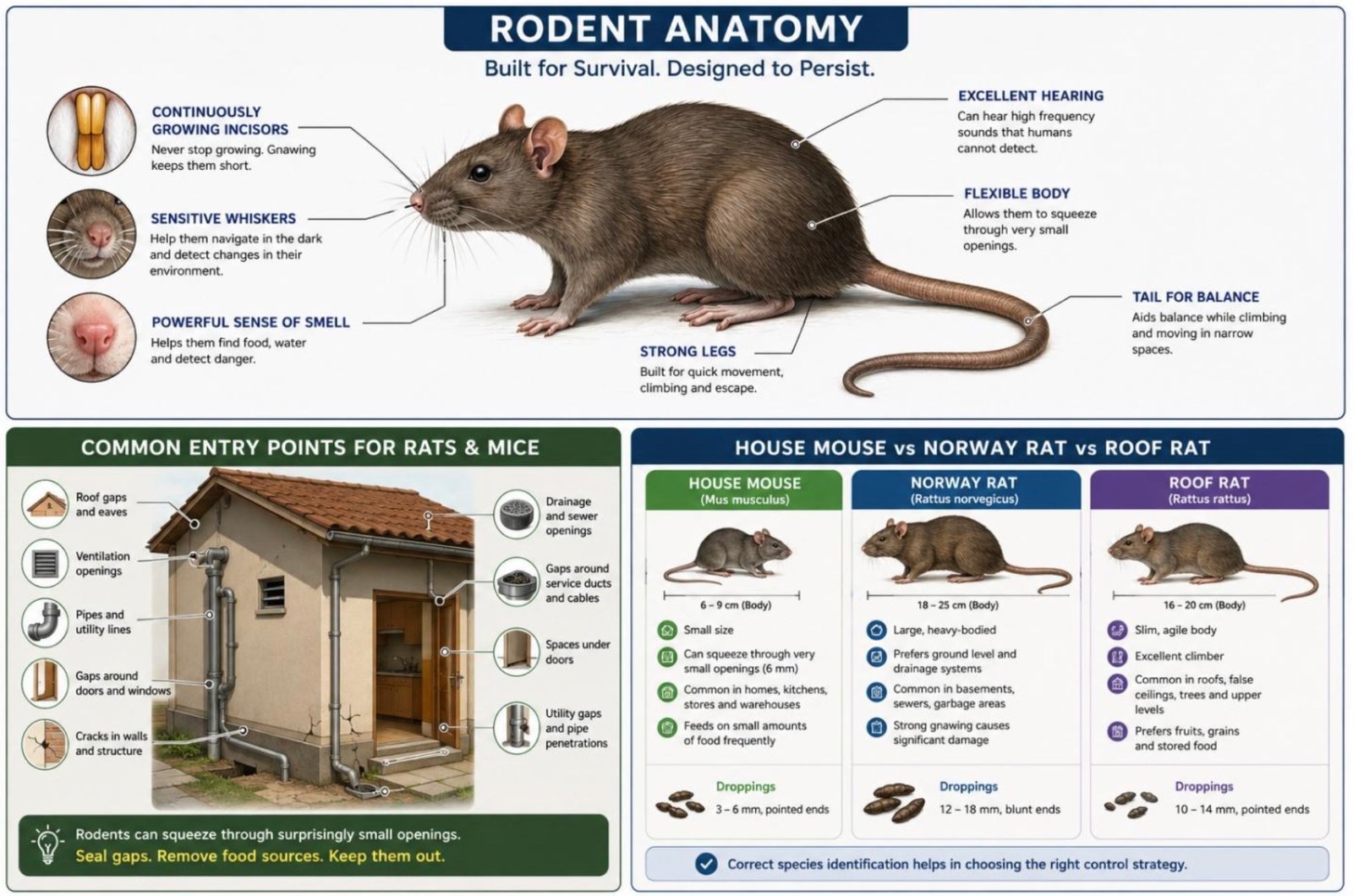
Rodents are among the most persistent pests found in homes, apartments, restaurants, warehouses, offices and commercial properties. Rats and mice can enter through surprisingly small openings, hide in difficult-to-reach spaces, damage electrical wiring and contaminate food and surfaces.
But why are rodents so difficult to control?
A major part of the answer lies in rodent anatomy. Their teeth, flexible bodies, sensitive whiskers, powerful senses and climbing abilities are perfectly suited for survival around human environments.
Understanding how rats and mice are built helps explain why simply placing a few traps may not solve an established rodent problem.
What Makes Rodents Different From Other Pests?
Rodents are mammals belonging to the order Rodentia. One of their defining anatomical characteristics is a pair of continuously growing front teeth called incisors.
Common rodent pests encountered around buildings include:
- House mice
- Norway rats
- Roof rats
Each species behaves differently, but they share several physical characteristics that make them excellent survivors.
1. Continuously Growing Teeth Make Rodents Constant Gnawers
One of the most important features of rodent anatomy is their incisors. Rodent front teeth continue growing throughout their lives. To keep them manageable, rodents naturally gnaw on different materials.
This is why rats and mice may damage:
- Electrical wires
- Wooden doors and furniture
- Plastic containers
- Cardboard boxes
- Stored products
- Pipes and insulation
- Packaging materials
Why Is Rodent Gnawing Dangerous?
Gnawing is more than property damage. When rodents chew electrical cables, they can expose wiring and potentially increase the risk of electrical faults.
Finding repeated gnaw marks around a property can therefore be an important sign of rodent activity — see our detailed guide on signs of rodent infestation.
2. Flexible Bodies Help Rodents Enter Small Spaces
A rat may look too large to enter a particular opening, but appearances can be misleading. Rodents have highly adaptable bodies and can exploit gaps around:
- Doors
- Utility lines
- Drainage systems
- Pipe penetrations
- Ventilation openings
- Roof gaps
- False ceilings
- Service ducts
Mice in particular can take advantage of very small openings. This is one reason professional rodent control should focus on more than catching the rodents already inside.
Finding and closing potential entry points — known as rodent proofing or exclusion — is an important part of long-term prevention.
Worried about entry points around your property? Get a free inspection and rodent-proofing assessment.
Book Free Inspection Call Now3. Powerful Sense Of Smell Helps Them Locate Food
Rodents rely heavily on their sense of smell. Food crumbs, garbage, pet food, stored grains and poorly sealed waste can attract rodents and help sustain an infestation.
In restaurants, hotels and commercial kitchens, even small amounts of accessible food can create favourable conditions.
Good rodent management therefore includes sanitation, food management, waste management, exclusion, monitoring and control together. Simply eliminating individual rats without addressing food and shelter may allow the problem to return.
4. Whiskers Help Rodents Navigate In Darkness
The whiskers on a rat or mouse are not merely hair. They are important sensory structures that help rodents understand their surroundings, particularly when moving through dark or narrow areas.
Rodents frequently travel close to walls and other structural edges. This behaviour helps pest-control professionals identify potential rodent pathways and determine suitable locations for monitoring devices and control measures.
5. Their Hearing Helps Them Detect Danger
Rodents have sensitive hearing and can detect sounds that humans may not notice. This contributes to their ability to survive in environments where they are frequently disturbed.
It also helps explain why rodents may become cautious when something unfamiliar suddenly appears within their normal environment. Successful rodent management therefore requires careful inspection and correct placement of control devices rather than randomly placing traps around a building.
6. Rodents Are Excellent Climbers
Not every rat infestation starts at ground level. Roof rats, in particular, are capable climbers and may use trees, pipes, cables and building structures to reach elevated areas.
They can establish themselves in:
- Roof spaces
- False ceilings
- Upper floors
- Storage areas
- Service shafts
- Utility spaces
This is why rodent inspections should not be limited to kitchens and ground-floor rooms. Technicians may also need to inspect ceilings, roofs, ducts and utility routes.
Not sure which rodent you're dealing with? See our guide on rats vs. mice identification or book a free inspection.
Book Free Inspection WhatsApp Us7. Strong Legs Help Rodents Move Quickly
Rodents are built for rapid movement. Their legs and body structure allow them to move quickly between feeding areas and hiding places.
This mobility makes them particularly troublesome in warehouses, restaurants, food-processing environments and commercial buildings where multiple hiding locations may be available. A rat spotted in one room does not necessarily mean that its nesting or harbourage area is nearby.
8. Their Tails Play An Important Role
A rodent's tail contributes to movement, balance and other physiological functions. For climbing species such as roof rats, balance is especially useful when travelling across narrow surfaces and elevated structures.
This ability can help rodents exploit parts of a building that people may not immediately consider possible rodent routes.
9. Rodents Prefer Hidden Harbourage Areas
Rodent anatomy works together with highly cautious survival behaviour. Rats and mice commonly seek protected spaces such as:
- Behind kitchen equipment
- Inside storage areas
- Under cabinets
- False ceilings
- Utility rooms
- Drainage areas
- Wall cavities
- Cluttered spaces
- Around garbage collection points
These locations provide shelter while keeping rodents close to food and water. That is why seeing a rodent occasionally may represent only part of the actual activity within a property.
10. Rapid Reproduction Can Turn A Small Problem Into A Bigger Infestation
Rodents are also persistent because they can reproduce relatively quickly when food, water and shelter are readily available. A small, unnoticed population can therefore develop into a larger infestation.
Early intervention is generally easier than waiting until rodents are regularly seen during the daytime or damage becomes extensive.
House Mouse Vs Norway Rat Vs Roof Rat
Understanding the species is an important part of effective rodent management.
House Mouse
House mice are small and highly adaptable. Their size allows them to exploit small openings and establish themselves close to food sources. They are commonly associated with kitchens, storage rooms, warehouses and other indoor environments.
Norway Rat
Norway rats are larger and generally associated with ground-level activity, drains, garbage areas and burrows. They are powerful rodents capable of causing substantial damage through gnawing and contamination.
Roof Rat
Roof rats are agile climbers and are more likely to exploit elevated areas such as roofs, false ceilings, trees and upper structural spaces.
Correct species identification helps determine where technicians should inspect and how the rodent management programme should be designed — see our full rats vs. mice identification guide for a side-by-side comparison.
Why DIY Rodent Control Often Fails
Homeowners may catch one rat or mouse and assume the infestation has been eliminated. But the visible rodent is only one part of the problem.
Long-term control requires answering several questions:
- How are the rodents entering?
- Where are they hiding?
- What food or water source is supporting them?
- Which rodent species is present?
- Are there additional rodents that have not been detected?
Without addressing these factors, new rodents can continue entering the property.
Signs You May Need Professional Rodent Control
Consider arranging a professional inspection if you notice:
- Rodent droppings
- Gnaw marks
- Scratching noises at night
- Damaged food packaging
- Unusual smells
- Burrows around the building
- Greasy marks along frequently travelled routes
- Damage to wires or cables
- Rats or mice seen regularly
- Activity inside false ceilings
Early identification can help reduce contamination and property damage.
Rodent Control In Bangalore
Bangalore's combination of dense residential development, restaurants, commercial establishments, drainage networks, waste areas and construction activity can create suitable conditions for rats and mice.
Properties requiring rodent control in Bangalore may include:
- Apartments
- Independent houses
- Villas
- Restaurants
- Hotels
- Offices
- Warehouses
- Hospitals
- Commercial kitchens
- Industrial facilities
A professional rodent-control programme should begin with an inspection rather than immediately applying a single control method.
How Professional Rodent Control Works
A comprehensive rodent-management programme may include:
- Inspection: Identifying droppings, gnawing, burrows, harbourage areas and possible entry routes.
- Species identification: Determining whether house mice, Norway rats, roof rats or another rodent is responsible.
- Entry-point assessment: Checking doors, pipes, drains, roofs, service ducts and structural gaps.
- Control measures: Selecting appropriate trapping, monitoring and other control strategies based on site conditions.
- Rodent proofing: Recommending closure or modification of entry points wherever practical.
- Sanitation recommendations: Identifying food, water, waste or clutter conditions supporting rodent activity.
- Monitoring: Checking whether activity continues and adjusting the programme where necessary.
This Integrated Pest Management (IPM) approach provides a stronger long-term strategy than relying on a single treatment.
Frequently Asked Questions About Rodent Anatomy
Why do rats constantly chew things?
Rodent incisors grow continuously. Gnawing helps maintain their teeth, which is why rodents frequently damage wood, plastic, packaging and electrical wiring.
Can rats enter through small openings?
Yes. Rodents can exploit surprisingly small structural gaps. Mice can use especially small openings, making rodent proofing an important part of prevention.
Why do rats usually move along walls?
Rodents commonly follow structural edges because these routes provide guidance and some protection while travelling between harbourage and feeding locations.
Can rats climb walls and pipes?
Some rodents are very capable climbers. Roof rats are particularly adapted to climbing and may travel along pipes, cables, trees and building structures.
Why do I hear rats mainly at night?
Rats and mice are often most active when surroundings are quieter and human activity is reduced. Scratching or movement in walls and ceilings at night can indicate rodent activity.
Is catching one rat enough to solve the problem?
Not necessarily. There may be additional rodents or unresolved entry points, food sources and harbourage areas. A complete inspection helps determine the extent of the problem.
What is the best way to prevent rodents?
Long-term prevention usually combines exclusion, sanitation, proper food and waste storage, monitoring and appropriate professional control measures.
Final Thoughts: Rodent Anatomy Explains Their Survival
Rodents are persistent pests because almost every part of their anatomy supports survival. Their continuously growing teeth encourage gnawing, their adaptable bodies help them exploit small openings, their whiskers and senses help them navigate, and their climbing and movement abilities allow them to reach difficult areas.
This is why effective rodent control involves much more than eliminating the rat or mouse you can see.
If you are noticing droppings, gnaw marks, scratching noises or repeated rodent sightings, a professional inspection can help identify the species, entry points and conditions supporting the infestation.
Standard Pest Control — Bangalore. Professional rodent inspection, control, monitoring and prevention solutions for residential and commercial properties across Bangalore.
Related reading: Sanitation and Rodent Control: Eliminating Food and Water Sources | Rodent Exclusion: Sealing Entry Points to Keep Pests Out | 10 DIY Rodent Prevention Tips for a Rodent-Free Home | Rats Vs. Mice: Key Identification Differences | Signs of Rodent Infestation You Should Never Ignore | Are Rodents Using Your Kitchen as a Midnight Playground? | Can Rats Climb to the 15th Floor of Your Bangalore Apartment?