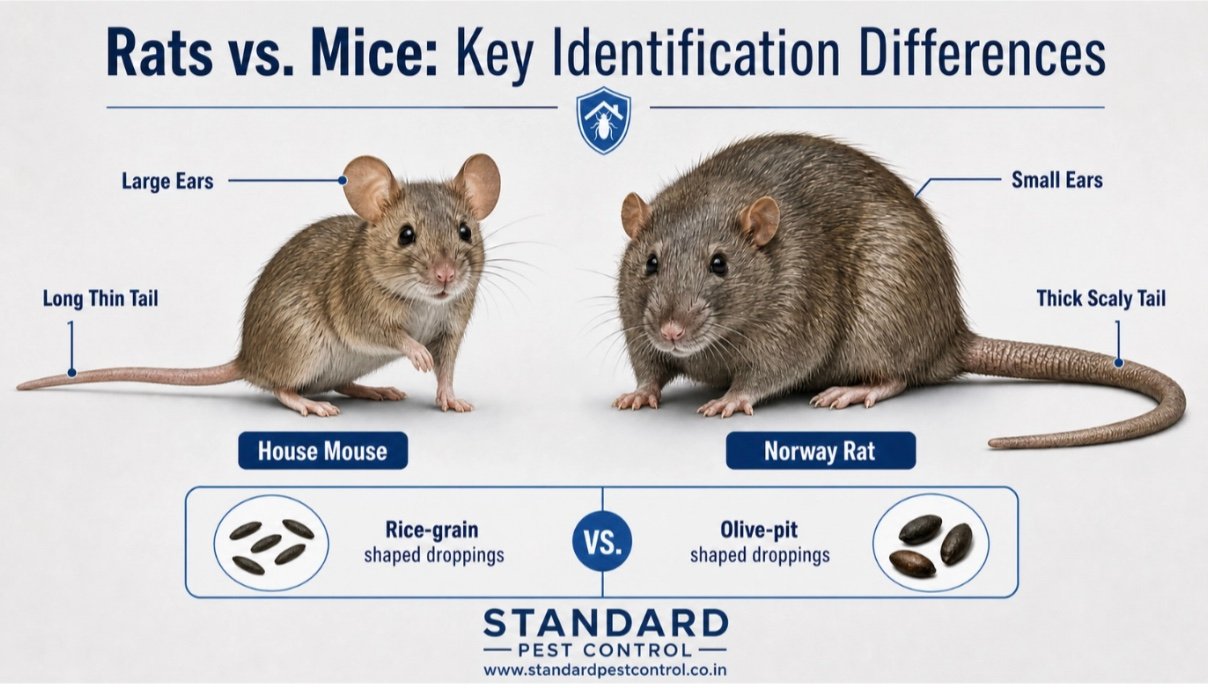
Rodent infestations rank among the most distressing household and commercial challenges across urban India. Property owners in metropolitan hubs frequently encounter scratching noises behind walls, chewed packaging, or mysterious droppings, yet they often misidentify the culprit. Correctly distinguishing between a rat infestation and a mouse problem is the vital first step toward effective eradication. Misidentifying the rodent can lead to ineffective traps, incorrect bait selection, and persistent property damage.
At Standard Pest Control, our licensed field technicians encounter diverse rodent challenges across residential and commercial properties in Bangalore. Drawing from nearly two decades of localized pest management expertise, this guide examines the biological, behavioral, and structural differences between rats and mice, so homeowners and property managers know exactly what they're dealing with before booking a treatment.
Quick Comparison: Rats Vs. Mice At A Glance
| Feature | House Mouse | Roof Rat | Norway Rat |
|---|---|---|---|
| Body length (head to tail) | 12–20 cm, tail longer than body | 30–45 cm, tail longer than body | 20–40 cm, tail shorter than body |
| Weight | 12–30 grams | 150–250 grams | 200–500 grams |
| Droppings | 3–6 mm, rice-grain shaped, pointed ends | 10–14 mm, spindle-shaped, pointed ends | 18–20 mm, capsule shaped like olive pits |
| Nesting preference | Low spaces, inside walls, boxes, upholstery | High places, false ceilings, attics, rafters | Burrows underground, crawl spaces, sub-floors |
| Behavioral traits | Curious, bold, explores new objects instantly | Agile climbers, cautious, excellent balancers | Suspicious of new objects, powerful diggers and swimmers |
Detailed Identification: Physical Characteristics And Morphology
To determine whether your property requires targeted mouse management or specialized rat control, a careful examination of physical morphology is essential. While both rodents belong to the order Rodentia and the family Muridae, their evolutionary adaptations differ significantly.
The House Mouse (Mus Musculus)
The common house mouse is small and slender, measuring between 60 to 95 millimeters in body length, with a tail that adds another 70 to 100 millimeters. An adult mouse typically weighs between 12 to 30 grams. Their fur is dusty grey or light brown, featuring a noticeably lighter underbelly. Mice possess large, floppy ears relative to their tiny head size, and their snouts are pointed with prominent whiskers. Because of their flexible skeletal structure, an adult mouse can squeeze through openings as small as a dime (approximately 6 millimeters in diameter).
The Roof Rat (Rattus Rattus)
Also known as the black rat or ship rat, the roof rat is significantly larger than a mouse but sleeker than a Norway rat. Body lengths range from 160 to 220 millimeters, complemented by a scaly, hairless tail measuring 190 to 250 millimeters. Roof rats weigh between 150 to 250 grams. Their fur is smooth, ranging from dark brown to black, though variants with grey bellies exist. True to their name, roof rats are exceptional climbers with superior balance, frequently nesting in upper wall voids, false ceilings, roof rafters, and tall trees surrounding buildings in Bangalore's leafy neighborhoods.
The Norway Rat (Rattus Norvegicus)
The Norway rat — also referred to as the brown rat, sewer rat, or wharf rat — is the largest pest rodent commonly managed by urban exterminators. Adults measure 180 to 250 millimeters in body length, with a shorter, thick, two-toned tail measuring 150 to 210 millimeters. They are heavy-bodied, weighing between 200 to 500 grams. Their coat is coarse, brown or reddish-grey on top, fading to greyish-white underneath. Unlike roof rats, Norway rats possess small ears, blunt snouts, and small eyes. They are powerful burrowers, excavating extensive subterranean tunnels beneath concrete slabs, waste disposal areas, and drainage systems.
Not sure which rodent you're dealing with? Get a free inspection and species-specific treatment plan.
Book Free Inspection Call NowBehavioral Differences: Nesting, Diet, And Navigation
Understanding rodent behavior allows property owners and pest management professionals to deploy traps and exclusion barriers effectively.
"Rodents do not merely share our living spaces; they exploit our infrastructure. Recognizing their distinct behavioral loops is the foundation of structural pest defense."
— Standard Pest Control Technical DivisionDietary Habits And Foraging Patterns
Mice are notorious nibblers and opportunistic omnivores with a strong preference for seeds, grains, and cereals. They consume small amounts of food across multiple locations (up to 20 to 30 feeding sites per night), making them erratic feeders.
Rats, by contrast, require dedicated water sources and consume significantly larger quantities of food daily (15 to 30 grams per rat). Roof rats prefer fresh fruits, vegetables, grains, and sweet items, whereas Norway rats are voracious carnivores and scavengers, frequently consuming meats, garbage, pet food, and discarded organic waste. Furthermore, rats exhibit neophobia — a profound fear of new objects in their environment. This wariness means newly introduced bait stations or traps may be ignored for several days until the rats grow accustomed to their presence.
Climbing Versus Burrowing Dynamics
- Mice jump vertically up to 30 centimeters and run along narrow cables or pipes. However, their primary preference is ground-level nesting within sheltered dark enclosures.
- Roof rats are vertical specialists. They scale brick walls, rough plaster, vines, and overhead utility lines with acrobatic precision, establishing colonies in elevated areas.
- Norway rats are horizontal and subterranean experts. They tunnel extensively into soil, undermine building foundations, enter through lower drainage pipes, and inhabit crawl spaces.
Identifying Infestations: Droppings, Gnaw Marks, And Smudge Trails
Early detection prevents minor rodent activity from escalating into a full-scale structural infestation. Property owners can identify specific rodent species by examining physical evidence left behind — read our full guide on signs of rodent infestation for more detail.
1. Dropping Analysis
- Mouse droppings: Small (3 to 6 millimeters long), rod-shaped with pointed ends, resembling dark grains of rice. A single mouse deposits between 40 to 100 droppings per night.
- Roof rat droppings: Medium-sized (10 to 14 millimeters long), spindle-shaped with pointed tips, often found scattered across attics and false ceilings.
- Norway rat droppings: Large (18 to 20 millimeters long), capsule-shaped with blunt, rounded ends resembling olive pits. Typically concentrated near runways, burrows, and feeding zones.
2. Gnaw Marks And Structural Damage
Both rats and mice possess continuously growing incisor teeth, compelling them to gnaw on wood, plastics, drywall, and electrical wiring to keep their teeth trimmed.
- Mouse gnaw marks: Small, clean-edged scratch marks and tiny notches on pantry boxes, plastic containers, and soft wood.
- Rat gnaw marks: Broad, deep gouges in structural timber, heavy plastic piping, aluminum siding, and electrical cables. Rodent-chewed electrical wiring is a leading cause of accidental residential and industrial fires in urban centers.
3. Rub Marks And Smudge Trails
Because rats have poor eyesight, they navigate by running along walls, baseboards, and pipes while brushing their oily, dirt-coated fur against surfaces. Over time, this leaves dark, greasy smear marks and smudge trails along vertical pathways and entry holes.
Seeing droppings or gnaw marks? Ask about our species-specific baiting and trapping plans.
Book Free Inspection WhatsApp UsStandard Pest Control Protocols In Bangalore
Urban environments like Bangalore present unique pest management challenges due to rapid real estate development, high population density, wet monsoons, and diverse residential-commercial layouts. Standard Pest Control applies an Integrated Pest Management (IPM) framework tailored to local conditions.
Step 1: Comprehensive Inspection And Risk Assessment
Licensed technicians conduct a thorough inspection of the property — checking false ceilings, kitchen utility ducts, drainage chambers, electrical shafts, and basement areas. Identifying the specific rodent species dictates whether high-reach baiting (for roof rats), perimeter burrow treatment (for Norway rats), or localized snap-trapping (for house mice) is deployed.
Step 2: Exclusion And Proofing
Chemical elimination alone fails if structural entry points remain open. Standard Pest Control seals gaps, reinforces entry vents with galvanized steel mesh, repairs damaged drainage pipes, and seals cable penetrations. For Bangalore homes and commercial complexes, securing weep holes and gap spaces around sliding doors is critical.
Step 3: Targeted Baiting And Trapping
- Rodenticides: Anticoagulant rodenticides formulated as single-feed or multi-feed block baits are placed in tamper-resistant stations to eliminate foraging colonies safely.
- Mechanical traps: Humane, heavy-duty snap traps and multi-catch live traps are positioned along established runways identified during the initial inspection.
Step 4: Sanitization And Ongoing Maintenance
Following rodent removal, technicians disinfect contaminated surfaces with specialized antimicrobial solutions to neutralize pathogens such as leptospirosis, hantavirus, and salmonellosis. Regular Annual Maintenance Contracts (AMC) ensure continuous monitoring and proactive defense for apartments, restaurants, corporate offices, and warehouses across Bangalore.
Frequently Asked Questions
How can I quickly tell if I have rats or mice in my Bangalore home?
Examine the droppings and structural damage. Mouse droppings are small and rice-grain-sized with pointed ends, whereas rat droppings are larger and capsule-shaped like olive pits. Rats also leave greasy rub marks along baseboards and cause heavier structural gnawing on wood and wiring.
Why is professional pest control necessary instead of over-the-counter traps?
Over-the-counter solutions often address only surface symptoms while leaving nesting colonies active behind walls or underground. Professional providers like Standard Pest Control use Integrated Pest Management (IPM), combining species-specific baiting, structural exclusion, and safe chemical protocols to eradicate the entire infestation.
Are pest control treatments safe for children and pets in Bangalore homes?
Yes. Standard Pest Control uses government-approved, eco-friendly, and low-toxicity formulations that ensure maximum safety for families, children, and pets without compromising treatment efficacy.
What areas in Bangalore do you serve?
Standard Pest Control provides same-day residential and commercial pest management services across all major localities in Bangalore, including Indiranagar, Koramangala, Jayanagar, Whitefield, Electronic City, Hebbal, and surrounding areas.
Conclusion
Distinguishing between rats and mice is not merely an exercise in rodent biology — it is the cornerstone of effective property protection. Whether dealing with agile roof rats in false ceilings, burrowing Norway rats in foundations, or adaptable house mice in pantries, prompt identification prevents costly structural damage and health hazards.
For homeowners and businesses seeking reliable, expert intervention, Standard Pest Control delivers certified, safe, and professional pest control Bangalore services. Backed by nearly 20 years of industry experience, same-day service availability, and government-approved licenses, we safeguard your living and working environments against all common urban pests.
Related reading: Sanitation and Rodent Control: Eliminating Food and Water Sources | Rodent Exclusion: Sealing Entry Points to Keep Pests Out | 10 DIY Rodent Prevention Tips for a Rodent-Free Home | Rodent Anatomy: What Makes Them Such Persistent Pests? | Signs of Rodent Infestation You Should Never Ignore | Are Rodents Using Your Kitchen as a Midnight Playground? | Can Rats Climb to the 15th Floor of Your Bangalore Apartment? | Is Your Apartment's Garbage Area Attracting a Rodent Army?