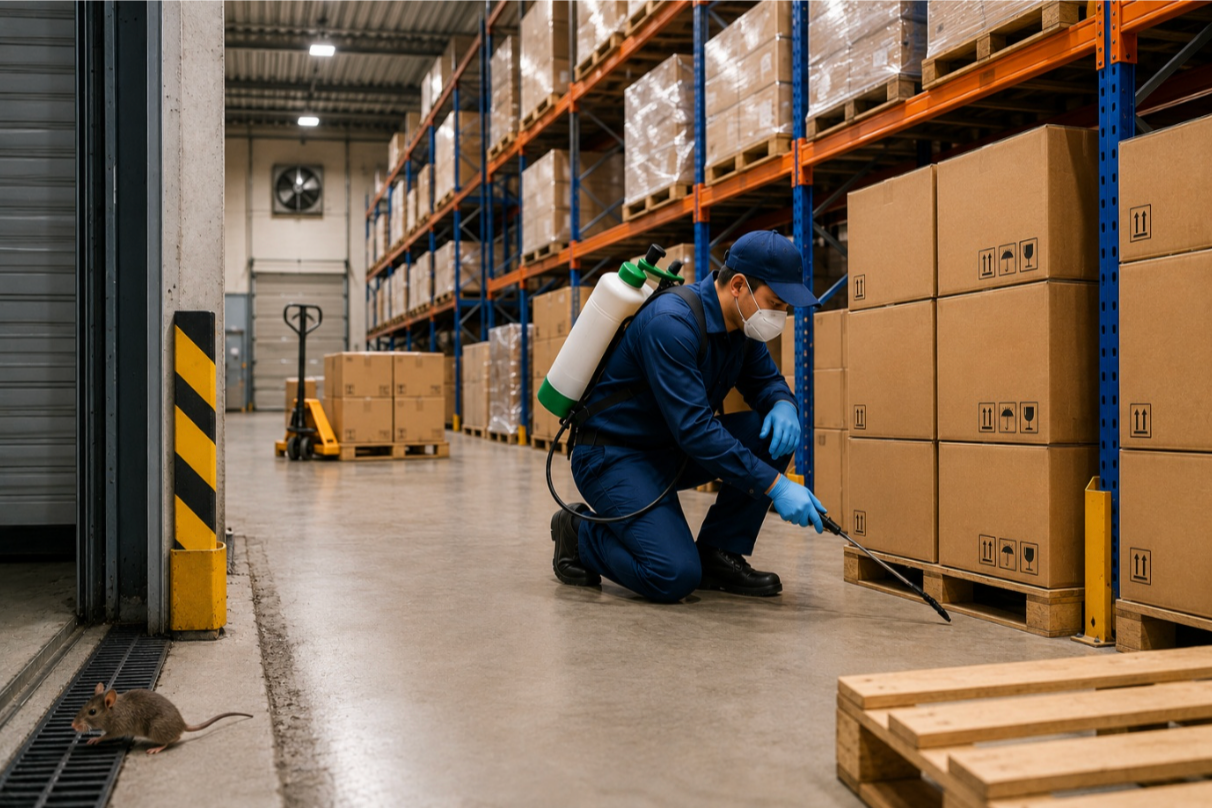
Warehouses and storage facilities may contain lakhs — or even crores — of rupees worth of inventory. Yet a small rodent infestation, cockroach problem, termite attack or stored-product insect infestation can damage goods, packaging and infrastructure before the problem is noticed.
Effective pest control for warehouses and storage facilities is therefore not simply about eliminating pests. It is about protecting inventory, preventing contamination, reducing product loss and maintaining efficient business operations.
For warehouses, distribution centres, logistics facilities, cold-storage support areas and commercial storage premises in Bangalore, preventive pest management should form part of routine facility management.
Why Warehouses Are Vulnerable to Pest Infestations
Warehouses provide many of the conditions pests need to survive, including large storage spaces, undisturbed corners, cardboard packaging, wooden pallets, food products, water sources, false ceilings, loading docks, drainage systems, structural gaps, and frequently opened shutter doors.
Constant movement of goods also means pests can sometimes be introduced through incoming shipments. A professional commercial pest control program should therefore address both pests already inside the warehouse and the routes through which new pests can enter.
How Pests Can Damage Stored Goods
Different pests cause different types of damage.
Product Damage
Rodents may gnaw through cartons, plastic packaging, food bags, containers and stored materials.
Contamination
Pest droppings, urine, insect fragments and pest activity can create contamination concerns, particularly in facilities storing food or other sensitive products.
Packaging Damage
Even when the product itself remains intact, damaged packaging may make goods unsuitable for sale or distribution.
Electrical Damage
Rodents frequently gnaw materials and may damage electrical wiring, communication cables, control systems and equipment wiring. This can potentially lead to equipment failure and other operational risks.
Structural Damage
Termites can attack wooden structural components, pallets, shelving and other cellulose-based materials.
Common Pests Found in Warehouses
1. Rats and Mice
Rodents are among the most important warehouse pests. They are highly adaptable and can exploit relatively small structural openings. Common signs include droppings, gnaw marks, damaged cartons, damaged food packaging, grease marks, burrows, scratching noises and damaged cables.
Rodent activity may be especially common around loading docks, shutter doors, storage racks, false ceilings, generator rooms, garbage areas and building perimeters. Professional rodent management should combine inspection, exclusion, monitoring and targeted control. Learn more: Rodent Pest Control Bangalore.
2. Cockroaches
Cockroaches can enter warehouses through cartons, drains, delivery vehicles and neighbouring premises. They may hide around dark storage areas, drains, electrical equipment, staff pantries, washrooms, cardboard storage and cracks and crevices.
Facilities storing food products require particularly careful cockroach monitoring. Learn more: Cockroach Pest Control Bangalore.
3. Stored-Product Insects
Warehouses storing grains, flour, cereals, pulses, spices, dry foods, pet foods and similar products may experience stored-product pest problems, including weevils, beetles, moths and other grain-infesting insects.
An important difference is that these pests may already be present inside incoming products. This means treatment alone cannot solve every stored-product pest problem — incoming inspection, stock rotation and inventory management are also essential.
4. Termites
Warehouses may contain large quantities of wooden pallets, wooden crates, cardboard, paper, wooden shelving and structural timber, all of which can be vulnerable to termite attack.
Termites may remain concealed for long periods, making regular inspection particularly important. Learn more: Termite Control Bangalore.
5. Ants
Ant activity may occur in food-storage facilities, staff pantries and other locations where food or moisture is available. Rather than treating only visible ants, the colony and entry points should be identified. Learn more: Ant Pest Control Bangalore.
6. Flies
Warehouses handling food, organic materials or waste may experience fly activity, with potential sources including waste areas, drains, damaged food products, organic residues and loading areas. Fly management should focus on eliminating breeding conditions rather than relying only on adult fly control.
Rodent Control for Warehouses
Rodent control deserves particular attention because rats and mice can move throughout large storage facilities while remaining hidden. An effective program starts by asking how rodents are entering, where they are travelling, where they are feeding, where they are nesting, and what environmental conditions are supporting them. Only then should an appropriate control strategy be implemented.
Rodent Proofing and Exclusion
Preventing rodent entry is one of the most important long-term control measures. Inspect areas around shutter doors, loading docks, pipe penetrations, cable openings, drain lines, roof gaps, wall openings and utility ducts.
Where appropriate, structural openings should be sealed using durable rodent-resistant materials. Simply placing bait stations while leaving entry points open can result in repeated rodent problems.
Not sure what's causing the problem? Get a professional inspection before you decide on treatment.
Book Free Inspection Call NowRodent Monitoring Stations
Commercial warehouses can benefit from systematically positioned rodent-monitoring devices. Each monitoring point can be assigned an identification number, for example R01, R02, R03, R04 and R05, with a warehouse map showing the exact location of each device.
During service visits, technicians can record activity, bait consumption where applicable, trap findings, droppings, gnawing and corrective actions required. This makes it easier to identify rodent hotspots and trends.
Loading Docks: A Major Pest Entry Point
Loading docks are among the most vulnerable areas of many warehouses. Doors may remain open while trucks are loading and unloading, allowing rodents and flying insects easier access.
Warehouses should check door seals, shutter gaps, dock levellers, wall openings, drainage, exterior vegetation and waste accumulation. Incoming vehicles and goods should also be inspected where appropriate.
Inspect Incoming Goods
Pest prevention should begin before inventory enters storage. Warehouse teams should check incoming shipments for damaged cartons, rodent gnaw marks, droppings, live insects, webbing, unusual holes and contaminated packaging.
Suspicious goods can be isolated for further inspection rather than immediately moving them into the main storage area. This is particularly important for food warehouses.
Proper Storage Helps Prevent Pests
Good warehouse organisation makes pest inspection significantly easier. Where operationally possible:
- Keep Stock Off the Floor. Use appropriate pallets or racking systems.
- Maintain Inspection Access. Avoid packing goods tightly against walls where this prevents inspection.
- Reduce Clutter. Unnecessary cardboard and unused materials provide pest harbourage.
- Rotate Stock. Use appropriate inventory rotation procedures such as FIFO — First In, First Out — where suitable.
- Remove Damaged Products. Damaged food packaging can provide pests with easy access to food.
Integrated Pest Management for Warehouses
A strong warehouse pest-control program should follow Integrated Pest Management (IPM) principles, combining several methods.
1. Inspection
Identify pest species, activity levels, entry points and environmental conditions.
2. Exclusion
Seal openings and improve structural pest-proofing.
3. Sanitation
Remove food residues, waste, standing water and unnecessary clutter — see our guide on Sanitation Best Practices for Commercial Pest Prevention for more detail.
4. Monitoring
Use appropriate monitoring devices to identify pest activity early.
5. Corrective Action
Address maintenance and sanitation problems identified during inspections.
6. Targeted Treatment
Apply appropriate treatments according to the pest, location and product label requirements.
The objective is to reduce dependence on unnecessary routine pesticide application.
Warehouse Pest Control Zone Planning
Large warehouses can be divided into risk zones.
Zone A – Receiving Area
Loading docks, receiving bays and incoming goods.
Zone B – Main Storage
Racking systems, pallets and stored inventory.
Zone C – Food or Sensitive Storage
Where applicable, these areas may require enhanced monitoring.
Zone D – Utility Areas
Electrical rooms, generator rooms, maintenance areas and false ceilings.
Zone E – Staff Areas
Pantries, washrooms and locker rooms.
Zone F – Exterior Perimeter
Drains, vegetation, waste areas, parking and building boundaries.
Each zone can have its own monitoring requirements.
Pest Control for Food Warehouses
Food-storage facilities require particularly careful pest management. Products such as rice, wheat, flour, pulses, cereals, spices, dry fruits and packaged foods can be vulnerable to both rodents and stored-product insects.
Pest management should work together with inventory management, sanitation, incoming inspection, stock rotation and monitoring — see our guide on HACCP and Pest Control for how this fits into a broader food-safety system.
Ready to get this sorted? Ask us about a structured, documented treatment plan.
Book Free Inspection WhatsApp UsPest Control for Retail Distribution Centres
Retail distribution centres continuously receive and dispatch products. A pest introduced into a distribution centre could potentially travel onward with stock, so preventive pest management protects not only the warehouse but also the downstream retail network.
Pest Control Documentation for Warehouses
Commercial warehouses should maintain organised pest-control records, including the pest-control agreement, scope of work, service schedule, service reports, pest-sighting register, rodent monitoring map, device inspection records, corrective-action reports, treatment records, product information, follow-up reports and pest trend reports.
Good documentation makes it possible to identify recurring problems instead of treating each pest sighting as an unrelated event.
Pest Trend Analysis
Imagine monitoring records show:
- R01 – No activity
- R02 – No activity
- R03 – Repeated activity
- R04 – No activity
- R05 – No activity
This suggests that the area around R03 needs additional investigation. The underlying problem could be a damaged shutter seal, a pipe opening, a nearby food source, an exterior burrow, a drainage route or a structural gap. Trend analysis helps management solve the cause, not simply the symptom.
Warehouse Pest Control AMC
An Annual Maintenance Contract (AMC) can provide continuous protection for warehouses and storage facilities. Depending on the property, the program may include scheduled inspections, rodent monitoring, cockroach management, ant management, fly monitoring, general pest control, monitoring devices, corrective recommendations, service documentation and periodic pest trend review.
Service frequency should be based on facility size, inventory, pest pressure, operating conditions and previous activity. When comparing providers, see our guide on Choosing a Commercial Pest Control Provider.
Warehouse Pest Prevention Checklist
Warehouse managers should regularly verify that:
- Incoming goods are inspected
- Damaged cartons are isolated
- Loading doors are properly sealed
- Pipe and cable openings are closed
- Stock is appropriately organised
- Inspection access is maintained where possible
- Unnecessary cardboard is removed
- Food spills are cleaned immediately
- Waste is removed regularly
- Water leaks are repaired
- Drains are maintained
- Monitoring devices remain correctly positioned
- Pest sightings are recorded
- Corrective actions are completed
- Pest-control records are maintained
Benefits of Professional Warehouse Pest Control
Professional pest management can help businesses:
- Protect Inventory. Reducing pest activity helps minimise damage to products and packaging.
- Reduce Product Loss. Early detection can prevent small infestations from becoming widespread.
- Protect Electrical Systems. Rodent management can help reduce the risk of gnawing damage to cables and equipment.
- Improve Audit Readiness. Structured pest-control records and monitoring maps provide clear documentation of pest-management activities.
- Detect Problems Early. Monitoring devices can identify pest activity before major damage occurs.
- Improve Facility Management. Corrective recommendations highlight structural, sanitation and maintenance issues.
- Protect Business Reputation. Damaged or pest-contaminated products reaching customers can create serious commercial consequences.
Professional Warehouse Pest Control in Bangalore
Standard Pest Control provides professional pest-management solutions for warehouses, storage facilities and commercial properties in Bangalore. Programs can be customised for commercial warehouses, distribution centres, food-storage warehouses, FMCG warehouses, retail distribution centres, logistics facilities, manufacturing storage areas, e-commerce warehouses, pharmaceutical storage facilities and industrial warehouses.
Our approach focuses on inspection, exclusion, monitoring, corrective action, targeted treatment and documentation. Related services: Cockroach Pest Control Bangalore, Rodent Pest Control Bangalore, Ant Pest Control Bangalore, Termite Control Bangalore, and Mosquito Pest Control Bangalore.
Frequently Asked Questions
What are the most common pests in warehouses?
Rodents, cockroaches, stored-product insects, ants, flies and termites are among the common warehouse pest concerns. The exact risk depends on the goods being stored and the surrounding environment.
How often should warehouse pest control be carried out?
The appropriate frequency depends on warehouse size, stored products, pest history, surrounding environment and monitoring results. Higher-risk food and distribution facilities may require more frequent monitoring.
How can warehouses prevent rats and mice?
Rodent prevention should combine structural proofing, sanitation, organised storage, exterior management and systematic monitoring.
Why should rodent stations be numbered?
Numbering allows each monitoring device to be mapped and tracked over time. This helps identify areas with recurring activity.
Can pests arrive with incoming goods?
Yes. Rodents, cockroaches and especially stored-product insects may sometimes be associated with incoming shipments or packaging. Receiving inspections are therefore an important preventive measure.
Is spraying enough for warehouse pest control?
No. Long-term pest management requires inspection, exclusion, sanitation, monitoring, corrective action and appropriately targeted treatments.
Should warehouses have a pest-control AMC?
For facilities storing valuable inventory throughout the year, a preventive AMC can provide regular inspection, monitoring and documentation instead of relying solely on emergency treatments.
Conclusion
Pest control for warehouses and storage facilities is fundamentally about protecting valuable goods from preventable damage.
The strongest pest-management programs do not begin with pesticide application. They begin by understanding how pests enter, where they hide, what attracts them and how activity can be detected early.
By combining inspection, pest proofing, sanitation, stock management, monitoring, targeted treatment and documentation, warehouses can significantly reduce pest risks.
For warehouses, logistics facilities, distribution centres and storage premises in Bangalore, professional preventive pest management can help protect inventory, infrastructure, operational continuity and business reputation.
Related reading: IPM for Commercial Properties: A Strategic Approach to Business Protection | Documentation in Commercial Pest Control: Why Records Matter | HACCP and Pest Control: Ensuring Food Safety Compliance | Choosing a Commercial Pest Control Provider: What to Look For | Sanitation Best Practices for Commercial Pest Prevention | Pest Control for Retail Stores: Protecting Inventory and Customer Experience | Pest Control for Car Dealerships: Protecting Inventory and Showrooms