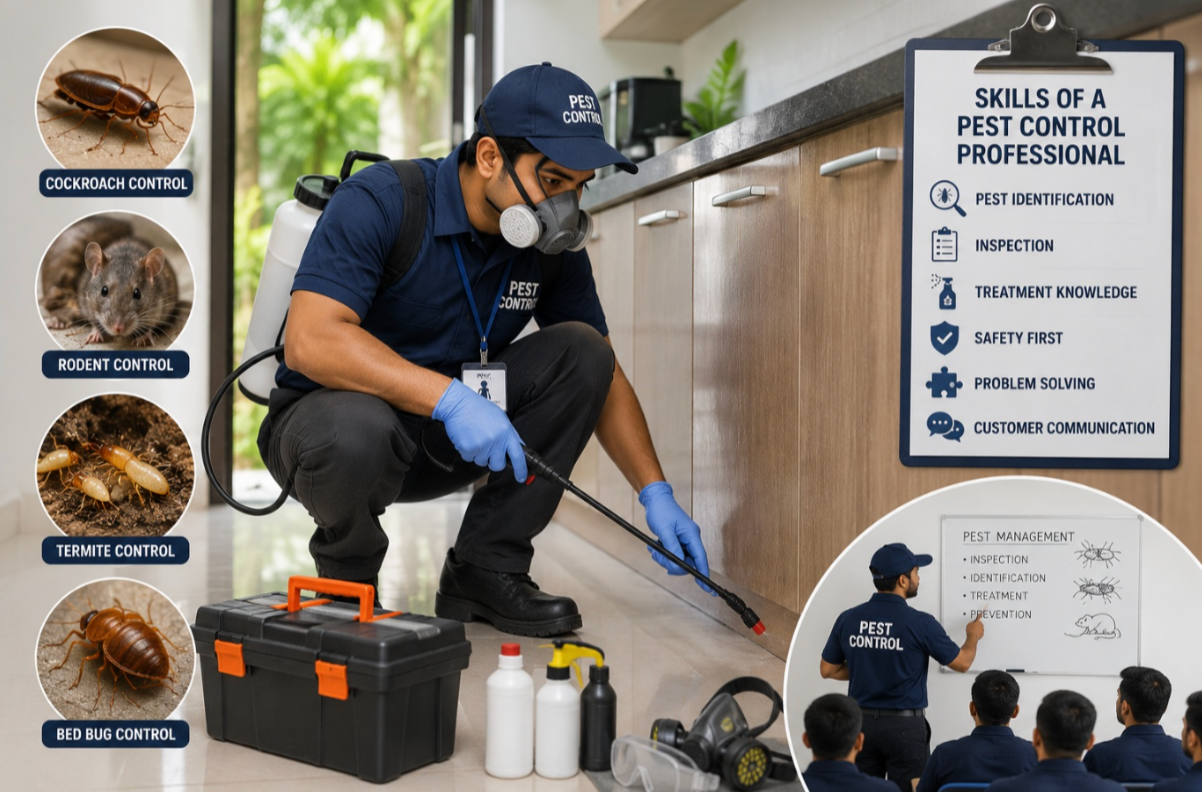
Pest control is more than spraying chemicals or setting traps. A professional pest-control technician needs technical knowledge, observation skills, safety awareness, communication ability and practical field experience to identify pest problems and provide appropriate solutions.
With the growth of residential apartments, hotels, restaurants, hospitals, warehouses, offices and industrial facilities in cities such as Bangalore, trained pest-management professionals play an important role in protecting properties, food environments and public hygiene.
If you're considering a career in pest control, here's what the job actually involves and the skills needed to succeed.
What Does a Pest Control Technician Do?
A pest-control technician—or exterminator, as the role is commonly called—is responsible for inspecting properties, identifying pest activity and carrying out suitable pest-management measures.
A typical technician may work with:
- Cockroaches
- Bed bugs
- Termites
- Rodents
- Ants
- Mosquitoes
- Flies
- Wood borers
- Other structural and public-health pests
The job requires much more than identifying the visible pest. Technicians need to understand where pests are coming from, why they are present and what conditions allow them to survive. Explore our Pest Control Services in Bangalore to understand the range of pest problems professional technicians handle.
10 Skills Every Professional Pest-Control Technician Needs
1. Pest Identification Is the First Essential Skill
Correct identification is fundamental to professional pest management. Two pests that look similar may have completely different behaviours, nesting locations and treatment requirements.
For example, a technician dealing with a cockroach infestation should understand where cockroaches typically hide, what conditions encourage their activity and which areas require inspection. Professional Cockroach Pest Control Bangalore therefore begins with inspection rather than simply spraying every visible surface.
2. Technicians Need Strong Inspection Skills
Good pest-control technicians are investigators. They look for evidence such as:
- Droppings
- Pest trails
- Gnaw marks
- Mud tubes
- Egg cases
- Shed skins
- Nesting materials
- Entry gaps
- Moisture problems
- Pest harbourage
- Structural conditions
Sometimes the customer sees a pest in one location while the actual source is somewhere completely different. A technician must be able to connect these clues.
3. Understanding Pest Biology and Behaviour
Professional pest management requires knowledge of pest biology. Technicians should understand basic concepts such as life cycle, reproduction, feeding behaviour, nesting habits, harbourage, movement patterns and environmental requirements.
For example, successful Rodent Control Bangalore requires more than placing traps. Technicians need to investigate rodent entry points, food availability, movement routes, nesting locations and sanitation conditions.
4. Chemical Knowledge and Responsible Application
Pesticides are professional tools and must be handled responsibly. Technicians need training in:
- Reading product labels
- Understanding application instructions
- Correct dilution where applicable
- Appropriate application equipment
- Personal protective equipment (PPE)
- Safe transportation and storage
- Protecting non-target areas
- Customer preparation requirements
- Post-treatment precautions
The principle should always be: use the right product, in the right place, for the right pest, using the appropriate application method. Chemical application should never replace proper inspection and pest identification — and it should always stay within the licensing and regulatory requirements that govern commercial pest-control operations.
5. Integrated Pest Management Skills
Modern pest control increasingly focuses on Integrated Pest Management (IPM) rather than depending entirely on pesticides. IPM combines different control measures, including inspection → identification → sanitation → exclusion → physical control → appropriate chemical treatment → monitoring.
For example, recurring cockroaches in a commercial kitchen may involve sanitation, drain conditions, cracks, food residues and structural harbourage. Treating the insects without addressing these conditions can lead to repeated infestations — which is why ongoing research into pest biology and bait technology keeps shaping how technicians are trained.
Curious what a professional inspection actually looks like? See how our trained technicians identify and treat pest problems.
Book Free Inspection Call Now6. Termite Treatment Requires Specialized Skills
Termite management is one of the more technically demanding areas of structural pest control. Technicians may need to understand both pre-construction and post-construction termite treatment.
Professional Termite Control Bangalore can involve inspecting:
- Soil-contact areas
- Wall-floor junctions
- Wooden fixtures
- Plumbing penetrations
- Service-entry points
- Termite mud tubes
- Concealed activity
Depending on the property and treatment method, technicians may also require skills in drilling, injection and soil treatment.
7. Bed Bug Treatment Requires Patience and Attention to Detail
Bed bugs can hide in extremely small spaces around sleeping and resting areas. A professional performing Bed Bug Control Bangalore needs to inspect mattresses, bed frames, furniture joints, cracks and other potential harbourage areas carefully.
Missing even a significant hiding area can affect treatment results. This makes attention to detail one of the most valuable skills in pest control.
8. Communication Skills Are Important
A technician represents the pest-control company directly in the customer's home or workplace. Technical ability alone is not enough. Technicians should be able to explain:
- What pest was identified
- Where activity was found
- What treatment will be performed
- How the customer should prepare
- What precautions should be followed
- What activity may occur after treatment
- Whether follow-up is required
- What preventive measures can help
Clear communication builds customer confidence and reduces misunderstandings — it's also one of the qualities customers should look for when they compare providers and choose a pest-control company.
9. Physical Fitness and Field Work
Pest control is a field-based profession. Depending on the assignment, technicians may need to walk around large properties, carry equipment, inspect difficult areas, work outdoors and access pest-prone locations. Commercial technicians may inspect:
- Kitchens
- Basements
- Warehouses
- Utility areas
- Parking areas
- Gardens
- Drainage locations
- False ceilings
- Storage rooms
Anyone considering a pest-control career should be comfortable with practical fieldwork.
10. Safety Must Come Before Speed
A professional technician should never sacrifice safety simply to finish a service faster. Proper PPE, correct equipment handling and compliance with product instructions are essential.
Extra care may be required in sensitive environments such as homes with children or pets, hospitals, schools, kitchens and food-handling facilities.
Residential vs Commercial Pest-Control Careers
Residential technicians commonly work in apartments, villas and independent houses. Commercial pest management can be more complex because businesses may require scheduled inspections, pest monitoring, documentation and preventive programs.
Hotels, restaurants, warehouses, hospitals and factories may operate under ongoing pest-management contracts. Technicians working in these environments need good record-keeping skills in addition to treatment knowledge.
Pest Control AMC and Monitoring
An Annual Maintenance Contract is not simply a schedule for repeated spraying. A professional AMC and follow-up program should focus on:
- Scheduled inspections
- Pest monitoring
- Identifying new activity
- Treatment where required
- Preventive recommendations
- Follow-up
- Documentation
This creates opportunities for technicians to develop from basic service roles into pest-management specialists and supervisors.
Want to see a documented, professional pest-management program in action? Ask us about scheduled AMC visits and monitoring.
Book Free Inspection WhatsApp UsCareer Growth in the Pest-Control Industry
A technician does not necessarily remain a technician throughout their career. With training and experience, career progression may include: Trainee Technician → Pest Control Technician → Senior Technician → Team Leader → Supervisor → Technical Executive → Operations Manager.
Experienced professionals may also move into sales, site inspection, quality control, customer service, training, commercial pest management, operations, business development or entrepreneurship.
What Makes a Good Pest-Control Technician?
The strongest pest-control professionals usually combine technical knowledge with the right working habits. A good technician should be:
- Observant
- Responsible
- Punctual
- Safety-conscious
- Willing to learn
- Comfortable with fieldwork
- Good at communicating
- Careful with chemicals and equipment
- Patient during detailed inspections
- Professional when entering customers' properties
Most importantly, a technician should understand that pest control is about solving the cause of a pest problem, not merely killing the pest that is visible — this is also why customers should evaluate what a good pest-control provider actually offers, not just the price of a visit.
Is Pest Control a Good Career?
For someone who enjoys practical work, problem-solving and working in different environments, pest management can offer a rewarding career path.
Every property presents a different challenge. One day may involve cockroach treatment in an apartment, while another may involve rodent monitoring in a warehouse or termite inspection at a construction site. As technicians gain experience, their knowledge of pest behaviour, treatment methods and site management can become increasingly valuable.
Frequently Asked Questions
Do I need technical knowledge to become a pest-control technician?
Yes. Pest identification, biology, treatment methods, equipment use and safety procedures all require proper training.
Is pest control only about pesticide spraying?
No. Professional pest management involves inspection, identification, sanitation, exclusion, monitoring and targeted treatment.
Can a pest-control technician become a supervisor?
Yes. Experienced technicians can progress into supervisory, technical, operations and management roles.
What is the most important skill for an exterminator?
Accurate inspection and pest identification are among the most important skills because treatment decisions depend on understanding the actual problem.
Is communication important in pest control?
Very important. Technicians must explain treatments, precautions, preparation requirements and preventive recommendations clearly to customers.
Can I start my own pest-control business after gaining experience?
Pest-control experience can provide valuable technical and operational knowledge for entrepreneurship. However, anyone establishing a pest-control business should also understand the licensing, regulatory, safety, business and pesticide-use requirements applicable in their location.
Pest Control Is a Skilled Profession
Professional pest control combines science, field experience, customer service, safety and problem-solving. A successful exterminator does not simply arrive with a sprayer. They inspect the property, identify the pest, understand its behaviour, determine why the infestation developed and choose an appropriate management strategy.
That combination of knowledge and practical skill is what separates professional pest management from temporary pest removal. To learn more about how professional pest-management programs work, explore Standard Pest Control's Pest Control Services in Bangalore.
Related reading: How to Choose the Best Pest Control Company in Bangalore | Pest Control Regulations: What Homeowners and Businesses Need to Know | Why Follow-Up Treatment Is Necessary | The Role of Research in Advancing Pest Control Solutions | Employee Training for Pest Awareness in the Workplace: Building a Pest-Smart Team